
Now Reading: On The Information Content of Ariel Transmission Spectra: Reassessing The Tier System
-
01
On The Information Content of Ariel Transmission Spectra: Reassessing The Tier System

On The Information Content of Ariel Transmission Spectra: Reassessing The Tier System

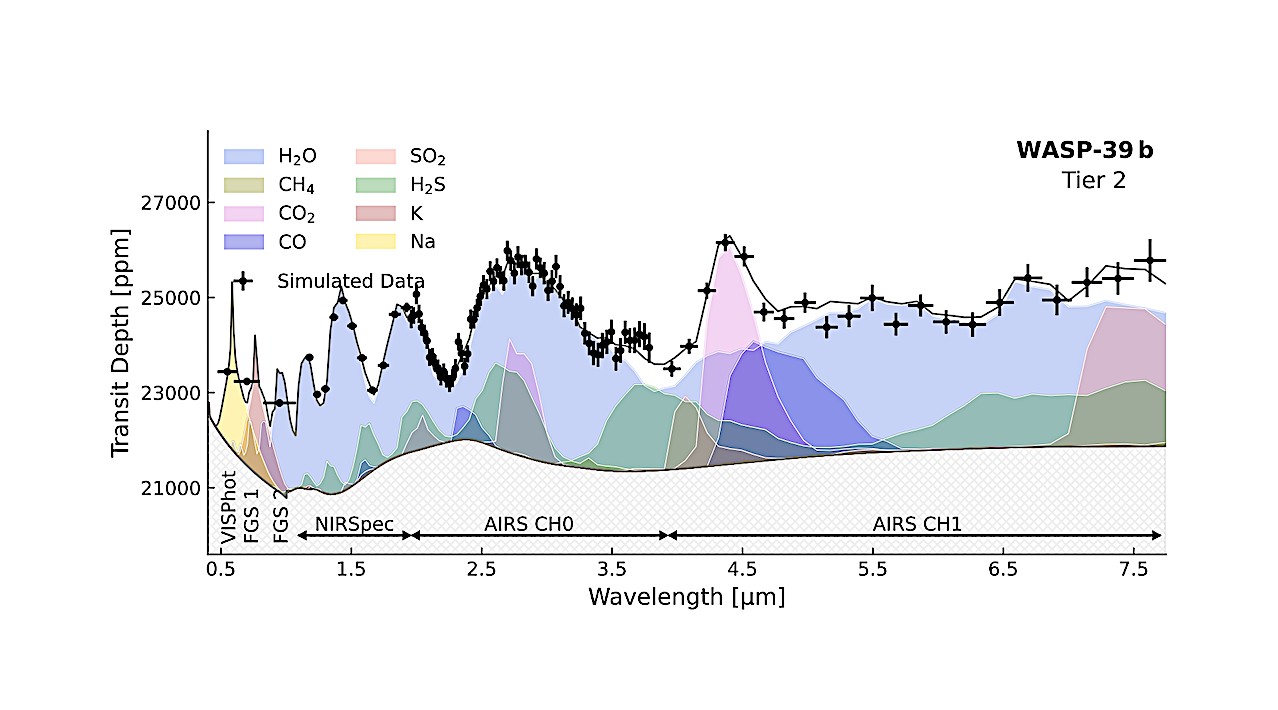
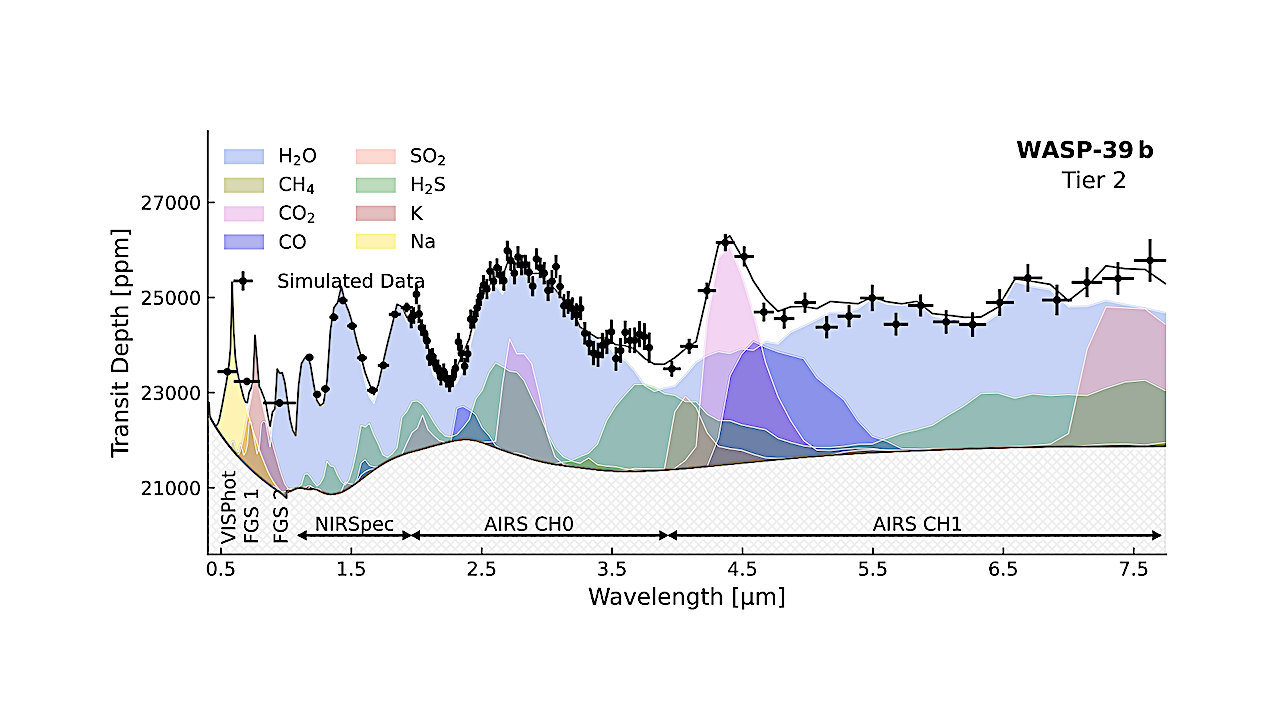
Example full-resolution Ariel transmission spectrum of the hot-Saturn WASP-39 b simulated at Tier 2 precision (black error bars). The underlying atmosphere model assumes chemical equilibrium with a solar C/O ratio (0.54), 10× solar metallicity, and no clouds. The opacity contributions of individual species to the total spectrum are shown with different colours and represent the major chemical species with significant opacity in the Ariel wavelength range. The wavebands of Ariel’s instruments are labelled underneath the spectrum. — astro-ph.EP
The European Space Agency’s Ariel mission will conduct a survey of the atmospheric properties of exoplanets around bright stars.
The mission is nominally divided into three Tiers. The Tier 1 survey will consist of low-precision observations of ~1000 planets, with a subset of these included in the higher-precision Tier 2 survey expected to be necessary for atmospheric characterization.
Tier 3 will be repeated observations of a small number of benchmark planets. Though previous studies have assessed the ability of Ariel to uncover population-level trends, they have generally presupposed a given Tier.
Here we interrogate this assumption and assess the information content of Ariel transmission spectra as a function of Tier for three benchmark planets: a hot-Saturn, warm-Neptune, and temperate sub-Neptune. We simulate a grid of Ariel transit spectra at different Tiers for each target and use retrievals to assess which chemical species are detectable.
We find that for giant planets like a hot-Saturn or warm-Neptune, Tier 1-quality observations are sufficient for <1.5dex constraints on H2O and CO2, irrespective of the presence of clouds — meaning important chemical insights are already obtainable in the Tier 1 survey. Moving to Tiers 2 and 3 result in an incremental increase in precision as well as other molecules becoming detectable in certain scenarios (e.g., H2S, CO).
Tier 1 observations are also sufficient to constrain CH4 in a cloud-free, temperate sub-Neptune, whereas observations with at least Tier 2 precision are necessary if the atmosphere is cloudy. The number of transits necessary to reach this precision, however, may be prohibitive for the inclusion of temperate sub-Neptunes in even the Tier 1 survey.
Michael Radica, Nicolas B. Cowan, Ryan Cloutier, Leo Yang Wang
Comments: 13 pages. Submitted to AAS Journals
Subjects: Earth and Planetary Astrophysics (astro-ph.EP); Instrumentation and Methods for Astrophysics (astro-ph.IM)
Cite as: arXiv:2604.07598 [astro-ph.EP] (or arXiv:2604.07598v1 [astro-ph.EP] for this version)
https://doi.org/10.48550/arXiv.2604.07598
Focus to learn more
Submission history
From: Michael Radica
[v1] Wed, 8 Apr 2026 21:08:18 UTC (270 KB)
https://arxiv.org/abs/2604.07598
Astrobiology, Astronomy, Exoplanet,










Related Posts
Stay Informed With the Latest & Most Important News




Advertisement
-
 01Two Black Holes Observed Circling Each Other for the First Time
 -
 02From Polymerization-Enabled Folding and Assembly to Chemical Evolution: Key Processes for Emergence of Functional Polymers in the Origin of Life
 -
 03Astronomy 101: From the Sun and Moon to Wormholes and Warp Drive, Key Theories, Discoveries, and Facts about the Universe (The Adams 101 Series)
 -
 04True Anomaly hires former York Space executive as chief operating officer
 -
 05Φsat-2 begins science phase for AI Earth images
 -
 06Hurricane forecasters are losing 3 key satellites ahead of peak storm season − a meteorologist explains why it matters
 -
 07Binary star systems are complex astronomical objects − a new AI approach could pin down their properties quickly