
Now Reading: Onset Of Persistent Surface Ocean Oxygenation During The Great Oxidation Event
-
01
Onset Of Persistent Surface Ocean Oxygenation During The Great Oxidation Event


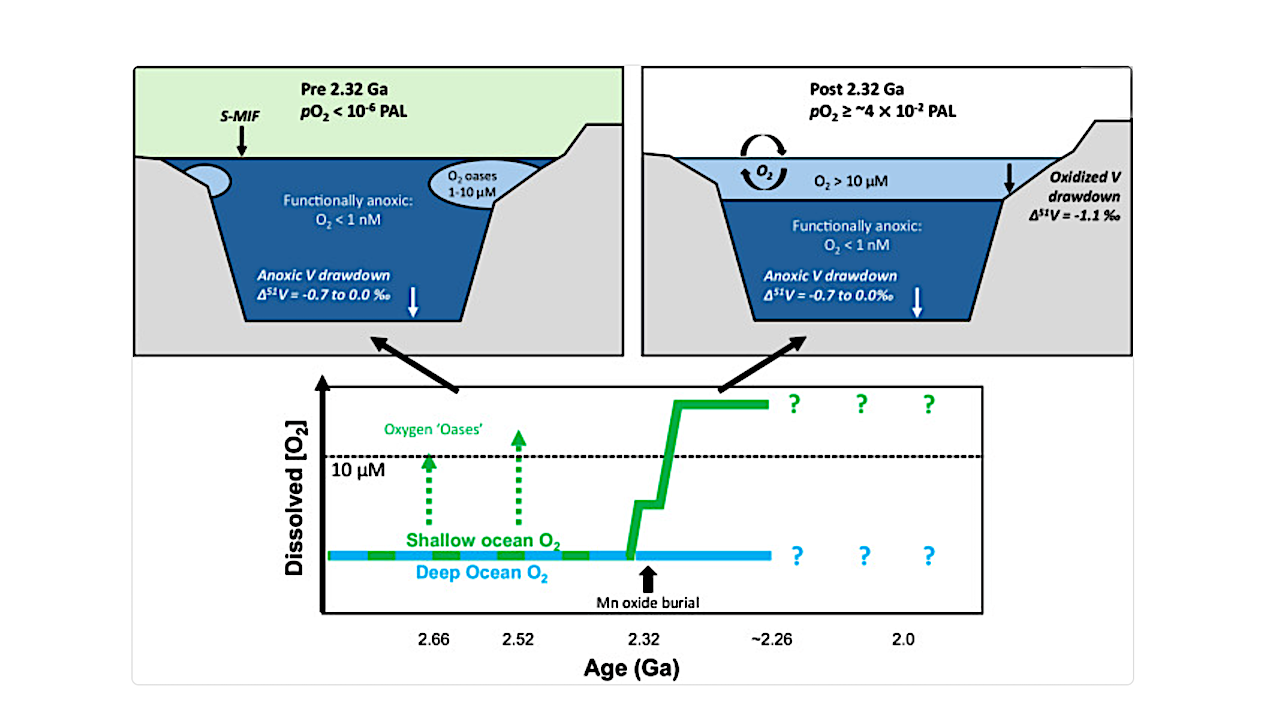

Prior to ca. 2.32 Ga, during deposition of the upper Rooihoogte and lower Timeball Hill formations, atmospheric pO2 10−6 PAL facilitated sulfur isotope mass-independent fractionation (S-MIF) signatures and a global ocean dominated by anoxic conditions and strong anoxic V drawdown. Any O2 oases that were present did not strongly impact V isotope mass balance. At ca. 2.32 Ga, atmospheric pO2 rose above 10−6 PAL, driving a disappearance of S-MIF and onset of extensive Mn-oxide burial, while bottom-water dissolved O2 initially remained below 10 μM in shallow marine environments. Subsequently, by the time of deposition of the upper Timeball Hill Formation, surface ocean redox conditions reached O2 > 10 μM, reflecting equilibration with pO2 ≥ ca. 4 × 10⁻² PAL, establishing a persistent, oxidized V sink on continental shelves. While most of the seafloor remained functionally anoxic with strong V drawdown, the new oxic sink increased the seawater V isotope composition by ≥0.27‰. In the bottom panel, the blue and green lines indicate marine dissolved O2 in the deep and shallow oceans, respectively, while the black arrow marks the onset of major Mn oxide burial in response to rising O2 recorded by Tl isotopes. — Nature Communications via PubMed
Free oxygen (O2) first began accumulating in Earth’s atmosphere shortly after the Archean-Proterozoic transition during the ‘Great Oxidation Event’ (GOE).
The nature of surface ocean oxygenation at this time is, however, poorly quantified, limiting our understanding of planetary oxygenation thresholds. Geochemical records of global ocean redox may potentially shed light on this critical interval.
Here, we show that vanadium (V) isotope ratios in 2.32-2.26-billion-year-old (Ga) shales from the Transvaal Supergroup, South Africa, capture a unidirectional transition in global ocean redox conditions shortly above the stratigraphic level marking the canonical rise of atmospheric O2. Around 2.32 Ga, sedimentary sinks were dominated by anoxic environments that drove extensive seawater V drawdown.
A positive shift in seawater V isotopic composition in the overlying stratigraphy indicates global expansion of marine settings with ≥ 10 μM dissolved O2 in bottom water, likely restricted to shallow-water environments and attributable to widespread equilibration with an oxygenated atmosphere.
Onset of persistent surface ocean oxygenation during the Great Oxidation Event, Nature Communications via PubMed
Astrobiology











Related Posts
Stay Informed With the Latest & Most Important News
Previous Post
Next Post




Advertisement
-
 01Two Black Holes Observed Circling Each Other for the First Time
 -
 02From Polymerization-Enabled Folding and Assembly to Chemical Evolution: Key Processes for Emergence of Functional Polymers in the Origin of Life
 -
 03Astronomy 101: From the Sun and Moon to Wormholes and Warp Drive, Key Theories, Discoveries, and Facts about the Universe (The Adams 101 Series)
 -
 04True Anomaly hires former York Space executive as chief operating officer
 -
 05Φsat-2 begins science phase for AI Earth images
 -
 06Hurricane forecasters are losing 3 key satellites ahead of peak storm season − a meteorologist explains why it matters
 -
 07Binary star systems are complex astronomical objects − a new AI approach could pin down their properties quickly