
Now Reading: Ortho-Para Chemistry of H2CO in the Protoplanetary Disk TW Hya
-
01
Ortho-Para Chemistry of H2CO in the Protoplanetary Disk TW Hya


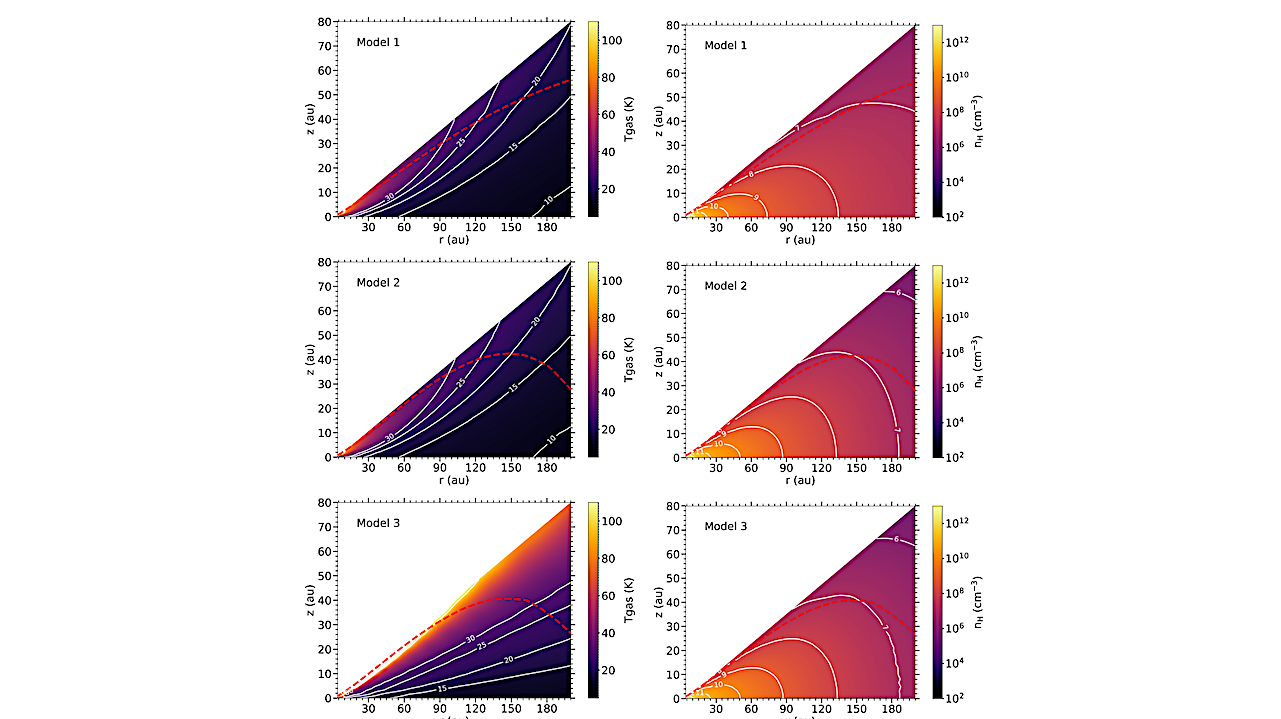
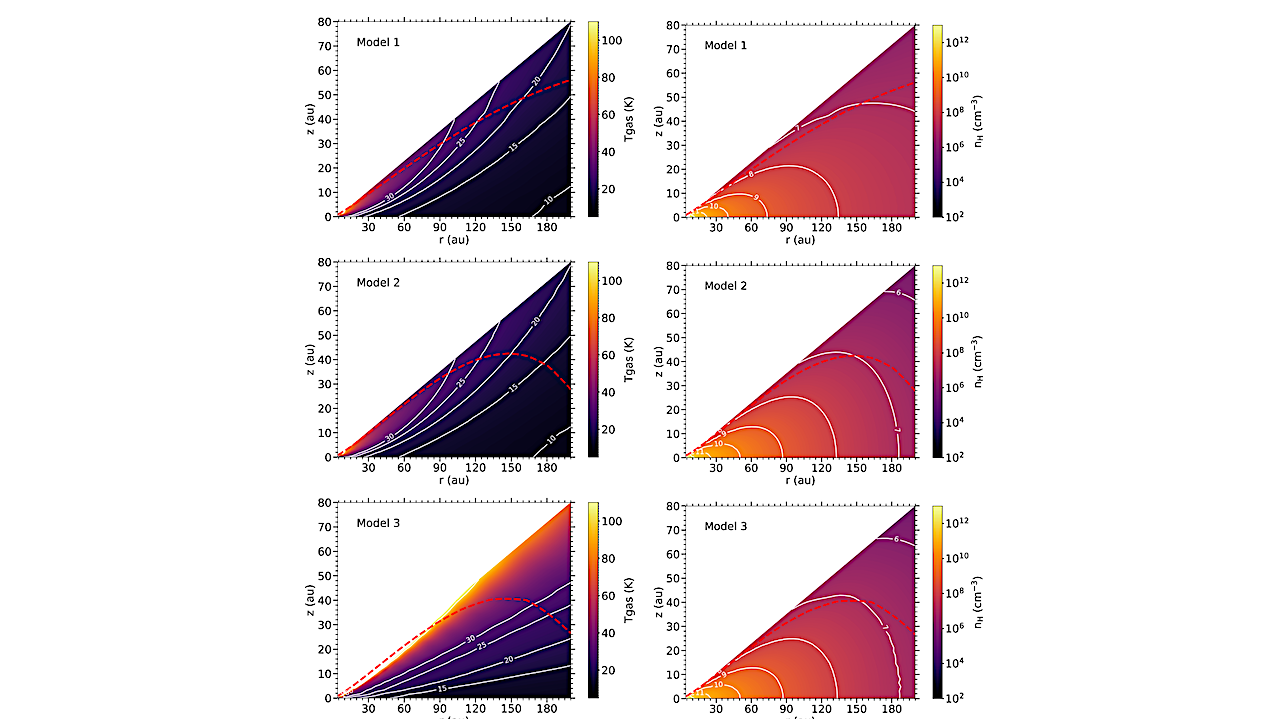
Disk physical structure from our three parametric models (Models 1 to 3 from top to bottom, see Tables 1 and 2). The 2D gas temperature (left) and total H density (right) are shown as colors, with iso-curves in white. The dashed red line corresponds to AV = 1 mag (as measured from the top). — astro-ph.EP
The spatial distribution of the chemical reservoirs in protoplanetary disks is key to elucidate the composition of planets, especially habitable ones. However, the partitioning of the main elements among the refractory and volatile phases is still elusive.
Key parameters such as the carbon-to-oxygen C/O elemental ratio and the ionization fraction remain poorly constrained, with the latter potentially orders of magnitude lower than in the interstellar medium. Moreover, the thermal structure of the gas is also poorly known, despite its deep influence on gas-phase chemistry.
In this context, ortho-to-para ratios could provide selective and sensitive probes. Recent ALMA observations have measured the spatially resolved column density of ortho-and para-H2CO in the transition disk orbiting TW Hya and derived the radial profile of the ortho-to-para ratio. Yet, current disk models do not include the nuclear-spin-resolved chemistry required to interpret these observations.
The present work aims to fill this gap, by combining a parametric disk physical model of TW Hya with the UGAN network, updated to include a comprehensive description of the nuclear-spin-resolved chemistry of formaldehyde. This new model reproduces the observed column density of H2CO to within a factor of 2, as well as the measured ortho-to-para ratio which varies from 1.5 in the outer disk to 3 inside 90au.
In particular the low value of this ratio beyond 90au is well explained by our model. However, the statistical value of 3 measured below 70au cannot be reproduced, suggesting that additional processes involving ices may be involved. Our parameter space exploration shows that the abundance of H2CO is highly sensitive to the C/O elemental ratio and to the cosmic-ray ionization rate.
Future observations of ortho-and para-H2CO, based on well selected rotational transitions, in a large sample of disks, appear highly desirable.
M. Gaillard, A. Faure, P. Hily-Blant, R. Le Gal, S. Lee, H. Nomura, K. Furuya
Comments: Accepted in ACS Earth and Space Chemistry special issue Eric Herbst Festschrift 2026
Subjects: Earth and Planetary Astrophysics (astro-ph.EP); Astrophysics of Galaxies (astro-ph.GA); Solar and Stellar Astrophysics (astro-ph.SR)
Cite as: arXiv:2603.13172 [astro-ph.EP] (or arXiv:2603.13172v1 [astro-ph.EP] for this version)
https://doi.org/10.48550/arXiv.2603.13172
Focus to learn more
Related DOI:
https://doi.org/10.1021/acsearthspacechem.5c00292
Focus to learn more
Submission history
From: Mathéo Gaillard
[v1] Fri, 13 Mar 2026 17:05:53 UTC (3,965 KB)
https://arxiv.org/abs/2603.13172
Astrobiology, Astrochemistry,










Related Posts
Stay Informed With the Latest & Most Important News



Advertisement
-
 01Two Black Holes Observed Circling Each Other for the First Time
 -
 02From Polymerization-Enabled Folding and Assembly to Chemical Evolution: Key Processes for Emergence of Functional Polymers in the Origin of Life
 -
 03Astronomy 101: From the Sun and Moon to Wormholes and Warp Drive, Key Theories, Discoveries, and Facts about the Universe (The Adams 101 Series)
 -
 04True Anomaly hires former York Space executive as chief operating officer
 -
 05Φsat-2 begins science phase for AI Earth images
 -
 06Hurricane forecasters are losing 3 key satellites ahead of peak storm season − a meteorologist explains why it matters
 -
 07Binary star systems are complex astronomical objects − a new AI approach could pin down their properties quickly