
Now Reading: Overestimated Pressure Broadening Misleads Model Spectra in Cool M Dwarf Stars
-
01
Overestimated Pressure Broadening Misleads Model Spectra in Cool M Dwarf Stars


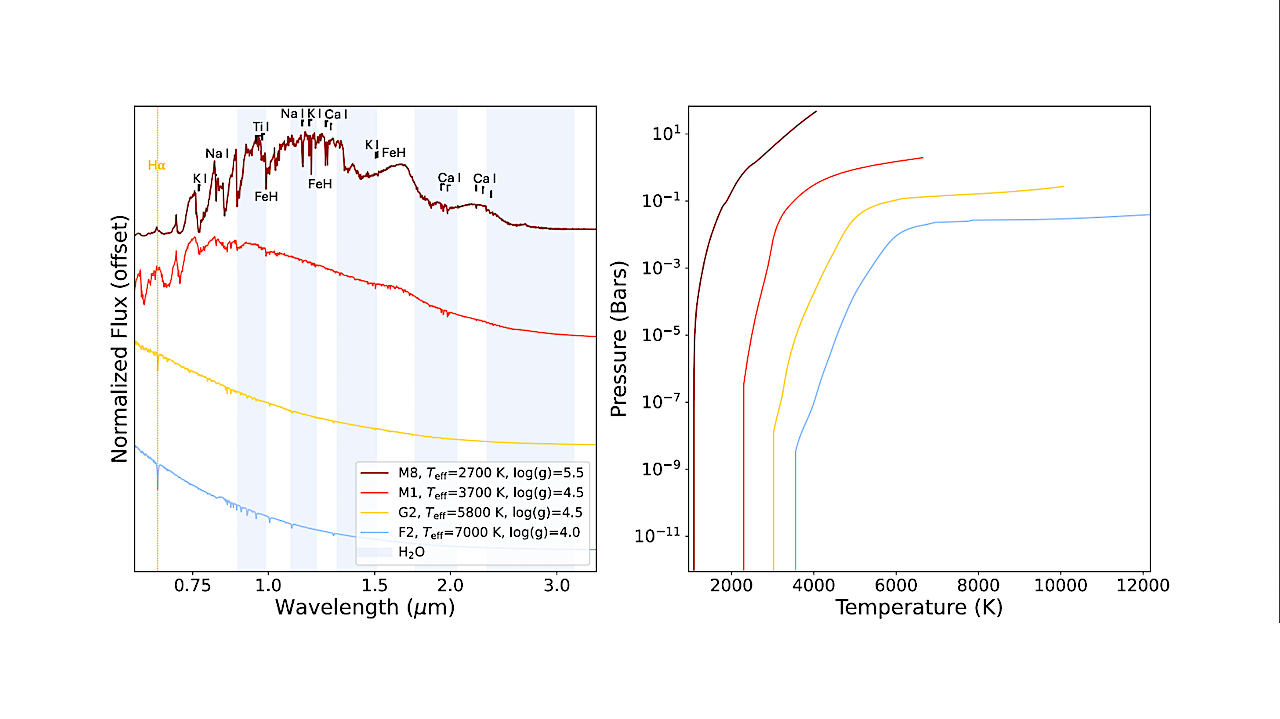
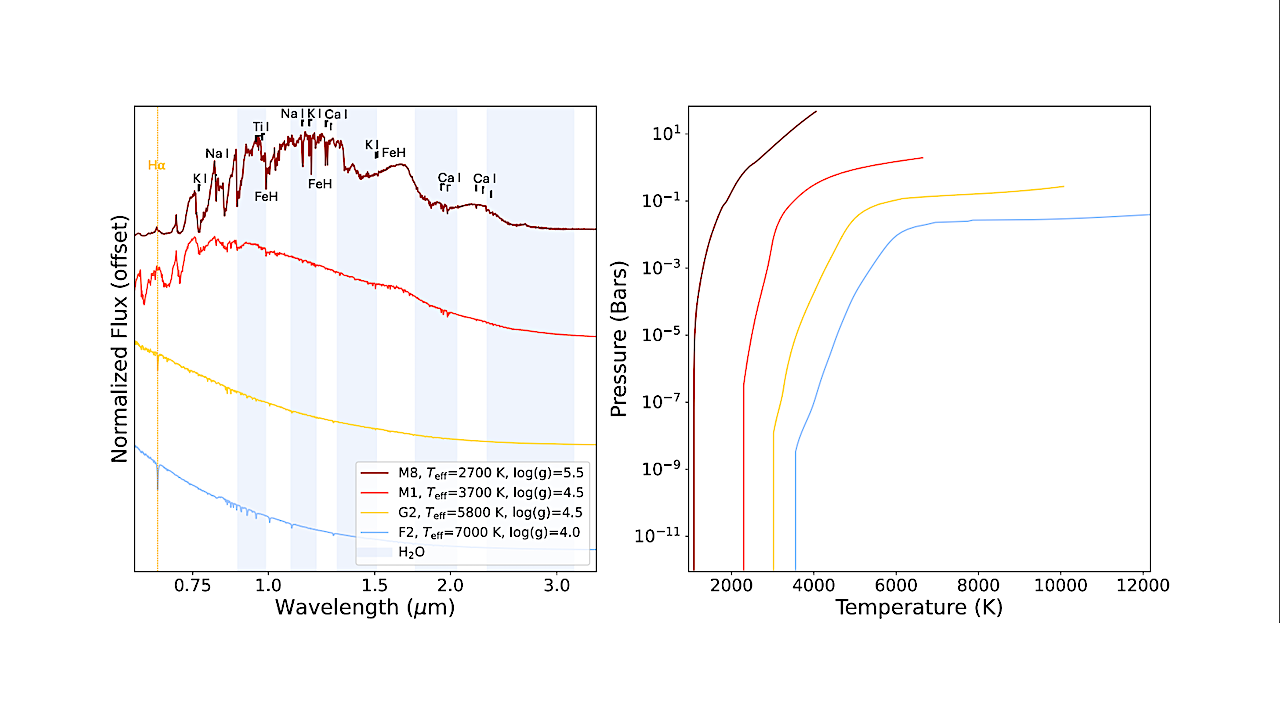
Spectra of different stellar types. On the left, scaled and vertically shifted flux from NewEra stellar grid is shown on the y-axis and wavelength is shown in microns on the x-axis. On the right, the corresponding pressure-vs-temperature profiles are shown, with temperature in Kelvin on the x-axis and pressure in bars on the y-axis. Prominent atomic and molecular features are annotated (Cushing et al. 2005; Rajpurohit et al. 2018, and references therein). Molecular features increase as we move toward cooler stars. In particular, the FeH and water features (shaded blue bands) stand out in the M8 model and are not present in hotter stars. — astro-ph.SR
Available one-dimensional stellar models fail to reproduce the observed spectrum of the ultracool M dwarf TRAPPIST-1.
In particular, current models predict strong iron hydride (FeH) absorption due to the Wing-Ford bands at 0.99μm, yet this spectral feature is only weakly present in TRAPPIST-1 and other mid-to-late M dwarf stars.
Additionally, the shape of the continuum between the water bands in the near-infrared does not match between models and observations. Here, we show that assumptions about pressure broadening, specifically van der Waals broadening, have a dramatic effect on modeled broadband spectral features.
We use Merged Parallelized Simplified-ATLAS to generate synthetic spectra over a range of van der Waals broadening strengths, adopting 1D PHOENIX temperature-pressure structures.
We find that minimal broadening best matches the observed FeH profile at 0.99μm and in the pseudocontinuum between the large water bands. These results suggest that broadening prescriptions derived for Sun-like stars are not valid for lower-mass stars and that pressure broadening for molecular lines in cool stellar atmospheres must be reevaluated.
Refining pressure broadening treatments will improve the accuracy of M dwarf spectral models, enabling more reliable determinations of stellar properties and atmospheric compositions of planets orbiting M dwarfs.
Ana Glidden, Veronika Witzke, Alexander I. Shapiro, Sara Seager
Comments: 9 pages, 5 figures, accepted for publication in ApJL
Subjects: Solar and Stellar Astrophysics (astro-ph.SR); Earth and Planetary Astrophysics (astro-ph.EP)
Cite as: arXiv:2601.05313 [astro-ph.SR] (or arXiv:2601.05313v1 [astro-ph.SR] for this version)
https://doi.org/10.48550/arXiv.2601.05313
Focus to learn more
Submission history
From: Ana Glidden
[v1] Thu, 8 Jan 2026 19:00:01 UTC (1,343 KB)
https://arxiv.org/abs/2601.05313
Astrobiology,











Related Posts
Stay Informed With the Latest & Most Important News
Previous Post
Next Post



Advertisement
-
 01Two Black Holes Observed Circling Each Other for the First Time
 -
 02From Polymerization-Enabled Folding and Assembly to Chemical Evolution: Key Processes for Emergence of Functional Polymers in the Origin of Life
 -
 03Astronomy 101: From the Sun and Moon to Wormholes and Warp Drive, Key Theories, Discoveries, and Facts about the Universe (The Adams 101 Series)
 -
 04True Anomaly hires former York Space executive as chief operating officer
 -
 05Φsat-2 begins science phase for AI Earth images
 -
 06Hurricane forecasters are losing 3 key satellites ahead of peak storm season − a meteorologist explains why it matters
 -
 07Binary star systems are complex astronomical objects − a new AI approach could pin down their properties quickly