
Now Reading: Overview Energy demonstrates technologies for space solar power
-
01
Overview Energy demonstrates technologies for space solar power


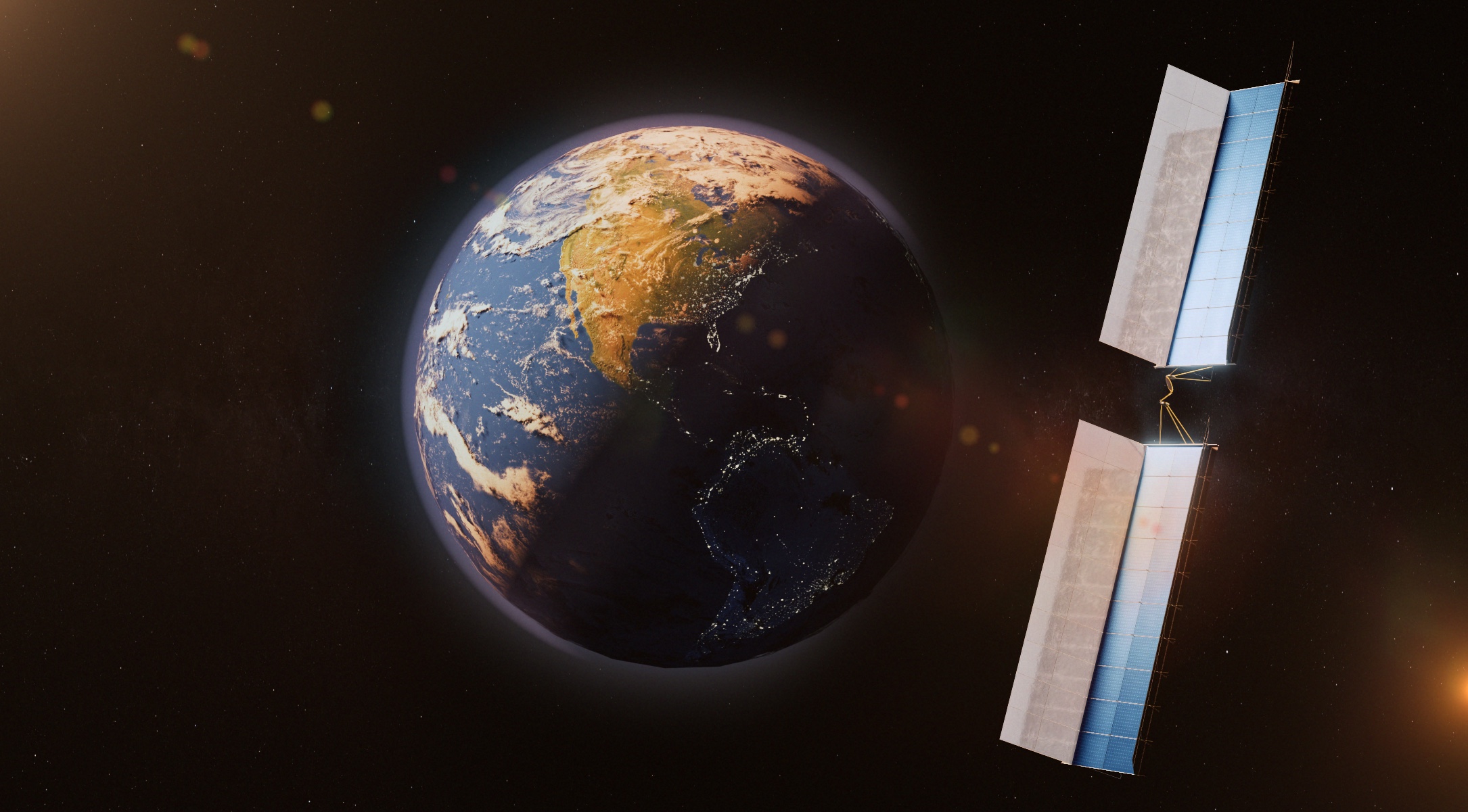

WASHINGTON — A space solar power startup has emerged from stealth after demonstrating a key technology for its plans to transmit power from space to the Earth.
Overview Energy announced Dec. 10 that it successfully tested a system that transmitted power using a near-infrared laser from an aircraft flying at an altitude of 5,000 meters to a receiver on the ground.
The test involved transmitting “multiple thousands of watts” of power from the aircraft to a receiver on the ground, where it was converted into electricity, said Marc Berte, founder and chief executive of Overview Energy, in an interview.
“This is an approach that uses all of the tracking and guidance methodology that we would take to space,” he said. “This is an integrated system test of all the elements of the piece in a way that is economically scalable into the future.”
Overview Energy is one of the latest efforts to realize a decades-old vision of generating electricity by collecting solar power in space and transmitting it to Earth. Space-based solar power offers the potential of providing vast amounts of power without the limitations of terrestrial solar power, which is unavailable at night or in cloudy conditions, and without the environmental impacts of many other energy sources.
The company’s approach differs from other concepts for space solar power in that it will transmit the power it collects in space using near-infrared lasers to existing terrestrial solar facilities, allowing them to generate power at times when they would be idle. Many other concepts have involved using microwaves to transmit power to dedicated rectenna arrays.
Berte said growing efficiencies of near-infrared lasers make them preferable over microwaves, allowing the transmission antenna on the spacecraft to be scaled down from hundreds of meters across to about half a meter.
The laser is low intensity, unlike microwave beams, avoiding any safety concerns. “We’re passively safe, where you can stand in the beam and stare at it,” he said. Standing in the beam in daytime, he said, would be like being on a white sand beach or in the snow on a sunny day.
One disadvantage of the technology is that the near-infrared laser will not penetrate clouds. The company plans to overcome this by working with a network of receivers, making it likely one or more are available at any time to maximize the utilization of the satellite beaming the power.
The company’s plans have the endorsement of former NASA Administrator Mike Griffin, who is advising the company. “I’ve been looking at concepts for space solar energy for 48 years, and this is the first one I’ve seen that I think might work,” he said in an emailed statement.
Satellite plans
With the aircraft demonstration completed, Overview Energy plans to fly a low Earth orbit satellite demonstration. That will use the same types of lasers and optics as the aerial test involving “many kilowatts” of power.
Berte said the company has booked a slot on SpaceX’s Bandwagon-7 rideshare mission launching in early 2028. Most of the satellite will be built in-house.
After the demonstration mission in LEO, the company plans to move to operational spacecraft in geosynchronous orbit, with the first launching as soon as 2030. Each spacecraft would provide at least a megawatt of delivered electricity using large deployable solar arrays. “The satellite is 90% or more deployed array instead of it being that core chunk in the middle,” he said.
The spacecraft are designed to be about twice as massive as existing large commercial GEO communications satellites, allowing them to be launched on a range of vehicles and not limited to heavy-lift rockets. The company’s approach is to ultimately mass-produce those spacecraft rather than try to scale up the spacecraft, which introduce launch and deployment challenges.
“Starlink and the other megaconstellations have shown the economy of mass production wins over economy of scale for the most part,” he said. The company may later make its spacecraft larger, but not by more than a factor of two so that it can continue to use deployable systems rather than rely on in-space assembly.
Berte declined to estimate the price of the electricity that that satellites would provide, but argued it would be competitive with other carbon-neutral sources, such as terrestrial solar, geothermal and nuclear. “We’re building around matching the price points of all of those technologies, but doing so in an almost near-term way: our goal is megawatts and gigawatts on the grid in the 2030s and scale up that fast.”
“In the next 25 years, we need to basically add an Earth’s worth of power to Earth, and it would be great if that was environmentally friendly,” he said.
Origins
Berte said he started working on what would become Overview Energy in 2017. “I realized that space solar energy was one of the things that could power the planet,” he recalled, “but it was the underinvested one.”
While concepts for space-based solar power date back more than half a century, he said he opted for a clean-sheet approach, using constraints such as minimizing investment and being passively safe. “Once I took all those into account, I ended up with the Overview concept of wide-beam infrared from geosynchronous orbit.”
The company got its start in 2021 inside of Vast, the commercial space company founded by billionaire Jed McCaleb, testing some of the core technologies. Once Vast decided to focus on commercial space stations, Overview Energy was spun out into a separate company, with Vast retaining a stake.
Overview raised nearly $20 million in two seeds rounds since then from several investors, funding the company through its current demonstrations. The company, based in Ashburn, Virginia, currently has about 25 employees but is “rapidly expanding,” Berte said, to work on its satellites.
The company is working on another round to support the satellite work as well as production facilities. That will initially be in Ashburn, but he said the company is considering other locations for additional factories to meet anticipated demand.
“This is an industry now. This isn’t science fiction,” he said of space solar power. “The technology works, and now it’s scaling up.”










Related Posts
Stay Informed With the Latest & Most Important News
Previous Post
Next Post



Advertisement
-
 01Two Black Holes Observed Circling Each Other for the First Time
 -
 02From Polymerization-Enabled Folding and Assembly to Chemical Evolution: Key Processes for Emergence of Functional Polymers in the Origin of Life
 -
 03Astronomy 101: From the Sun and Moon to Wormholes and Warp Drive, Key Theories, Discoveries, and Facts about the Universe (The Adams 101 Series)
 -
 04True Anomaly hires former York Space executive as chief operating officer
 -
 05Φsat-2 begins science phase for AI Earth images
 -
 06Hurricane forecasters are losing 3 key satellites ahead of peak storm season − a meteorologist explains why it matters
 -
 07Binary star systems are complex astronomical objects − a new AI approach could pin down their properties quickly