
Now Reading: Pave Space raises $40 million to develop European heavy kickstage
-
01
Pave Space raises $40 million to develop European heavy kickstage


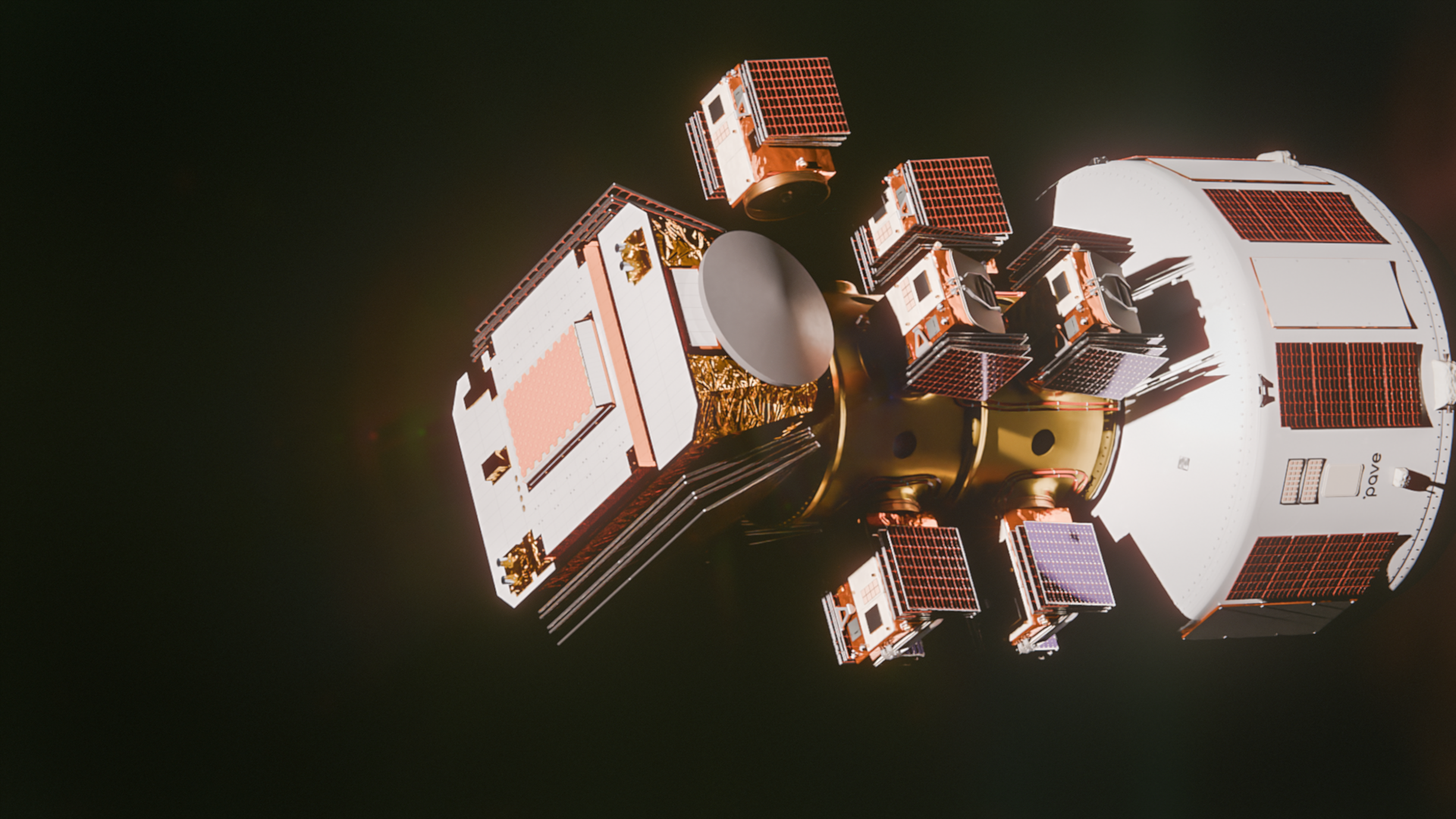

TAMPA, Fla. — Swiss startup Pave Space has raised $40 million to develop an orbital transfer vehicle that could move satellites from low Earth orbit (LEO) to their final destinations in hours instead of months.
The venture announced the seed funding March 25, ahead of plans to begin flying its heavy kickstage vehicle by 2029 to address what it sees as an emerging logistical bottleneck for the rapidly expanding space economy.
Julie Böhning, Pave’s CEO and cofounder, said the roughly 20-metric-ton vehicle would be able to deliver up to 5 metric tons of payload from LEO to medium and geostationary Earth orbit, or lunar trajectories, in less than a day.
Most satellites today are deployed into LEO, and Böhning said those bound for higher-energy orbits without a space tug tend to rely on onboard electric propulsion to reach their final positions over six to 12 months. Faster options exist to generate revenues sooner, including chemical propulsion, dedicated launches to higher orbits and third-party transfer vehicles, but they can be more expensive or constrained by capacity and scheduling.
“The vehicle is compatible with all the heavy-launchers for LEO insertion, positioning it as a cost-effective and flexible layer of in-space transport,” Böhning said via email.
“Compared to alternatives, beyond being cost-competitive, PAVE leverages storable propulsion, reducing ground operation constraints, simplifying integration with launch vehicles, and eliminating boil-off risks — resulting in a more reliable and operationally efficient system.”
Pave said it has already secured eight reservation agreements with satellite operators and manufacturers and is in discussions with several major industry players.
Bolstering European capabilities
Pave was founded in 2024 by Böhning and chief technology officer Jérémy Marciacq, who have been building rockets together since their student years at EPFL (École Polytechnique Fédérale de Lausanne). They previously co-founded the Gruyère Space Program, a European reusable rocket initiative, where they developed a demonstrator that completed 53 test flights in 2024 with about CHF 250,000 ($317,000) in sponsorship funding.
Pave now has a team of about 40 engineers and space industry specialists.
“Geopolitical dynamics are making sovereign telecommunications more critical than ever,” Böhning said.
“In a fragmented market like Europe, high-energy orbits such as GEO are increasingly compelling, enabling each country to deploy its own sovereign communication satellite rather than relying on shared mega-constellations.
“In this context, access to these orbits must be both fast and cost-efficient. That means avoiding the 6–12 month delays associated with electric orbit raising, and bypassing the cost of dedicated launches.”
Böhning said Pave plans to fly a pathfinder called Graze in October to validate in-house avionics. The venture is also targeting the first ignition of its main thruster combustion chamber by the end of this year at a recently announced test site in the Swiss Alps.
An integrated spacecraft is slated to fly late next year, combining an onboard computer and 50-newton thrusters.
Pave’s seed round was led by Visionaries Club and Creandum, with participation from Lombard Odier Investment Managers, Atlantic Labs, Sistafund, b2venture, ACE Investment Partners, Ilavaska Vuillermoz Capital, Pareto and Motier Ventures.










Related Posts

Stay Informed With the Latest & Most Important News
Previous Post
Next Post

Advertisement
-
 01Two Black Holes Observed Circling Each Other for the First Time
 -
 02From Polymerization-Enabled Folding and Assembly to Chemical Evolution: Key Processes for Emergence of Functional Polymers in the Origin of Life
 -
 03Astronomy 101: From the Sun and Moon to Wormholes and Warp Drive, Key Theories, Discoveries, and Facts about the Universe (The Adams 101 Series)
 -
 04True Anomaly hires former York Space executive as chief operating officer
 -
 05Φsat-2 begins science phase for AI Earth images
 -
 06Hurricane forecasters are losing 3 key satellites ahead of peak storm season − a meteorologist explains why it matters
 -
 07Binary star systems are complex astronomical objects − a new AI approach could pin down their properties quickly