
Now Reading: Paving the Road to the Habitable Worlds Observatory with High-Resolution Imaging I: New and Archival Speckle Observations of Potential HWO Target Stars
-
01
Paving the Road to the Habitable Worlds Observatory with High-Resolution Imaging I: New and Archival Speckle Observations of Potential HWO Target Stars

Paving the Road to the Habitable Worlds Observatory with High-Resolution Imaging I: New and Archival Speckle Observations of Potential HWO Target Stars

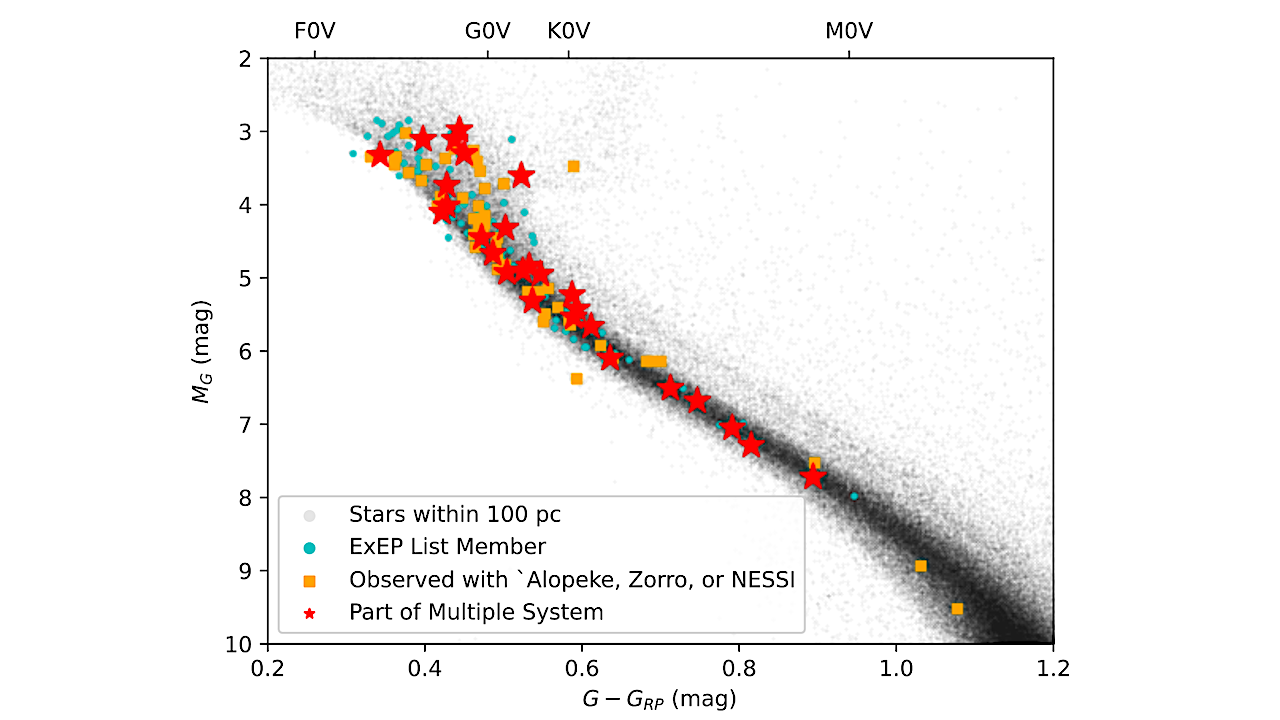

Color-magnitude diagram showing the targets in the ExEP target list for HWO. The grey points represent a sample of stars within 100 pc taken from Gaia DR3. The cyan points indicate the locations of the Mamajek & Stapelfeldt (2024) targets that are in Gaia and have not been observed with speckle imaging. Orange squares highlight 80 ExEP list targets that have ‘Alopeke, Zorro, or NESSI observations. Red stars show the 27 targets that have been identified as members of stellar multiples by this work. The top axis provides approximate G − GRP values for F0V, G0V, K0V, and M0V stars. — astro-ph.SR
One of the key goals of the Habitable Worlds Observatory (HWO) is to directly image about 25 potentially habitable exoplanets and determine their properties.
This challenge will require a large survey of nearby, bright stars — ~100 according to the Astro2020 Decadal Survey. To ensure the success of the mission and to help guide design decisions, the stellar multiplicity of the target stars must be well-understood. To this end, we present optical speckle imaging of stars in the NASA Exoplanet Exploration Program (ExEP) provisional HWO star list, which is currently the Tier 1 target list for the HWO Target Stars and Systems Sub-Working Group.
We obtained new observations using `Alopeke and Zorro at Gemini Observatory and queried the Exoplanet Follow-up Observing Program Archive for archival observations, resulting in speckle imaging data for 80 of the 164 stars. We confirmed one candidate companion detected previously by Gaia (HD 90089) and obtained an ambiguous detection of a known companion (HD 212330).
To examine our sensitivity to companions, we simulated stellar companions down to ~0.1 M⊙ for each target and found that 75%-85% would be detected in our speckle images; the remaining simulated companions are either too faint or too close-in, and will require follow-up using other methods such as long-term spectroscopic measurements and space-based techniques.
This work represents a first step towards surveying potential HWO targets for close-in stellar companions and helping to inform the target selection process for the HWO direct-imaging survey, bringing us closer towards the discovery of potential habitable worlds.
Zachary D. Hartman, Catherine A. Clark, Michael B. Lund, Kathryn V. Lester, José A. Caballero, Steve B. Howell, David Ciardi, Sarah Deveny, Mark E. Everett, Elise Furlan, Venu Kalari, Colin Littlefield, Andrew W. Stephens, Jennifer A. Burt, Guillaume Huber, Rachel Matson, Eric E. Mamajek, Noah Tuchow
Comments: 26 pages, 9 figures, Accepted for publication in ApJ
Subjects: Solar and Stellar Astrophysics (astro-ph.SR); Earth and Planetary Astrophysics (astro-ph.EP); Instrumentation and Methods for Astrophysics (astro-ph.IM)
Cite as: arXiv:2601.05387 [astro-ph.SR] (or arXiv:2601.05387v1 [astro-ph.SR] for this version)
https://doi.org/10.48550/arXiv.2601.05387
Focus to learn more
Submission history
From: Zachary Hartman
[v1] Thu, 8 Jan 2026 21:27:40 UTC (1,519 KB)
https://arxiv.org/abs/2601.05387
Astrobiology, Astronomy,










Related Posts
Stay Informed With the Latest & Most Important News
Previous Post
Next Post


Advertisement
-
 01Two Black Holes Observed Circling Each Other for the First Time
 -
 02From Polymerization-Enabled Folding and Assembly to Chemical Evolution: Key Processes for Emergence of Functional Polymers in the Origin of Life
 -
 03Astronomy 101: From the Sun and Moon to Wormholes and Warp Drive, Key Theories, Discoveries, and Facts about the Universe (The Adams 101 Series)
 -
 04True Anomaly hires former York Space executive as chief operating officer
 -
 05Φsat-2 begins science phase for AI Earth images
 -
 06Hurricane forecasters are losing 3 key satellites ahead of peak storm season − a meteorologist explains why it matters
 -
 07Binary star systems are complex astronomical objects − a new AI approach could pin down their properties quickly