
Now Reading: Pentagon casts Golden Dome as model for faster, risk-tolerant defense buying
-
01
Pentagon casts Golden Dome as model for faster, risk-tolerant defense buying


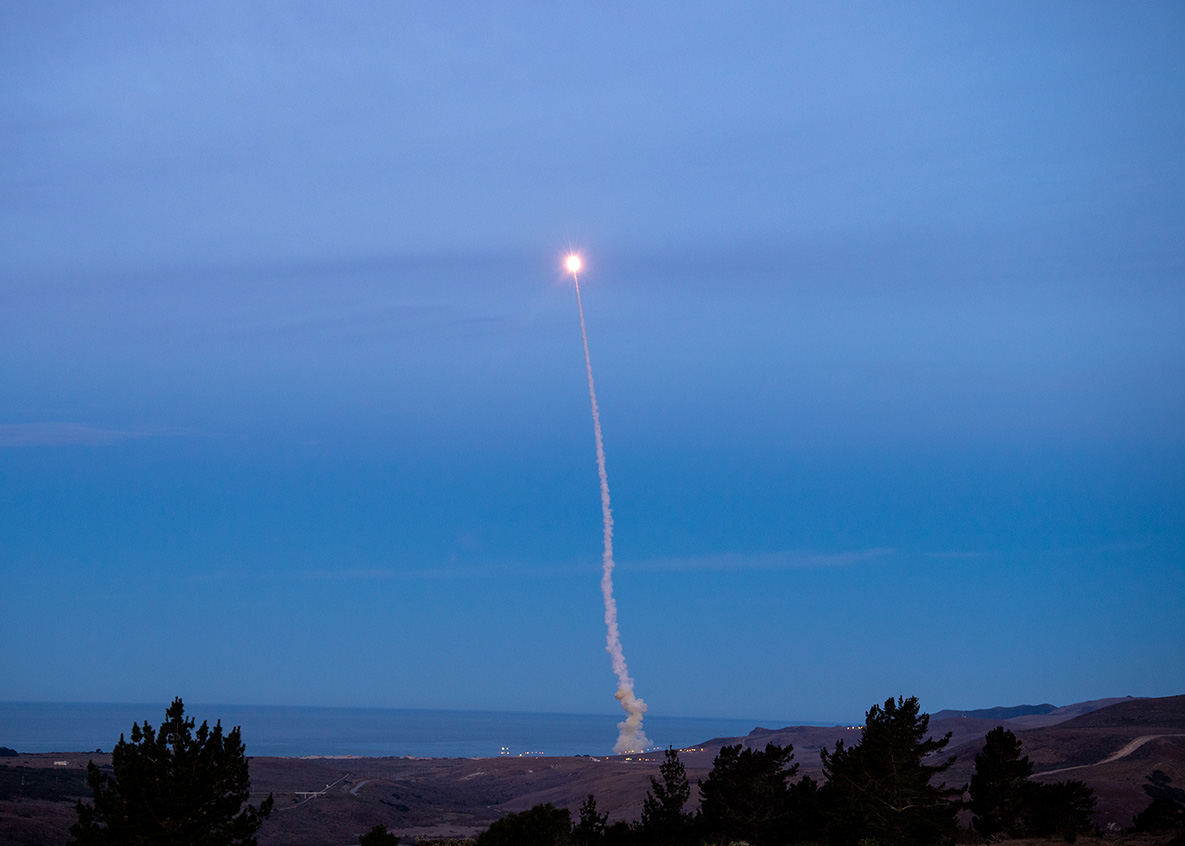

WASHINGTON — A senior Pentagon official pitched the Golden Dome missile defense initiative to investors and executives as both a national security priority and a proving ground for a new way the Defense Department intends to buy major systems, one that places greater emphasis on performance, speed and contractor risk-taking.
Speaking Feb. 5 at the Miami Space Summit, Marcia Holmes, the deputy director of the Golden Dome program, said the effort is being used deliberately to test acquisition reforms championed by the Trump administration. The goal, she said, is to move away from what officials see as an overly cautious procurement culture that has slowed the delivery of advanced capabilities.
“We are going to be easier to work with, as well as incentivize and reward risk taking and innovation from our personnel,” Holmes said.
Holmes told executives and investors at the Miami event, organized by the SmallSat Alliance, that her office is aligning with the administration’s defense acquisition strategy, which emphasizes bringing in new companies and private capital while leaning more heavily on commercial technologies.
“We are embracing the expansion of the industrial base, accelerating private capital investment, the creation of new companies, use of commercial products and services while enabling innovation through regular communication with industry,” she said. “That’s very refreshing from my perspective.”
Golden Dome is envisioned as a layered homeland defense network integrating ground, airborne and space-based systems to detect, track and intercept ballistic, hypersonic and cruise missiles. The program has drawn intense interest across the defense and commercial space sectors, as Golden Dome funding could reach as much as $175 billion over several years.
Large defense contractors and smaller, non-traditional firms are positioning themselves for early competition across sensing, interceptors, space systems and software. Startups and established space companies alike have begun investing in technologies they believe could be relevant, including space-based intercept concepts, advanced propulsion, distributed sensor networks and artificial-intelligence-driven command and control systems. Many are betting that dual-use technologies with commercial and defense markets will give them an edge once requirements are defined.
Commercial firms making bets
For now, those requirements remain largely opaque. Public descriptions of Golden Dome have been kept at a high level, and the Pentagon has not spelled out how commercial systems would be integrated with classified or government-developed capabilities. The head of the program, Gen. Michael Guetlein, has said the department intends to keep key details classified, leaving many companies to make strategic investments without knowing precisely what the government plans to buy.
Guetlein has also warned that affordability is one of the program’s central challenges, particularly the cost per interceptor, and has said the Pentagon will need the private sector’s help to produce systems at prices low enough to make a large-scale missile defense architecture viable.
“We need industry to deliver at a speed we’ve never seen before, and the Department of War is taking action to enable speed like never before,” Holmes said. “The U.S. government is accelerating defense procurement and revitalizing the defense industrial base to restore peace through strength.”
She added that Golden Dome is also being used internally to rethink how the Pentagon staffs and manages major programs. “We intend to modernize the duties and composition of our defense acquisition workforce,” Holmes said. “Golden Dome is the shining example of how we can address these opportunities.”
President Donald Trump’s executive order directing the Pentagon to field a next-generation missile shield calls for a space layer that could involve hundreds or even thousands of satellites to support sensing and interceptor coordination. That goal aligns closely with commercial space business models built around high-volume satellite production, reusable launch systems and large constellations.
Executives from companies with experience in mass manufacturing satellites and operating integrated communications networks said they would offer mature technologies rather than developing bespoke systems under traditional defense procurement timelines.
Holmes said Golden Dome represents the kind of complex, multi-component system that traditional acquisition processes have struggled to deliver quickly.
As part of that experimentation, Holmes pointed to efforts by Space Force’s Space Systems Command to try non-traditional contracting models. Among them is a prize-based incentive structure aimed at broadening industry participation in developing space-based interceptors, weapons designed to destroy missiles during boost or midcourse flight.










Related Posts
Stay Informed With the Latest & Most Important News
Previous Post
Next Post



Advertisement
-
 01Two Black Holes Observed Circling Each Other for the First Time
 -
 02From Polymerization-Enabled Folding and Assembly to Chemical Evolution: Key Processes for Emergence of Functional Polymers in the Origin of Life
 -
 03Astronomy 101: From the Sun and Moon to Wormholes and Warp Drive, Key Theories, Discoveries, and Facts about the Universe (The Adams 101 Series)
 -
 04True Anomaly hires former York Space executive as chief operating officer
 -
 05Φsat-2 begins science phase for AI Earth images
 -
 06Hurricane forecasters are losing 3 key satellites ahead of peak storm season − a meteorologist explains why it matters
 -
 07Binary star systems are complex astronomical objects − a new AI approach could pin down their properties quickly