
Now Reading: Pentagon weighs consolidation of DIU tech portfolio
-
01
Pentagon weighs consolidation of DIU tech portfolio


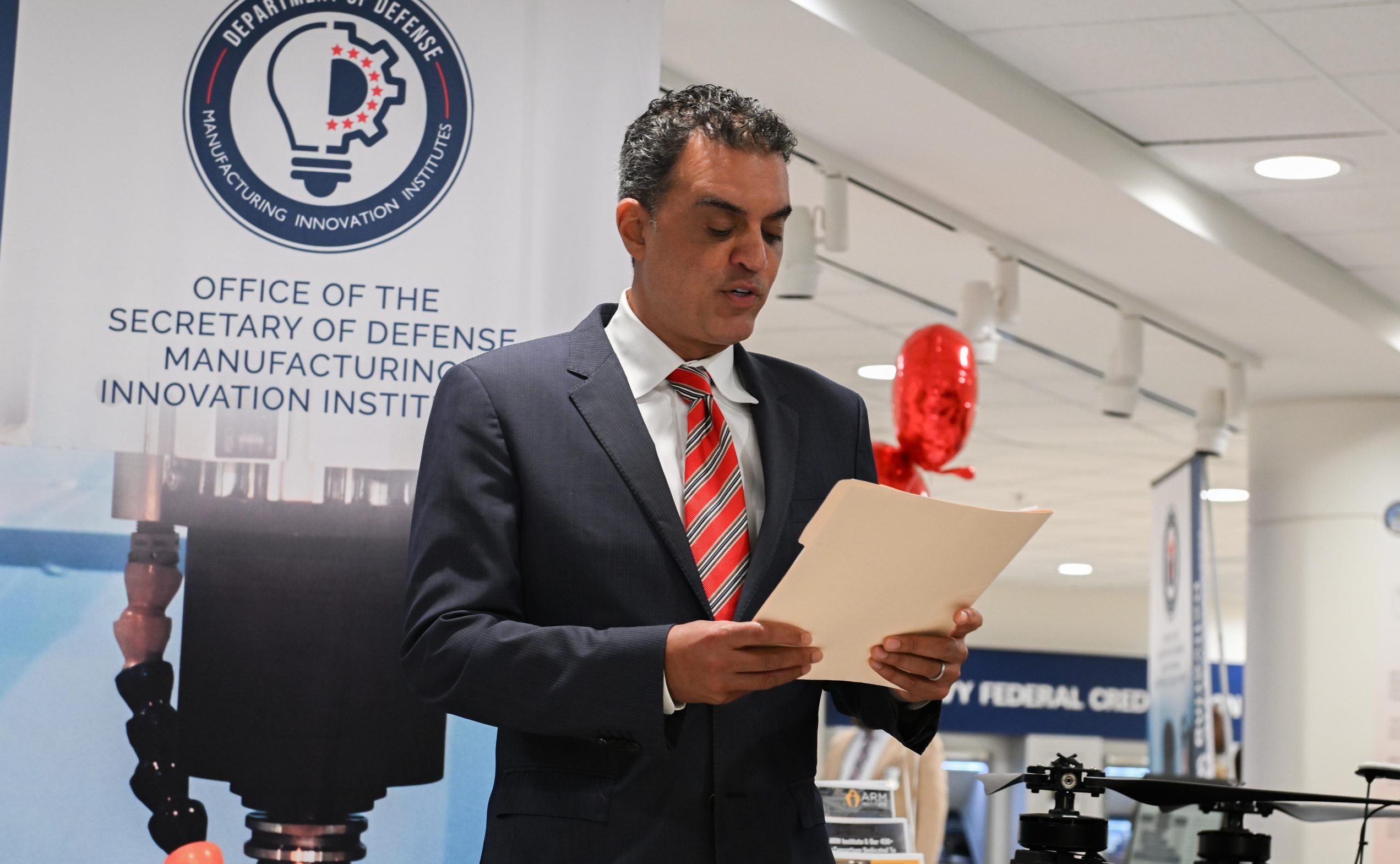

WASHINGTON — The Pentagon is reviewing the Defense Innovation Unit’s sprawling technology portfolio, a move that could reshape the agency’s space projects.
Emil Michael, undersecretary of defense for research and engineering and the Pentagon’s chief technology officer, told reporters Dec. 8 that his office is assessing projects across DIU and other organizations he oversees. The review is part of a broader push to align investments with six “critical technology areas” the department says need sharper focus: applied artificial intelligence, biomanufacturing, contested logistics technologies, quantum and battlefield information dominance, scaled directed energy and scaled hypersonics.
“We are continuing to push the envelope” on next-generation technologies, he said at a Defense Writers Group meeting. “And I couldn’t imagine that space wouldn’t continue to be part of that portfolio,” he added of DIU. “But again, we’re looking at all the portfolios at DIU.”
DIU has become a key entry point for commercial space firms, backing work in hybrid communications, space domain awareness, sensors, logistics, servicing concepts and launch-related innovation. The unit’s model relies on tapping fast-moving commercial markets, and space remains one of the most active. Still, the new framework favors tech with cross-domain, near-term operational payoff rather than domain-specific portfolios like space. Michael did not say how the review might ultimately affect DIU’s space pipeline.
Too many projects?
A central question, he said, is whether there are too many programs. DIU’s work spans space, autonomy and AI, energy and logistics, cyber modernization, human systems and advanced communications.
Michael said DIU had 133 projects underway at one point. “It’s a lot, especially when the goal or the measurement of success is how many of them transition to the services to become a program of record,” he said. “And it’s very hard for the services to absorb that much capability. So the question is, what is the right amount for the threat environment? And so I’m going through that assessment.”
He also pointed to overlap across the Pentagon’s innovation ecosystem. “Duplication is a broad challenge in the Pentagon,” Michael said. “I’m trying to do my part to tackle that, and that’s part of the reason for some of this consolidation of the DIU, CDAO, R&E,” he added, referring to the chief digital and artificial intelligence office.
The review comes as the Defense Department seeks to transition from one-off experimentation to more institutionalized adoption of commercial technology. DIU’s signature tool, the Commercial Solutions Opening process, was created to give the Pentagon a rapid path to prototype awards. But a recent Government Accountability Office review found persistent challenges in transitioning those prototypes into fielded capabilities and coordinating efforts across DoD innovation offices.
Michael said DIU’s mission remains intact: finding commercial solutions to warfighter needs and helping companies cross the defense “valley of death,” the long-standing gap between prototype and procurement. DIU has grown significantly in recent years and now operates with roughly $1 billion a year, with signals from Congress that funding could increase in fiscal 2025.
Founded in 2015 to serve as a bridge between Silicon Valley and the military, DIU has expanded beyond its initial offices in California and Boston to hubs in Austin, Chicago and near the Pentagon.










Related Posts
Stay Informed With the Latest & Most Important News
Previous Post
Next Post





Advertisement
-
 01Two Black Holes Observed Circling Each Other for the First Time
 -
 02From Polymerization-Enabled Folding and Assembly to Chemical Evolution: Key Processes for Emergence of Functional Polymers in the Origin of Life
 -
 03Astronomy 101: From the Sun and Moon to Wormholes and Warp Drive, Key Theories, Discoveries, and Facts about the Universe (The Adams 101 Series)
 -
 04True Anomaly hires former York Space executive as chief operating officer
 -
 05Φsat-2 begins science phase for AI Earth images
 -
 06Hurricane forecasters are losing 3 key satellites ahead of peak storm season − a meteorologist explains why it matters
 -
 07Binary star systems are complex astronomical objects − a new AI approach could pin down their properties quickly