
Now Reading: PHANGS-JWST: The Largest Extragalactic Molecular Cloud Catalog Traced By Polycyclic Aromatic Hydrocarbon Emission
-
01
PHANGS-JWST: The Largest Extragalactic Molecular Cloud Catalog Traced By Polycyclic Aromatic Hydrocarbon Emission

PHANGS-JWST: The Largest Extragalactic Molecular Cloud Catalog Traced By Polycyclic Aromatic Hydrocarbon Emission

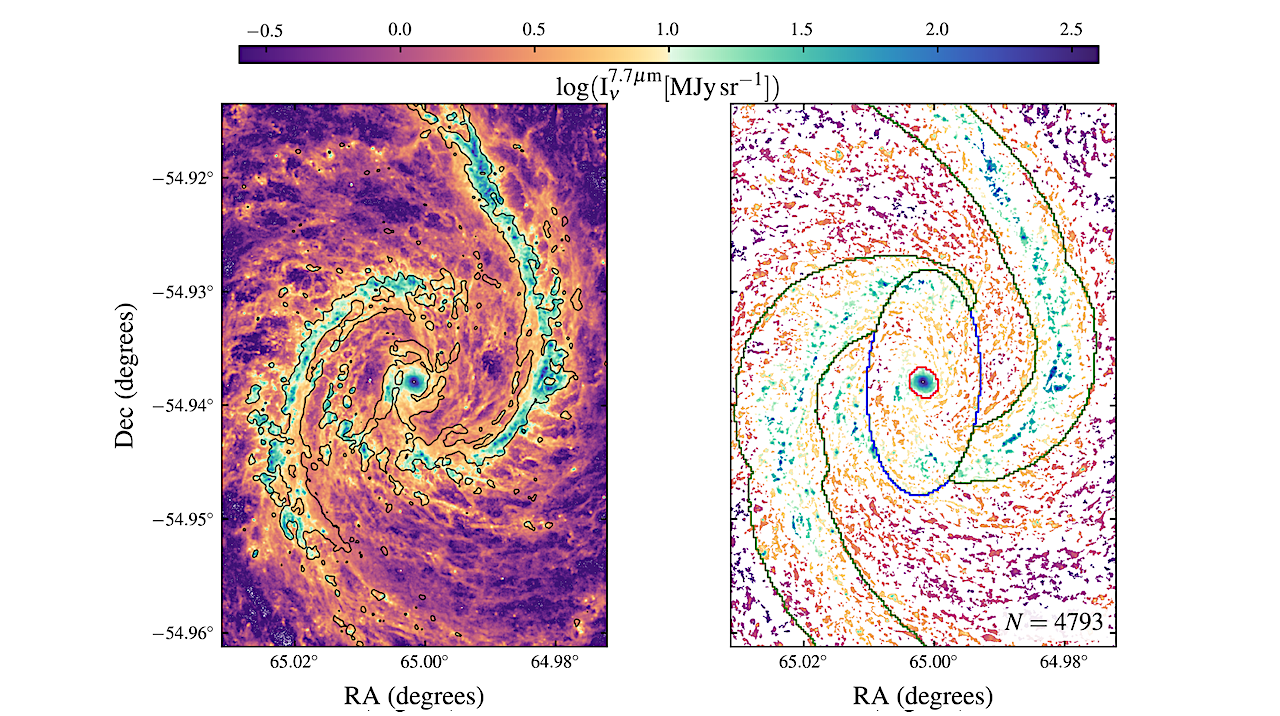
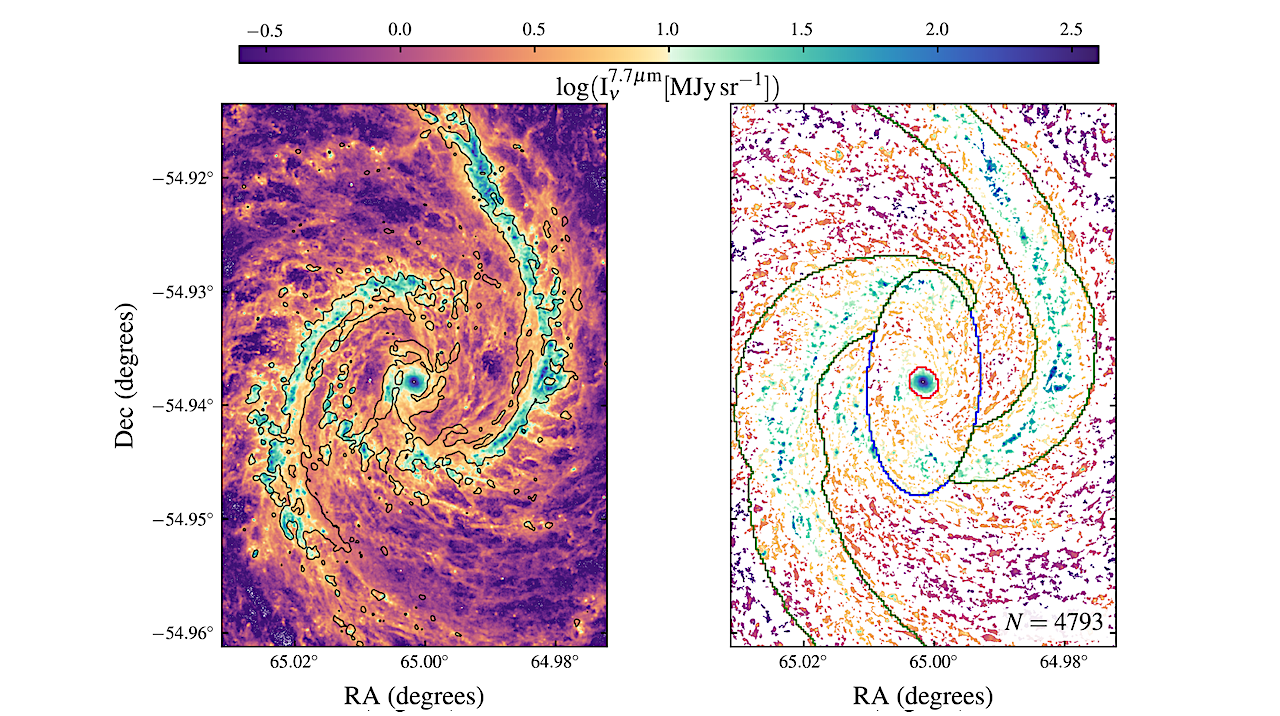
A zoomed-in view of NGC1566, one of the 66 galaxies. Left: continuum-subtracted intensity image of the galaxy in the F770W MIRI band. The 2 σ CO intensity contours from PHANGS-ALMA are represented in black. Right: The PAH cloud structures identified by SCIMES are color-coded by their F770W intensities. The green, blue, and red contours indicate the spiral arm, bar, and central region masks, respectively. The interarm region, in this case, consists of the remaining clouds that are not enclosed by the contours. The number of PAH clouds identified in this galaxy is represented in the bottom right. The color bar on top of the image shows the 7.7µm intensity range of the identified clouds. — astro-ph.GA
High-resolution JWST images of nearby spiral galaxies reveal polycyclic aromatic hydrocarbon (PAH) emission structures that trace molecular gas, including CO-dark regions.
We identify ISM cloud structures in PHANGS-JWST 7.7 μm PAH maps for 66 galaxies, smoothed to 30 pc and at native resolution, extracting 108,466 and 146,040 clouds, respectively. Molecular properties were inferred using a linear conversion from PAH to CO. Given the tendency for clouds in galaxy centers to overlap in velocity space, we opted to flag these and omit them from the analysis in this work.
The remaining clouds correspond to giant molecular clouds, such as those detected in CO(2-1) emission by ALMA, or lower surface density clouds that either fall below the ALMA detection limits of existing maps or genuinely have no molecular counterpart. Cross-matching with ALMA CO maps at 90 pc in 27 galaxies shows that 41 % of PAH clouds have CO associations.
The converted molecular properties vary little across environments, but the most massive clouds are preferentially found in spiral arms. Fitting lognormal mass distributions down to 2×10³M⊙ shows that spiral arms host the highest-mass clouds, consistent with enhanced formation in arm gravitational potentials.
Cloud molecular surface densities decline by a factor of ∼1.5−2 toward 2−3Re. However, the trend largely varies in individual galaxies, with flat, decreasing, and even no trend as a function of galactocentric radius. Factors like large-scale processes and morphologies might influence the observed trends.
We publish two catalogs online, one at the common resolution of 30 pc and another at the native resolution. We expect them to have broad utility for future PAH clouds, molecular clouds, and star formation studies.
Z. Bazzi, D. Colombo, F. Bigiel, A. K. Leroy, E. Rosolowsky, K. Sandstrom, A. Duarte-Cabral, H. Faustino Vieira, M. I. N. Kobayashi, H. He, S. E. Meidt, A. T. Barnes, R. S. Klessen, S. C. O. Glover, M. D. Thorp, H.-A. Pan, R. Chown, R. J. Smith, D. A. Dale, T. G. Williams, A. Amiri, S. Dlamini, J. Chastenet, S. K. Sarbadhicary, A. Hughes, J. C. Lee, L. Hands, the PHANGS collaboration
Comments: 24 pages, 18 figures, accepted for publication in A&A
Subjects: Astrophysics of Galaxies (astro-ph.GA)
Cite as: arXiv:2511.06596 [astro-ph.GA] (or arXiv:2511.06596v1 [astro-ph.GA] for this version)
https://doi.org/10.48550/arXiv.2511.06596
Focus to learn more
Submission history
From: Zein Bazzi
[v1] Mon, 10 Nov 2025 00:55:54 UTC (12,767 KB)
https://arxiv.org/abs/2511.06596
Astrobiology,










Related Posts
Stay Informed With the Latest & Most Important News
Previous Post
Next Post


Advertisement
-
 01Two Black Holes Observed Circling Each Other for the First Time
 -
 02From Polymerization-Enabled Folding and Assembly to Chemical Evolution: Key Processes for Emergence of Functional Polymers in the Origin of Life
 -
 03Astronomy 101: From the Sun and Moon to Wormholes and Warp Drive, Key Theories, Discoveries, and Facts about the Universe (The Adams 101 Series)
 -
 04True Anomaly hires former York Space executive as chief operating officer
 -
 05Φsat-2 begins science phase for AI Earth images
 -
 06Hurricane forecasters are losing 3 key satellites ahead of peak storm season − a meteorologist explains why it matters
 -
 07Binary star systems are complex astronomical objects − a new AI approach could pin down their properties quickly