
Now Reading: Physicochemical Controls On The Compositions Of The Earth And Planets
-
01
Physicochemical Controls On The Compositions Of The Earth And Planets


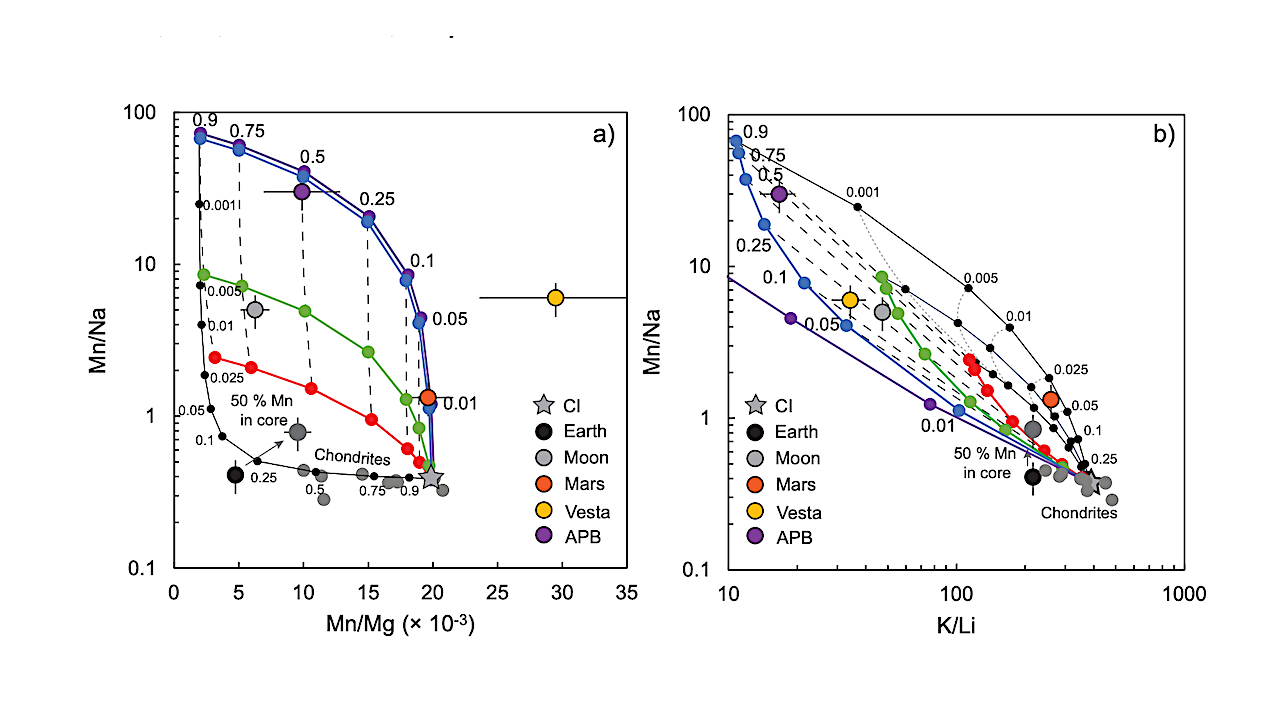
a) Mn/Na vs. Mn/Mg and b) Mn/Na vs. K/Li ratios among planetary bodies. The coloured curves denote the evolution of the composition of an evaporation residue calculated using eq. 35 at 1100 K (purple), 1500 K (blue), 2000 K (green) and 2500 K (red) at a fixed relative oxygen fugacity (∆IW-1, except for 1100 K, which was calculated at ∆IW-6, see text), with numbers denoting the fraction of Mn loss undergone by the body. The black dashed lines connect equal degrees of Mn loss at different temperatures. The solid black curves trace a binary mixture of a volatile-depleted end-member with 90 % Mn loss and a CI-like end-member. The small numbers denote the mass fraction of CI in the mixture. On a), only the volatile-depleted end-member at 1500 K is shown due to clarity, whereas in b) the end-members are taken at the three temperatures, and the dotted grey lines connect equal fractions of CI material. The grey point gives the composition of the Earth assuming 50 % of its Mn budget resides in the core [see Siebert et al., 2018]. The grey field denotes the compositional range of chondrites [Wasson and Kallemeyn, 1988; Siebert et al., 2018]. — astro-ph.EP
Despite the fact that the terrestrial planets formed from the protoplanetary disk, their compositions show marked departures from that of solar nebula condensates.
Metallic cores fix oxygen fugacities (fO2s) of the planets to 5 (Mercury) to 1 log units below the iron-wüstite (IW) buffer, orders of magnitude higher than the nebular gas. Their oxidised character is coupled with a lack of volatile elements with respect to the solar nebula.
Condensates from a solar gas at different temperatures (T0) have Fe/O (by mass) of 0.93 (T0 = 1250 K) to 0.81 (T0 = 400 K), far lower than that of Earth (1.06). Because the reaction Fe(s) + H2O(g) = FeO(s) + H2(g) proceeds <600 K, temperatures at which most moderately volatile elements (MVEs) have condensed, oxidised planets should be volatile-rich, and vice-versa.
That this is not observed suggests that planets did not accrete from equilibrium nebular condensates and/or underwent additional volatile depletion/fO2 changes. Indeed, MVEs in small telluric bodies (Moon, Vesta) indicate near equilibrium evaporation/condensation at IW-1 and 1400-1800 K. Volatile-depleted elemental yet near-chondritic isotopes of larger telluric bodies (Earth, Mars) reflect mixing of bodies of variable volatile depletion, overprinted by volatile-undepleted material. From the Cr- and Ti isotopes in the BSE, such undepleted matter has been proposed to be CI chondrites. 6% CI added late to an enstatite chondrite-like proto-Earth would match the Earth.
However, because Earth is an end-member in isotopic anomalies of heavier elements, no combination of existing meteorites alone can account for its chemical- and isotopic composition. Instead, the Earth is made partially or essentially entirely from an NC-like missing component. If so, the oxidised-, yet volatile-poor nature of inner solar system bodies, including Earth and Mars, is intrinsic to the NC reservoir.
Paolo A. Sossi, Remco C. Hin, Thorsten Kleine, Alessandro Morbidelli, Francis Nimmo
Subjects: Earth and Planetary Astrophysics (astro-ph.EP)
Cite as: arXiv:2512.00373 [astro-ph.EP] (or arXiv:2512.00373v1 [astro-ph.EP] for this version)
https://doi.org/10.48550/arXiv.2512.00373
Focus to learn more
Journal reference: Space Sci Rev 221, 118 (2025)
Related DOI:
https://doi.org/10.1007/s11214-025-01243-w
Focus to learn more
Submission history
From: Paolo Sossi
[v1] Sat, 29 Nov 2025 07:53:18 UTC (12,958 KB)
https://arxiv.org/abs/2512.00373
Astrobiology, Astrochemistry, Astrogeology,










Related Posts

Stay Informed With the Latest & Most Important News
Previous Post
Next Post
Previous Post
Next Post

Advertisement
-
 01Two Black Holes Observed Circling Each Other for the First Time
 -
 02From Polymerization-Enabled Folding and Assembly to Chemical Evolution: Key Processes for Emergence of Functional Polymers in the Origin of Life
 -
 03Astronomy 101: From the Sun and Moon to Wormholes and Warp Drive, Key Theories, Discoveries, and Facts about the Universe (The Adams 101 Series)
 -
 04True Anomaly hires former York Space executive as chief operating officer
 -
 05Φsat-2 begins science phase for AI Earth images
 -
 06Hurricane forecasters are losing 3 key satellites ahead of peak storm season − a meteorologist explains why it matters
 -
 07Binary star systems are complex astronomical objects − a new AI approach could pin down their properties quickly