
Now Reading: Planet Finder PLATO Input Catalogs For Technical Calibration And Fine Guidance
-
01
Planet Finder PLATO Input Catalogs For Technical Calibration And Fine Guidance


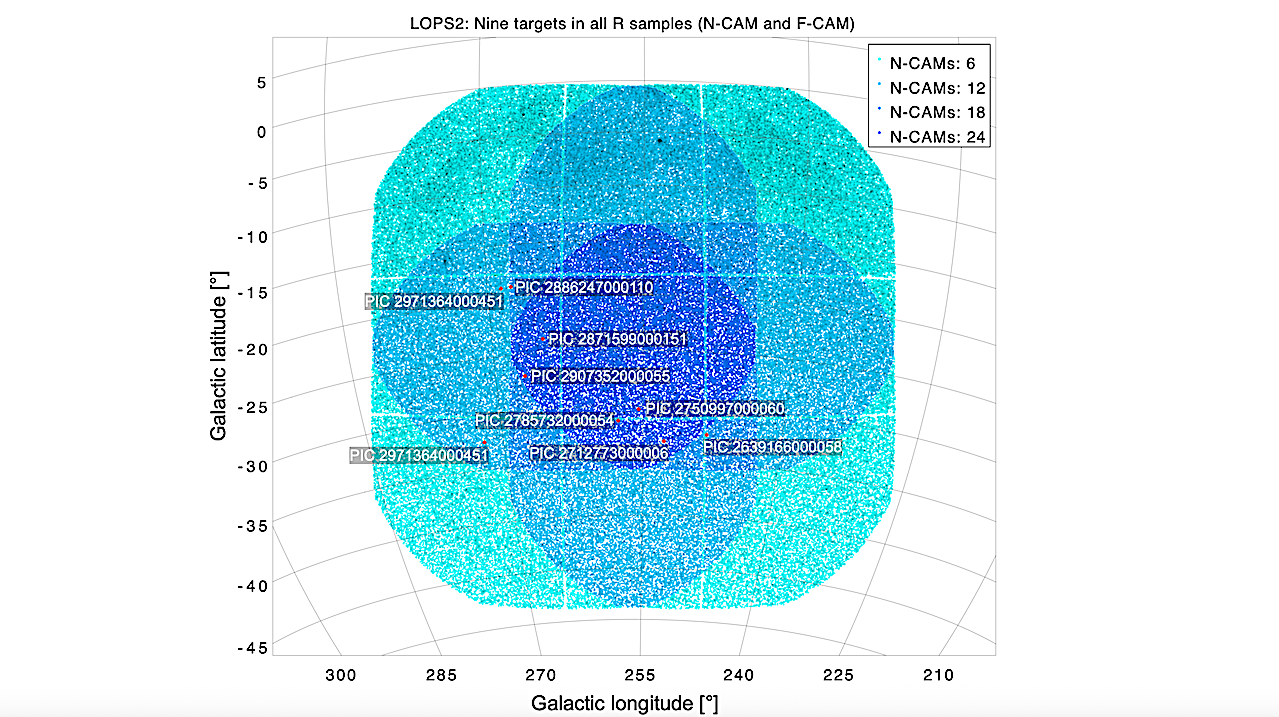
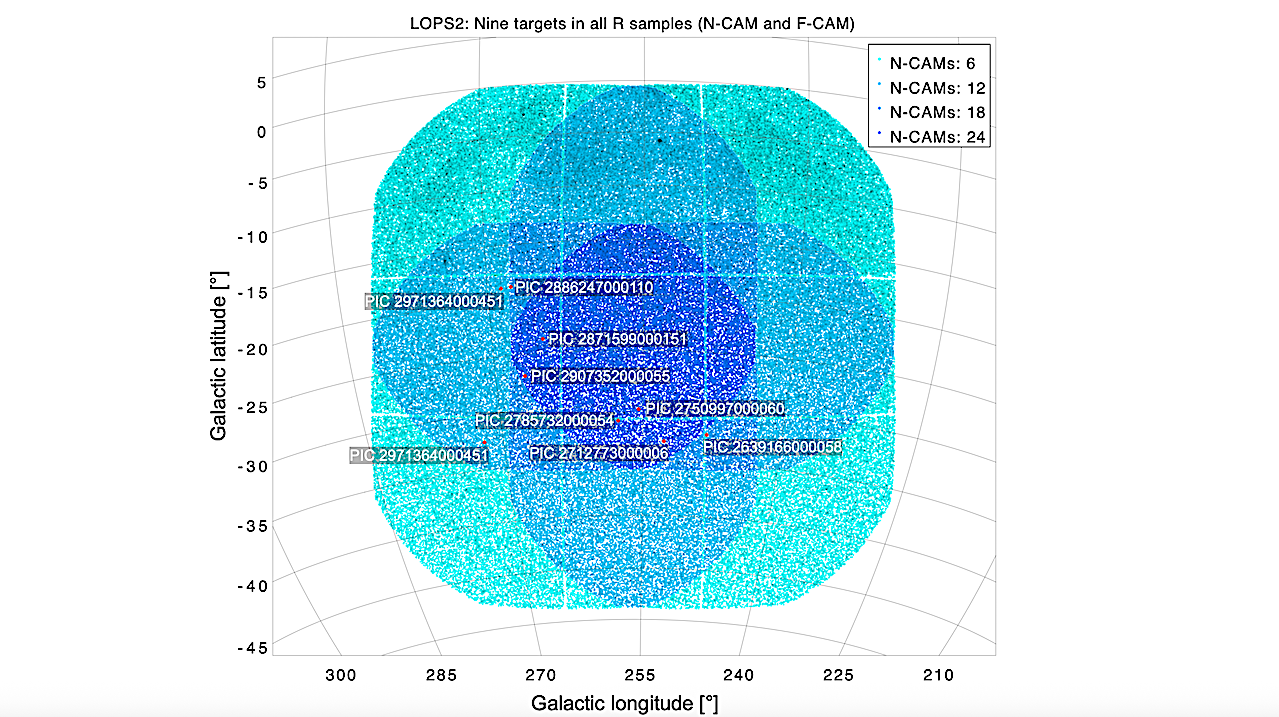
Sky plot of nine cPIC targets that are present in all stellar reference samples.
Their PIC names are indicated with labels. — astro-ph.IM
A few weeks after launch, the PLATO spacecraft is expected to start its payload commissioning, which will be completed within the first three months of the mission. This phase includes the in-orbit verification, calibration, and configuration of the instrument prior to nominal science operations.
During this mission-critical period, and again later during regular spacecraft rotations and re-pointings, a set of reference stars is required to complete various calibration steps. This set, referred to as the calibration PLATO Input Catalog (cPIC), is part of the PIC.
The cPIC comprises various stellar samples, each serving a dedicated technical calibration purpose, and it contains 71671 unique stellar targets across PLATO’s entire field of view (FoV). Once the spacecraft commences science observations, the on-board Fine Guidance System (FGS) will rely on a small set of guide stars.
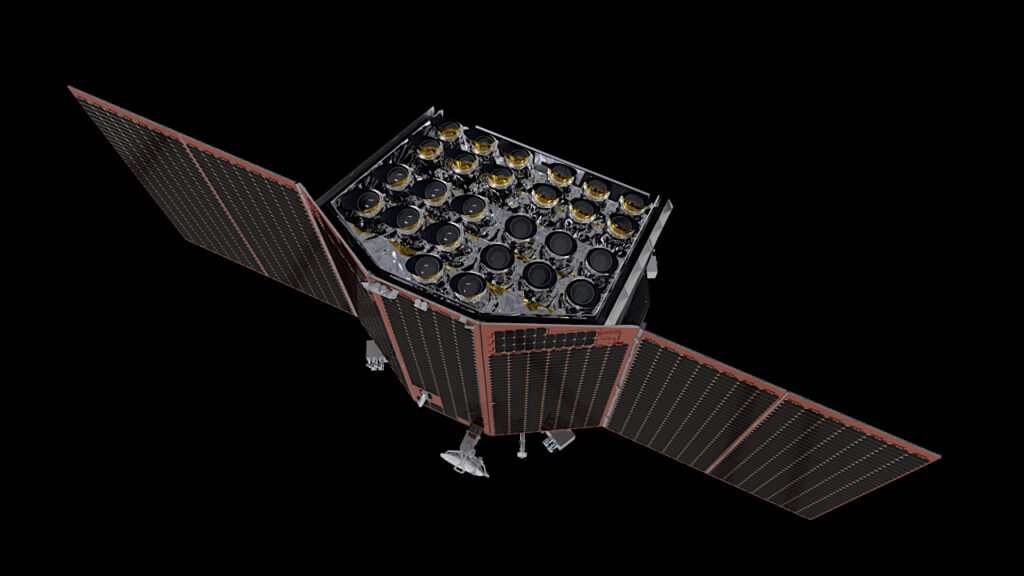
These stars must be particularly bright and will be observed with the two fast cameras, which cover only a smaller central region of PLATO’s FoV. This target list, referred to as the fine-guidance PLATO Input Catalog (fgPIC), contains 2640 unique targets, of which about 30 are used by the FGS at any given time.
In this paper, we present the selection criteria for both the cPIC and the fgPIC, and asses their impact on the construction of these calibration catalogs for PLATO.
René Heller (1), Chen Jiang (1), Paz Bluhm (2), Valentina Granata (3,4), Juan Cabrera (5), Denis Grießbach (5), Carsten Paproth (5), Szilárd Csizmadia (5), Philipp Eigmüller (5), Paola Maria Marrese (6,7), Silvia Marinoni (6,7), Réza Samadi (8), Giampaolo Piotto (3,4), Marco Montalto (9), Martin Schäfer (1), Cilia Damiani (1), Nicholas Walton (10), Christoph Rauterberg (1), Matthias Ammler-von Eiff (1), Aaron C. Birch (1), Laurent Gizon (1) ((1) Max Planck Institute for Solar System Research, Göttingen (GER), (2) Freie Universität Berlin (GER), (3) Università degli Studi di Padova (ITA), (4) Osservatorio Astronomico di Padova, Istituto Nazionale di Astrofísica (ITA), (5) Institute of Space Research, German Aerospace Center, Berlin (GER), (6) Italian National Institute of Astrophysics, Rome (ITA), (7) Agenzia Spaziale Italiana, Rome (ITA), (8) Université PSL, Sorbonne Université, Université Paris Cité, CY Cergy Paris Université, CNRS, (9) Catania Astrophysical Observatory, Italian National Institute of Astrophysics, Catania (ITA), (10) Institute of Astronomy, University of Cambridge (UK))
Comments: submitted to Experimental Astronomy for their Special Issue on the PLATO Mission, 22 pages, 5 colored Figures, Supplementary Material: this https URL
Subjects: Instrumentation and Methods for Astrophysics (astro-ph.IM); Earth and Planetary Astrophysics (astro-ph.EP); Solar and Stellar Astrophysics (astro-ph.SR)
Cite as: arXiv:2604.02437 [astro-ph.IM](or arXiv:2604.02437v1 [astro-ph.IM] for this version)
https://doi.org/10.48550/arXiv.2604.02437
Focus to learn more
Submission history
From: René Heller
[v1] Thu, 2 Apr 2026 18:08:14 UTC (5,094 KB)
https://arxiv.org/abs/2604.02437
AStrobiology, exoplanet,










Related Posts
Stay Informed With the Latest & Most Important News


Advertisement
-
 01Two Black Holes Observed Circling Each Other for the First Time
 -
 02From Polymerization-Enabled Folding and Assembly to Chemical Evolution: Key Processes for Emergence of Functional Polymers in the Origin of Life
 -
 03Astronomy 101: From the Sun and Moon to Wormholes and Warp Drive, Key Theories, Discoveries, and Facts about the Universe (The Adams 101 Series)
 -
 04True Anomaly hires former York Space executive as chief operating officer
 -
 05Φsat-2 begins science phase for AI Earth images
 -
 06Hurricane forecasters are losing 3 key satellites ahead of peak storm season − a meteorologist explains why it matters
 -
 07Binary star systems are complex astronomical objects − a new AI approach could pin down their properties quickly