
Now Reading: Planetary Architectures of Kepler Compact Multis with Binary Star Companions
-
01
Planetary Architectures of Kepler Compact Multis with Binary Star Companions


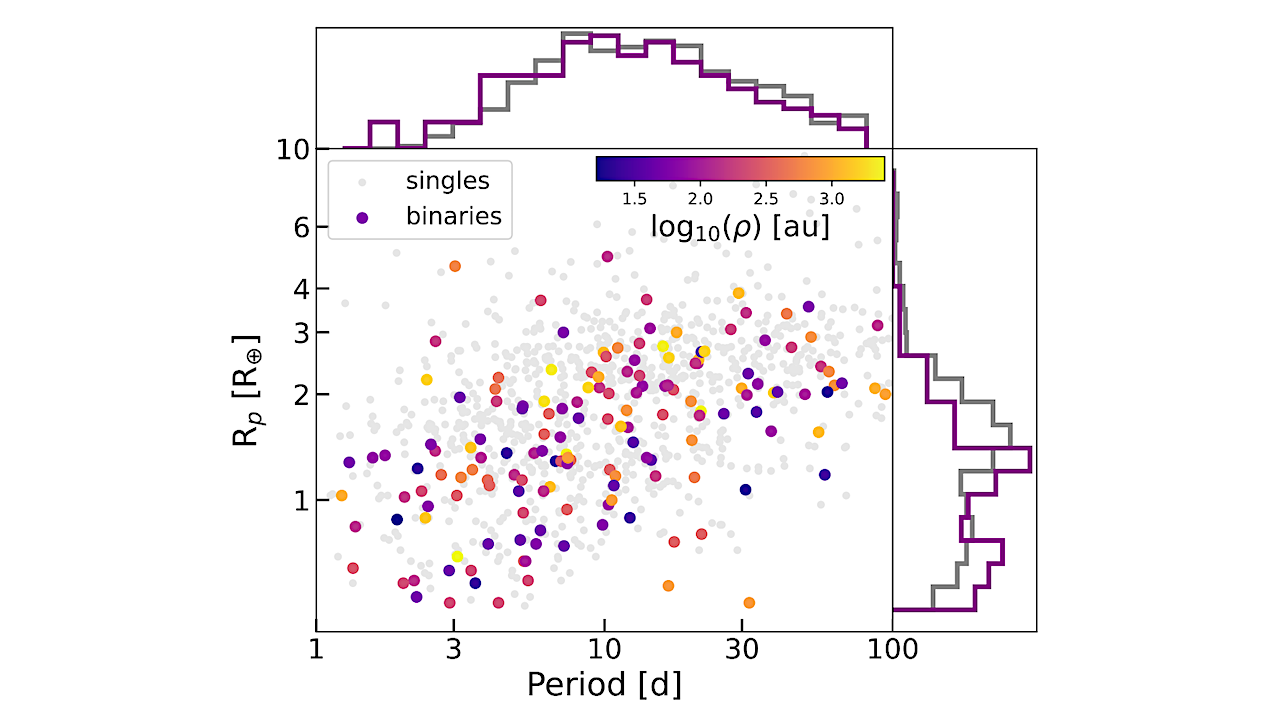
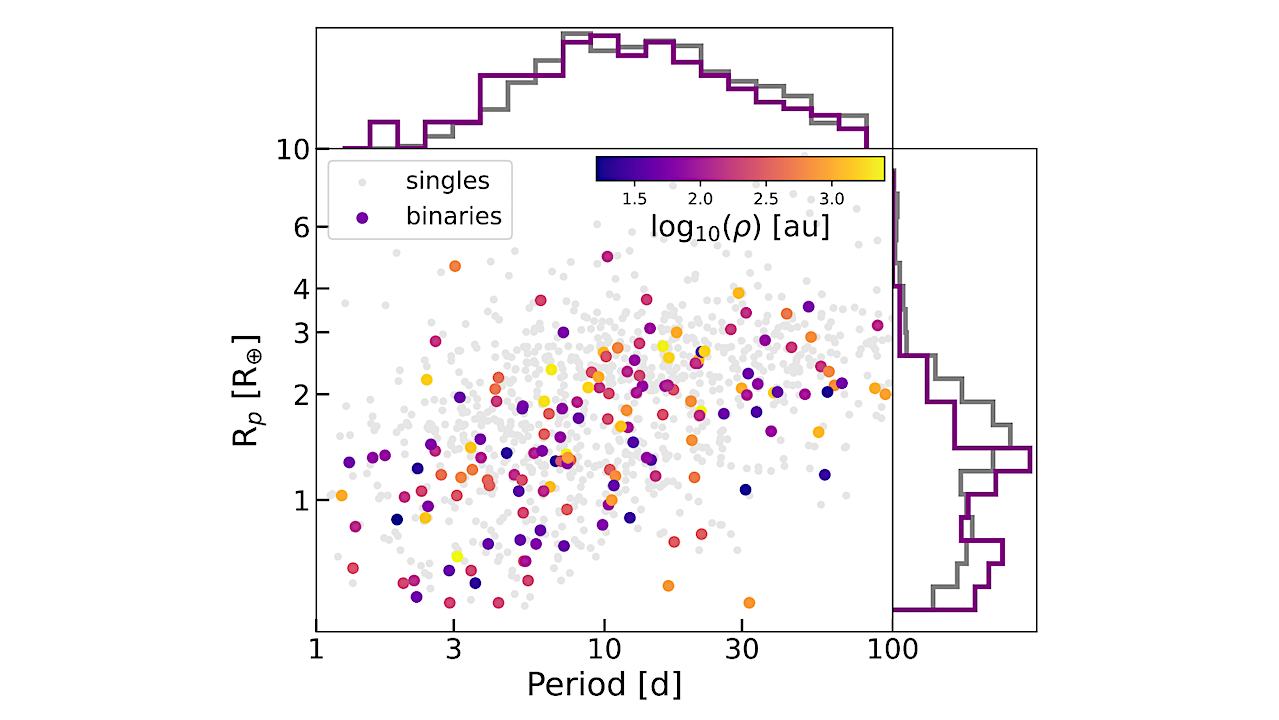
Period-radius plot for planets in single-star (gray points) and binary-star (colored points) systems considered in this work. Colors correspond to log10(ρ), i.e. the projected physical binary separation in au. We restricted the sample to planets with 1 P 100 d and 0.5 Rp 4R⊕. The planets in binary-star systems have a similar distribution in period-radius space as the planets in single-star systems, although the relative occurrence rate of sub-Neptunes (2 Rp 4R⊕) is suppressed in small-separation binary-star systems (K. Sullivan et al. 2024). — astro-ph.EP
Planets in binary-star systems exhibit demographic differences compared to planets in single-star systems.
In particular, planets with binary-star hosts have a lower overall occurrence rate compared to their single-star counterparts, as well as a suppressed relative occurrence rate for sub-Neptunes (Rp=2−4R⊕) compared to super-Earths (Rp=1.0−1.5R⊕). These differences are most pronounced in close separation binaries (ρ<100 au) which has been interpreted as a result of binary stars disrupting the protoplanetary disks of their stellar companions.
The architectures of planetary systems — i.e. the arrangements of planet sizes and orbits — provide additional information about system formation and evolution. Architectures of single-star planetary systems are well studied, but architectures of binary-star planetary systems have not been investigated in detail.
In this work, we analyzed a large sample of Kepler planetary systems (162 planets in 118 binary-star systems; 880 planets in 544 single-star systems) to compare their architectures as a function of stellar multiplicity.
We found that planets with binary-star hosts follow a similar “peas-in-a-pod” tendency toward uniformity in planet radii and log-uniformity in period spacing as planets with single-star hosts. However, we also detected modest (2.5−3σ) differences in period spacing and planet multiplicity, with binary-star systems having higher typical gap complexities (indicating more uneven spacing) and a higher prevalence of single planets.
We interpret these results as evidence that binary stars primarily influence the planetary architectures of their stellar companions by shaping the protoplanetary disk at formation, with subsequent dynamical processing more gently altering the system architectures over secular timescales.
Kendall Sullivan, Gregory J. Gilbert
Comments: 18 pages, 15 figures. Accepted to AJ
Subjects: Earth and Planetary Astrophysics (astro-ph.EP)
Cite as: arXiv:2603.21897 [astro-ph.EP] (or arXiv:2603.21897v1 [astro-ph.EP] for this version)
https://doi.org/10.48550/arXiv.2603.21897
Focus to learn more
Submission history
From: Kendall Sullivan
[v1] Mon, 23 Mar 2026 12:21:58 UTC (464 KB)
https://arxiv.org/abs/2603.21897
Astrobiology, Exoplanet,











Related Posts


Stay Informed With the Latest & Most Important News
Previous Post
Next Post




Advertisement
-
 01Two Black Holes Observed Circling Each Other for the First Time
 -
 02From Polymerization-Enabled Folding and Assembly to Chemical Evolution: Key Processes for Emergence of Functional Polymers in the Origin of Life
 -
 03Astronomy 101: From the Sun and Moon to Wormholes and Warp Drive, Key Theories, Discoveries, and Facts about the Universe (The Adams 101 Series)
 -
 04True Anomaly hires former York Space executive as chief operating officer
 -
 05Φsat-2 begins science phase for AI Earth images
 -
 06Hurricane forecasters are losing 3 key satellites ahead of peak storm season − a meteorologist explains why it matters
 -
 07Binary star systems are complex astronomical objects − a new AI approach could pin down their properties quickly