
Now Reading: Portal Space selects ‘Space Armor’ debris shield for 2026 mission
-
01
Portal Space selects ‘Space Armor’ debris shield for 2026 mission


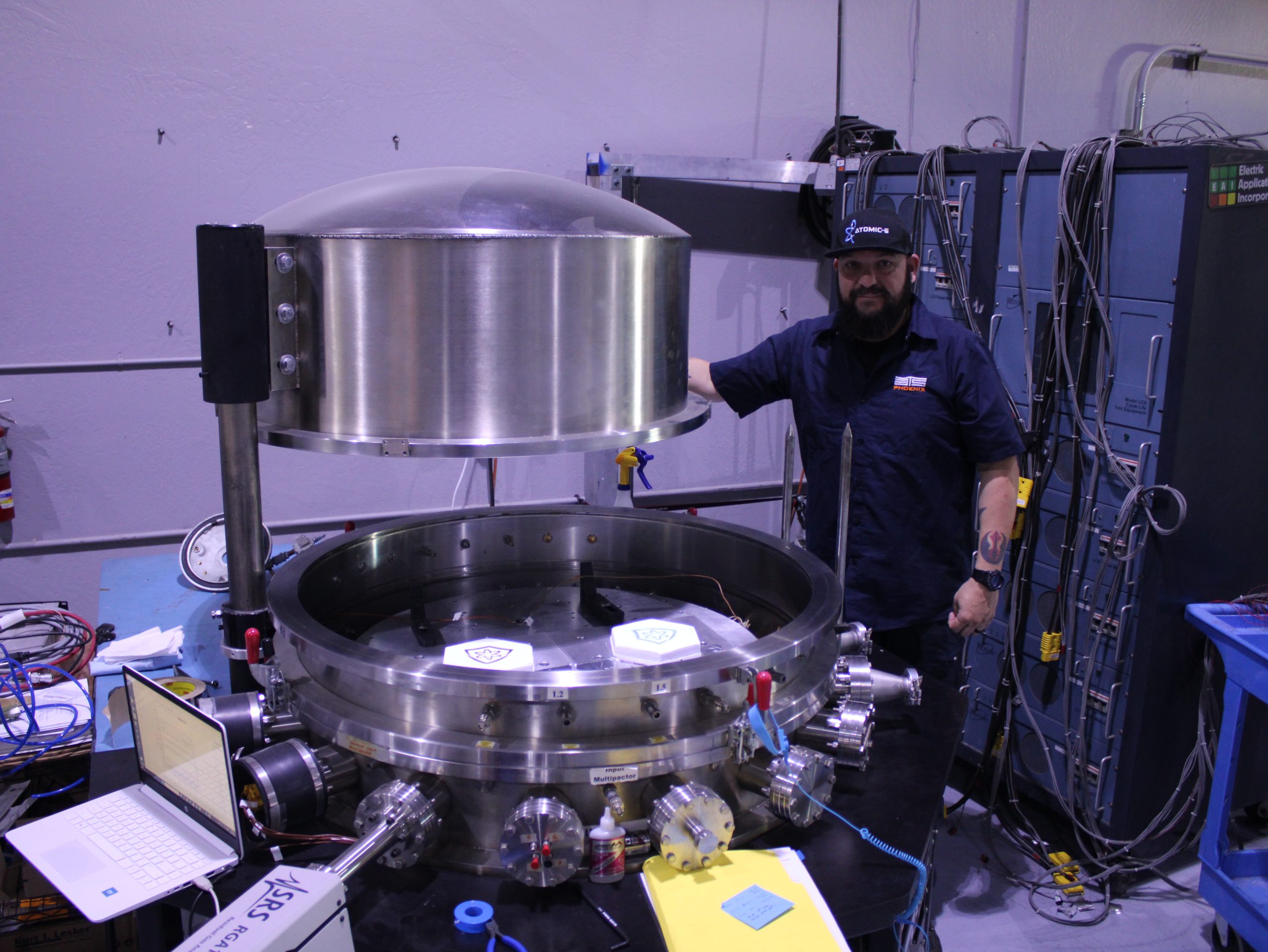

WASHINGTON — Portal Space Systems, a defense-focused space startup developing long-endurance maneuvering satellites for national security missions, has selected a new protective material made by Atomic-6 for a mission scheduled to launch in October 2026.
Atomic-6, a startup that specializes in advanced composite materials for extreme environments, produces a shielding product known as Space Armor, designed to protect spacecraft from debris impacts. The Portal mission would mark Space Armor’s first in-orbit test following ground-based validation.
“Portal Space Systems has selected Space Armor tiles as the primary Micrometeoroid and Orbital Debris (MMOD) protection system for their upcoming spacecraft,” Atomic-6 chief executive Trevor Smith said Jan. 15.
The tiles will be installed on Portal’s satellite before integration into SpaceX’s Transporter-18 rideshare mission, scheduled for launch in October 2026.
Challenging a long-standing standard
For decades, spacecraft designers have relied on Whipple-style shielding to protect against micrometeoroids and orbital debris. The Whipple shield uses metal layers to break incoming particles into fragments before they strike a spacecraft’s main structure. Variations of the approach remain the standard form of debris protection for crewed vehicles and high-value satellites.
Atomic-6 is positioning Space Armor as an alternative to those metallic shields, arguing that advances in composite materials can reduce mass while improving performance.
“The upcoming flight will validate installation procedures, on-orbit performance, and readiness for broader commercial and national security adoption,” Smith said.
Debris protection systems must absorb impacts from particles traveling faster than 7 kilometers per second while avoiding interference with radio-frequency signals used for communications and navigation. Additional mass also reduces a satellite’s maneuverability and operating life.
Portal said the Space Armor tiles support its focus on sustained maneuverability.
“Our customers rely on Portal spacecraft to remain maneuverable over extended mission timelines,” said Jeff Thornburg, chief executive of Portal Space Systems. “That means protecting critical systems in a way that supports, rather than limits, on-orbit performance.”
The use of Space Armor tiles allows Portal to “offer customers sustained maneuverability and longer operational time on orbit,” Thornburg said. “We’re pleased to have Atomic-6 as part of the Starburst-1 mission.”
Starburst-1 is Portal’s first on-orbit demonstration mission, a technology pathfinder spacecraft designed to validate the company’s long-endurance satellite architecture. The satellite will operate in a sun-synchronous orbit for about a year, demonstrating capabilities including rendezvous and proximity operations, rapid orbital changes and retasking.
Ground testing and design
Spacecraft face collision risks from untrackable debris particles traveling at extreme speeds.
“Even a tiny piece of debris can penetrate fuel tanks, destroy batteries, or tear through electronics and structures,” Smith said. “Traditional MMOD mitigations, namely Whipple shields, rely on metallic layers that add mass, block RF signals, and often generate more debris when struck.”
Space Armor uses hexagonal tiles about three-quarters of an inch thick that can be attached to spacecraft surfaces to protect specific components. According to Smith, the Space Armor Lite tiles are “about 30% lighter and 15% thinner than the Whipple aluminum shields.”
Atomic-6 conducted hypervelocity impact tests at the University of Dayton Research Institute and Texas A&M University, firing 3-millimeter aluminum projectiles at speeds exceeding 7 kilometers per second, roughly matching orbital conditions.
The tests showed that the tiles are fragmentation resistant, Smith said, meaning they absorb and contain impacts rather than producing secondary debris that could threaten other satellites.










Related Posts

Stay Informed With the Latest & Most Important News
Previous Post
Next Post



Advertisement
-
 01Two Black Holes Observed Circling Each Other for the First Time
 -
 02From Polymerization-Enabled Folding and Assembly to Chemical Evolution: Key Processes for Emergence of Functional Polymers in the Origin of Life
 -
 03Astronomy 101: From the Sun and Moon to Wormholes and Warp Drive, Key Theories, Discoveries, and Facts about the Universe (The Adams 101 Series)
 -
 04True Anomaly hires former York Space executive as chief operating officer
 -
 05Φsat-2 begins science phase for AI Earth images
 -
 06Hurricane forecasters are losing 3 key satellites ahead of peak storm season − a meteorologist explains why it matters
 -
 07Binary star systems are complex astronomical objects − a new AI approach could pin down their properties quickly