
Now Reading: Potential Metabolic Viability On Asteroid Chemistry
-
01
Potential Metabolic Viability On Asteroid Chemistry


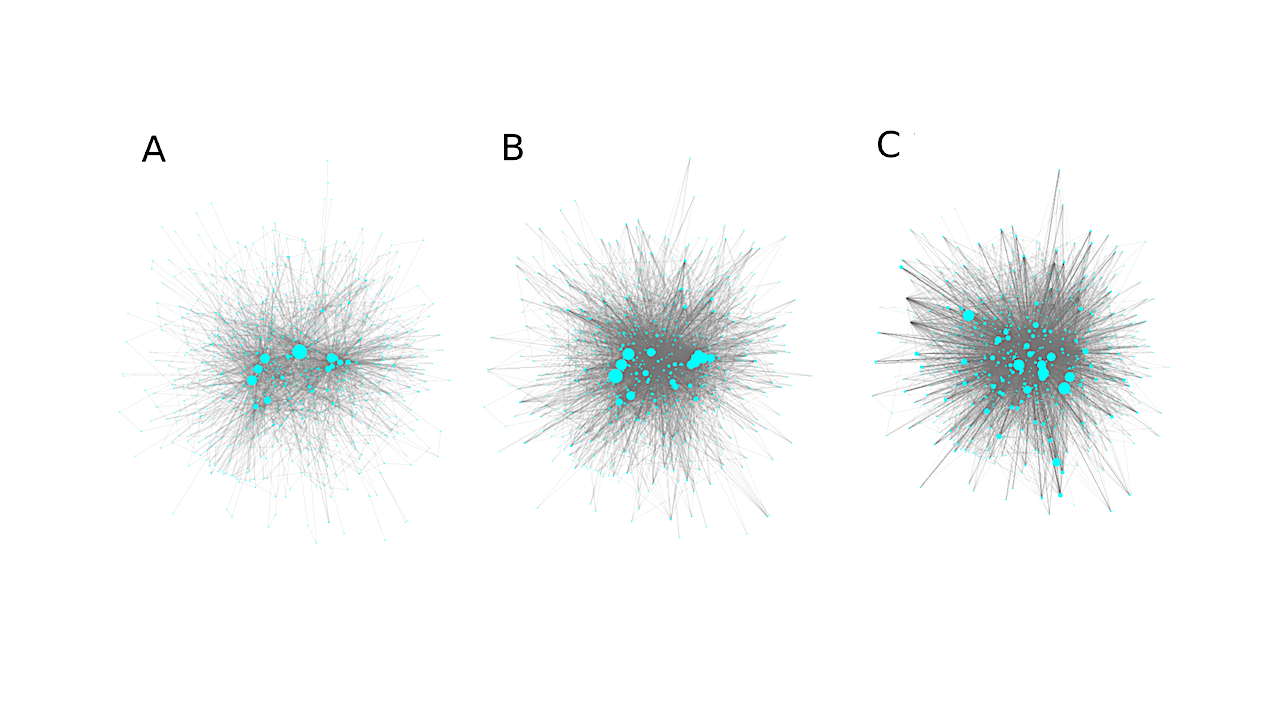
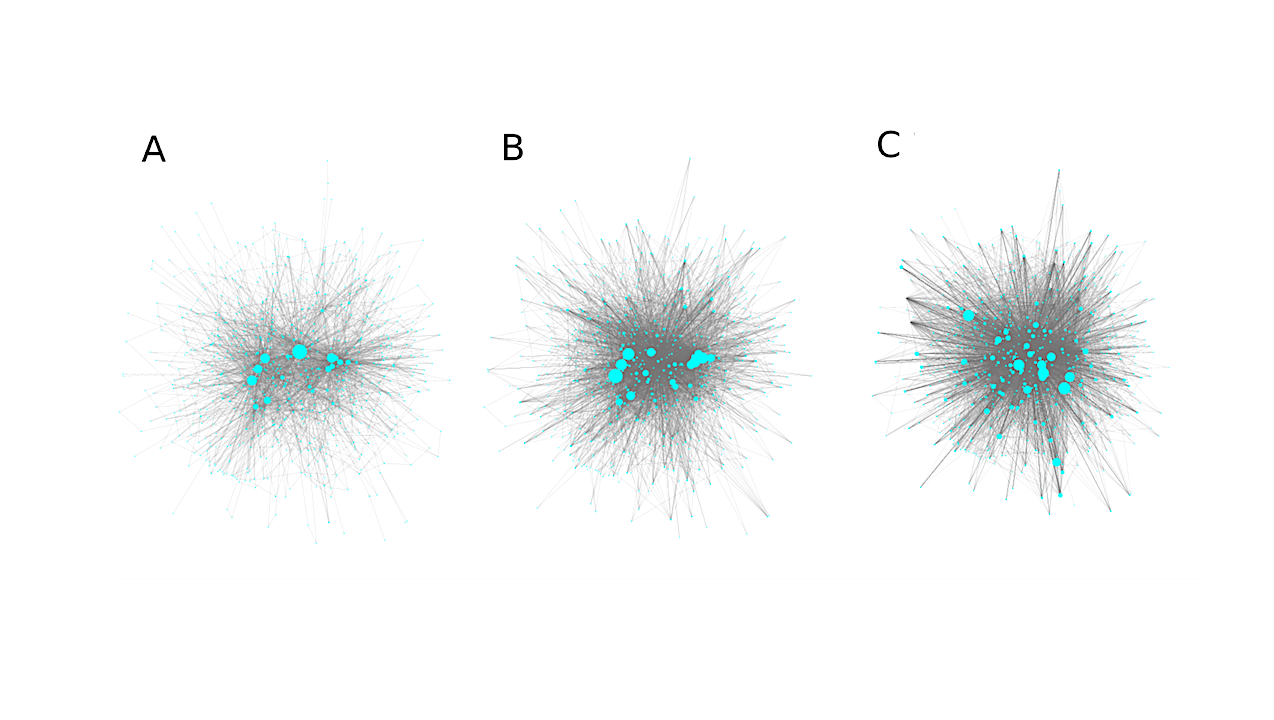
Examples of metabolic networks (gray nodes and edges) and seed sets (blue circles). A. Metabolic network and seed set of the bacterium Candidatus Desulforudis audaxviator which forms a single-species ecosystem in a deep-undergound isolated environment. The metabolic network is composed of 615 nodes and 2577 edges. The initial seed set contains 94 nodes, comprised of 26 compounds and 68 generic species (see Methods for more detail). B. Combined network of the 11 acetogenic bacterial species examined, composed of 1289 nodes and 5278 edges. Note that this combined network is different from the individual-species networks that we subject to network expansion (see Methods). C. Metabolic network of the total biosphere, composed of 8954 nodes and 34583 edges. Networks were constructed by querying the KEGG database for the reactants and products of every reaction in a species’ reaction list, which were then converted into nodes, and the reactions themselves assigned as edges. The resulting graph was then visualized using Cytoscape [21]. — Communications Chemistry via PubMed
While it has been long supposed that asteroids played a role in the delivery of important prebiotic compounds to early Earth, the exact nature of the interactions between asteroidal material and metabolism remains largely unquantified.
Pristine material from asteroid sample-return missions provides an unprecedented opportunity to evaluate the potential for the asteroids’ chemistry to support the origin and persistence of life.
Here we use metabolic network expansion to computationally test the viability of contrasted biochemical networks, including a group of acetogens and methanogens representing primitive metabolisms, on the known chemistry of three asteroids (Itokawa, Ryugu, Bennu) and two meteorites (Murchison, Murray).
The chemistry of Murchison and Bennu appears to support the potential viability of the acetogenic and methanogenic metabolisms. In contrast, Murray, Ryugu and Itokawa samples lack critical substrates, particularly adenine and D-ribose needed for ATP production, suggesting that carbonaceous bodies vary in their compositional capacity to support the acetogenic and methanogenic metabolisms.
This highlights the astrobiological relevance of asteroids rich in carbon, nitrogen, and phosphate such as Bennu, and hints at the habitability, past or present, of their parent bodies.
Potential metabolic viability on asteroid chemistry, Communications Chemistry via PubMed (open access)
Astrobiology, Astrochemistry, Astrogeology,











Related Posts
Stay Informed With the Latest & Most Important News
Previous Post
Next Post




Advertisement
-
 01Two Black Holes Observed Circling Each Other for the First Time
 -
 02From Polymerization-Enabled Folding and Assembly to Chemical Evolution: Key Processes for Emergence of Functional Polymers in the Origin of Life
 -
 03Astronomy 101: From the Sun and Moon to Wormholes and Warp Drive, Key Theories, Discoveries, and Facts about the Universe (The Adams 101 Series)
 -
 04True Anomaly hires former York Space executive as chief operating officer
 -
 05Φsat-2 begins science phase for AI Earth images
 -
 06Hurricane forecasters are losing 3 key satellites ahead of peak storm season − a meteorologist explains why it matters
 -
 07Binary star systems are complex astronomical objects − a new AI approach could pin down their properties quickly