
Now Reading: Private group unveils plans for large space telescope
-
01
Private group unveils plans for large space telescope


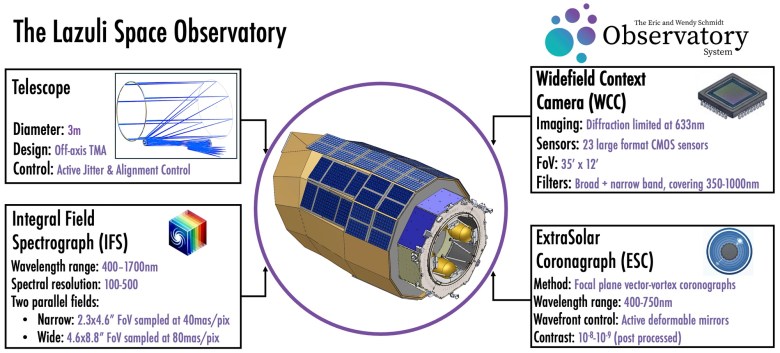
PHOENIX — A billionaire-backed philanthropic organization is funding the development of a series of new observatories, including a space telescope larger than Hubble that its backers say can be built at a fraction of the cost and on a much faster schedule.
Schmidt Sciences, founded by former Google chief executive Eric Schmidt and his wife, Wendy Schmidt, announced Jan. 7 the creation of the Eric and Wendy Schmidt Observatory System, a suite of four observatories it plans to develop over the next several years.
The centerpiece of the system is Lazuli, a space telescope with a primary mirror three meters across. Lazuli will operate in a highly elliptical Earth orbit and will carry a camera, spectrograph and coronagraph. By comparison, both the Hubble Space Telescope and NASA’s Nancy Grace Roman Space Telescope, scheduled to launch later this year, have primary mirrors 2.4 meters in diameter.
“We are going to build a philanthropic, three-meter, off-axis telescope with capabilities that are approaching Hubble,” Pete Klupar, executive director of the Lazuli project at Schmidt Sciences, said during a session at the 247th meeting of the American Astronomical Society to announce the observatory program. “And we’re going to do it in three years, and we’re going to do it for a ridiculously low price.”
Klupar did not disclose a specific cost estimate but said the telescope would cost roughly 10% of a NASA flagship astrophysics mission. Flagship missions have reached costs of up to $10 billion, most notably for the James Webb Space Telescope. In an interview after the session, Klupar confirmed Lazuli is expected to cost in the hundreds of millions of dollars.
“Our goal is to demonstrate a fast, low-cost paradigm for world-class space science,” he said, including “a focused mission scope with three instruments using proven technology and emphasizing a ruthless risk management approach.”
Klupar, a former director of engineering at NASA’s Ames Research Center who has also worked at the Air Force Research Laboratory and in industry, said about 80% of Lazuli will use off-the-shelf components with previous spaceflight heritage.
“One of the focuses was to put the risk into the payload and not on the spacecraft,” he said. Components without prior flight heritage include the instruments and some telescope hardware.
Lazuli is scheduled to undergo a preliminary design review in the spring as part of a fast-track schedule targeting a launch as early as mid-2028. The project follows earlier studies of a larger 6.5-meter space telescope before shifting in 2024 to the smaller Lazuli design.
Klupar said the project is streamlining development by assembling the spacecraft in Florida near the launch site and potentially skipping some system-level tests, such as acoustic and vibration testing.
He said Schmidt Sciences has identified vendors for key spacecraft elements and expects one company to serve as the de facto prime contractor for integration, though he declined to identify any of the firms involved.
A planning schedule shown during the presentation indicated the spacecraft would be delivered to Space Launch Complex 16 at Cape Canaveral, Florida, for launch. The complex is currently used by Relativity Space, which is developing the Terran R medium-lift launch vehicle. Eric Schmidt invested in Relativity Space and became its chief executive last year.

System of observatories
Lazuli is designed to support a wide range of astrophysics research, from exoplanet studies to cosmology.
“Lazuli fits into a niche that we think is missing in current capabilities,” said Arpita Roy, head of the astrophysics and space science institute at Schmidt Sciences. She said the telescope will follow up on discoveries from survey instruments such as the Vera C. Rubin Observatory in Chile and rapidly respond to transient events like gamma-ray bursts and supernovas.
Among those involved in Lazuli is Saul Perlmutter, an astrophysicist at the University of California Berkeley who shared the 2011 Nobel Prize in physics for the discovery of the accelerating expansion of the universe. He said the telescope could help address outstanding questions in cosmology related to that expansion.
“This, I think, is going to be the beginning of a very exciting period of physics and cosmology coming together,” he said.
Schmidt Sciences is also funding three complementary ground-based observatories:
- Argus Array, a network of more than 1,200 small telescopes that together will have the performance of a single eight-meter telescope and conduct surveys of the northern sky;
- Deep Synoptic Array, a collection of 1,650 small radio dishes designed to provide real-time radio images of the sky; and
- Large Fiber Array Spectroscopic Telescope, a system of small telescopes optimized for collecting spectra of stars and galaxies.
Although ground-based, Argus Array has applications related to space operations. Its telescopes will be built by Observable Space, a company formed last year through the merger of OurSky, a developer of software for space object tracking, and telescope manufacturer PlaneWave Instruments.
Observable Space has explored applications for its telescope that include tracking space objects and serving as ground terminals for space-to-ground optical communications.
“The Argus Array’s commitment to open data and open science represents a new model for how astronomical discovery should happen,” Dan Roelker, chief executive of Observable Space and a former SpaceX vice president of software engineering, said in a statement.
“We think of these observatories not as ends in themselves but as enablers of astrophysical discovery,” Roy said. She added that the observatories are designed to complement one another and support multiple research areas. All four are expected to enter service in about three years.
“Throughout the history of astrophysics, discovery has happened in leaps and bounds that coincided with technological improvements,” she said. “We think these observatories not only answer existing questions but open up new discovery space.”
“Our mandate, as we see it, is to build the enabling layer and open it up to all of you,” Roy told a standing-room-only audience of astronomers, “to populate it with the science that will bring us into the next decade.”










Related Posts
Stay Informed With the Latest & Most Important News
Previous Post
Next Post



Advertisement
-
 01Two Black Holes Observed Circling Each Other for the First Time
 -
 02From Polymerization-Enabled Folding and Assembly to Chemical Evolution: Key Processes for Emergence of Functional Polymers in the Origin of Life
 -
 03Astronomy 101: From the Sun and Moon to Wormholes and Warp Drive, Key Theories, Discoveries, and Facts about the Universe (The Adams 101 Series)
 -
 04True Anomaly hires former York Space executive as chief operating officer
 -
 05Φsat-2 begins science phase for AI Earth images
 -
 06Hurricane forecasters are losing 3 key satellites ahead of peak storm season − a meteorologist explains why it matters
 -
 07Binary star systems are complex astronomical objects − a new AI approach could pin down their properties quickly