
Now Reading: Probing Thermal Gradients Of Habitable-zone Rocky Planets Using Direct Imaging As An Anti-indicator Of A Global Surface Ocean
-
01
Probing Thermal Gradients Of Habitable-zone Rocky Planets Using Direct Imaging As An Anti-indicator Of A Global Surface Ocean

Probing Thermal Gradients Of Habitable-zone Rocky Planets Using Direct Imaging As An Anti-indicator Of A Global Surface Ocean

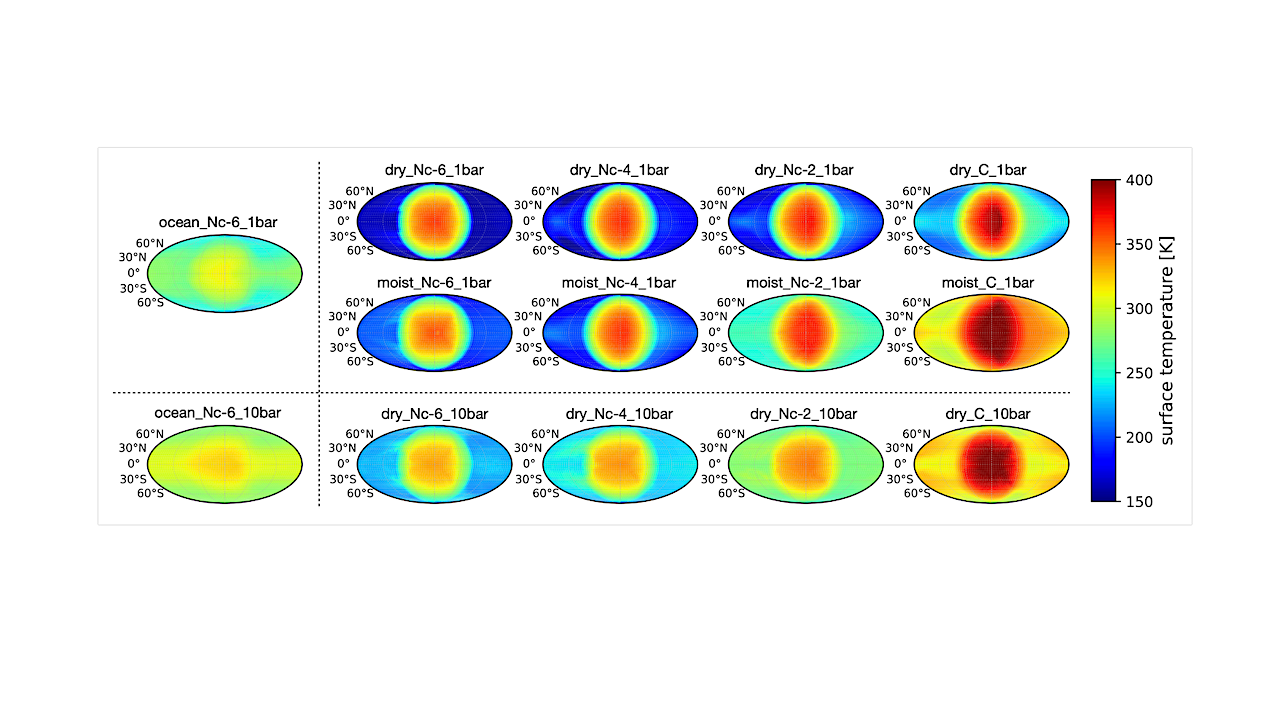
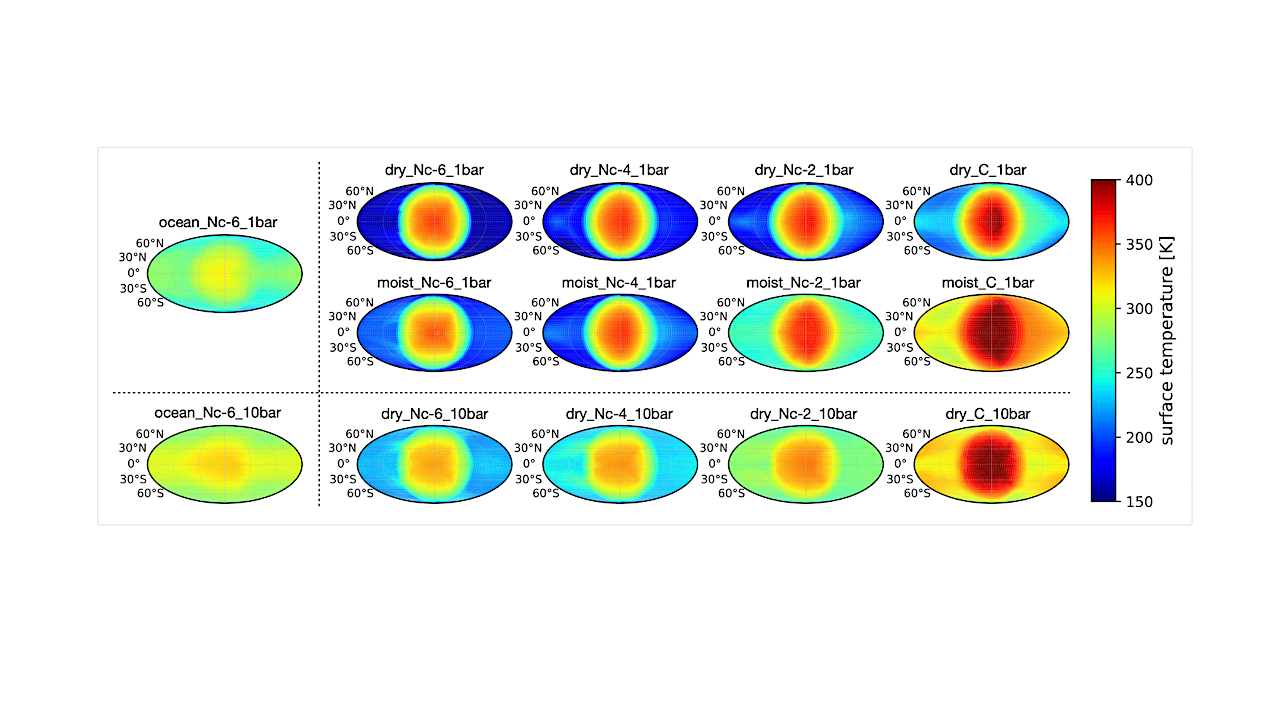
Surface temperature maps of our GCM simulations for different surface-atmosphere scenarios (Table 1) with 1 bar (top two rows) and 10 bar (bottom row) atmospheres. The substellar point is located at the center. — astro-ph.EP
Future direct-imaging missions, such as the Large Interferometer for Exoplanets (LIFE), aim to observe thermal emission from potentially habitable planets to characterize their surface environments and search for signs of life.
Previous studies of directly imaged Earth-like planets have mainly examined the signatures of atmospheric composition, often using one-dimensional models, while the effect of horizontal temperature gradients has received limited attention. Because a pronounced horizontal temperature gradient may signal the absence of a global ocean, we investigate its detectability through thermal-emission direct imaging.
Adopting Teegarden’s Star b (zero-albedo equilibrium temperature ∼280~K) as a benchmark, we compute three-dimensional atmospheric structures with and without a global ocean using the ROCKE-3D general circulation model and simulate geometry-dependent thermal emission spectra. We show that the temperature gradients that disfavor a global-ocean scenario manifest in both orbital phase variation and spectral shape of the snapshot spectra.
The phase variation is more readily detectable: one-day integrations with LIFE at two orbital phases would reveal flux variations in no-ocean cases with 1-10~bar atmospheres, depending on background atmospheric composition. Shapshot spectra provide complementary diagnostics of global temperature contrast, the running brightness temperature of the continuum and detailed absorption band shapes, but require integration a few times longer.
These three-dimensional effects, if neglected, can bias interpretations based on one-dimensional models. We also assess their detectability for other nearby exoplanets. Our results highlight the need to incorporate three-dimensional atmospheric structures when characterizing rocky exoplanets, both to constrain surface conditions and to avoid misinterpretation of spectral data.
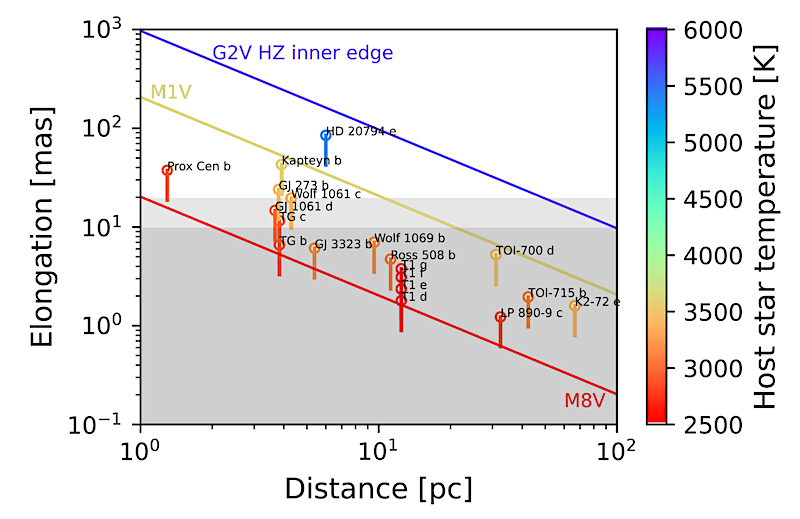
Relation between the elongation and the distance from Earth for the inner edge of the habitable zone around G2- (blue), M1- (gold) and M8-type (red) stars. The stellar radius, R⋆, and the effective temperature, Teff, are assumed to be {R⋆, T⋆, eff} = {R⊙, 5800 K}, {0.5R⊙, 3600 K}, {0.1R⊙, 2500 K} for an G2-, M1-, and M8-type star, respectively. The inner edge here is calculated based on R. K. Kopparapu et al. (2013). Known planets are overlaid with labels and color-coded according to the effective temperature of their host stars. The vertical lines indicate the range of elongation as the planets move between 30◦ < α < 150◦ . The gray filled region indicates that the elongation is smaller than the inner working angle (IWA), assumed to be 10 mas at λ = 10 µm and 20 mas at λ = 20 µm. — astro-ph.EP
Yuka Fujii, Daniel Angerhausen, Taro Matsuo, Eric T. Wolf
Comments: 18 pages, 11 figures, 2 tables, under review
Subjects: Earth and Planetary Astrophysics (astro-ph.EP)
Cite as: arXiv:2512.16575 [astro-ph.EP] (or arXiv:2512.16575v1 [astro-ph.EP] for this version)
https://doi.org/10.48550/arXiv.2512.16575
Focus to learn more
Submission history
From: Yuka Fujii
[v1] Thu, 18 Dec 2025 14:13:33 UTC (4,824 KB)
https://arxiv.org/abs/2512.16575
Astrobiology, Exoplanet,










Related Posts
Stay Informed With the Latest & Most Important News
Previous Post
Next Post




Advertisement
-
 01Two Black Holes Observed Circling Each Other for the First Time
 -
 02From Polymerization-Enabled Folding and Assembly to Chemical Evolution: Key Processes for Emergence of Functional Polymers in the Origin of Life
 -
 03Astronomy 101: From the Sun and Moon to Wormholes and Warp Drive, Key Theories, Discoveries, and Facts about the Universe (The Adams 101 Series)
 -
 04True Anomaly hires former York Space executive as chief operating officer
 -
 05Φsat-2 begins science phase for AI Earth images
 -
 06Hurricane forecasters are losing 3 key satellites ahead of peak storm season − a meteorologist explains why it matters
 -
 07Binary star systems are complex astronomical objects − a new AI approach could pin down their properties quickly