
Now Reading: PyISH: Python Integral Field Spectroscopy Simulation for Habitable Worlds Observatory (HWO)
-
01
PyISH: Python Integral Field Spectroscopy Simulation for Habitable Worlds Observatory (HWO)

PyISH: Python Integral Field Spectroscopy Simulation for Habitable Worlds Observatory (HWO)

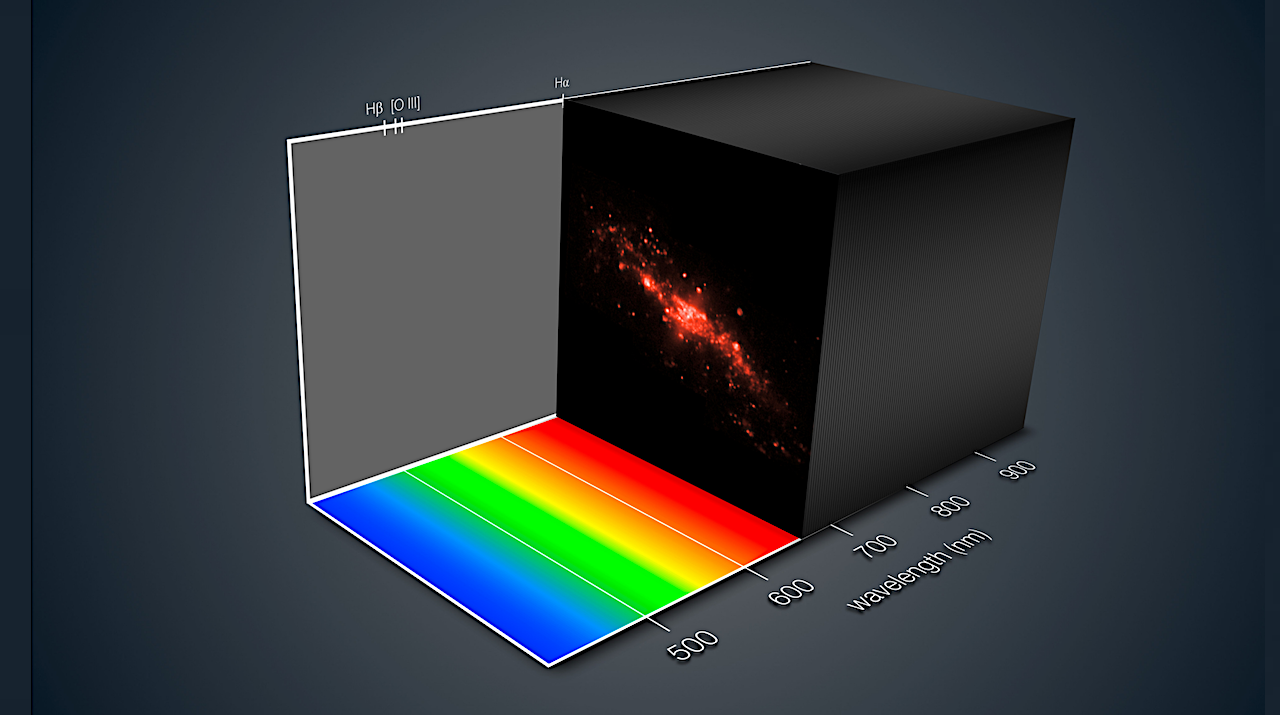
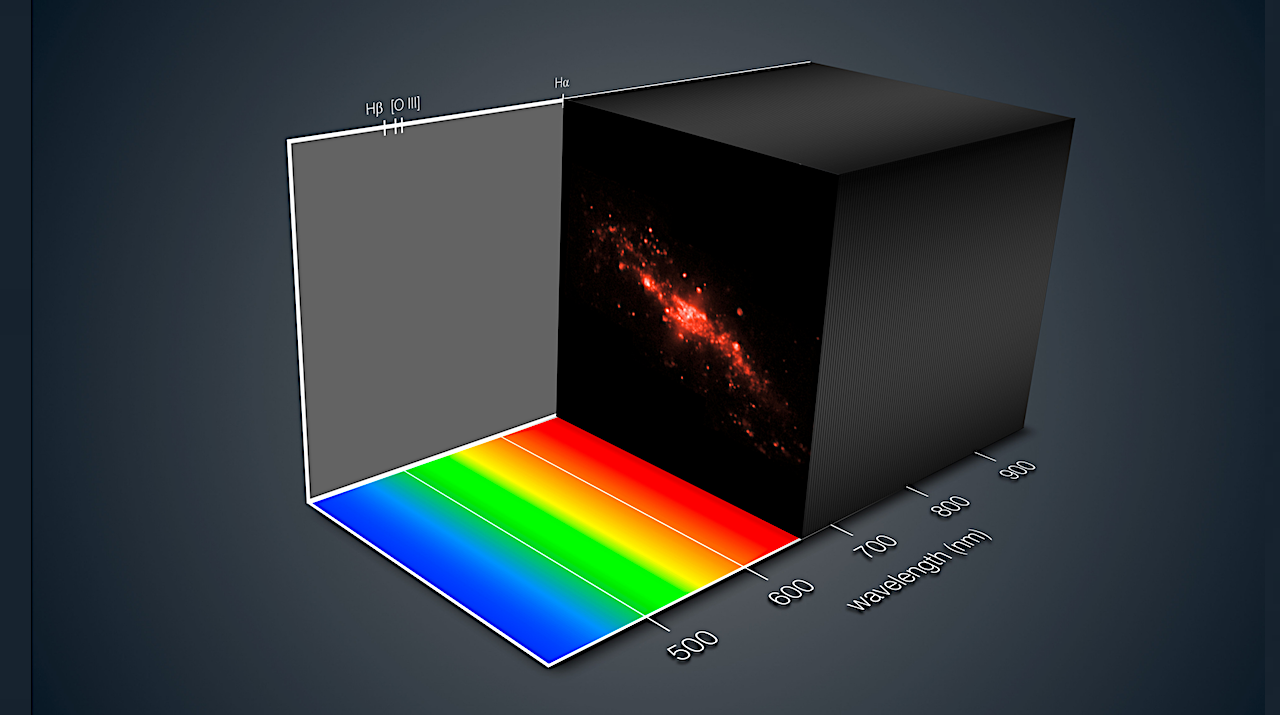
An example of a three-dimensional cube depicting the spatial dimensions and a visible spectral dimension. A 3D cube is one of the main data products from an Integral Field Spectrograph. — astro-ph.IM
The Habitable Worlds Observatory (HWO) will be a large ultraviolet/optical/near-infrared space telescope operating at the Sun-Earth Lagrange point L2.
HWO was highly recommended by the National Academies` 2020 decadal survey and will be the first telescope designed specifically to search for life on planets orbiting other stars. HWO will also be able to perform a host of other transformational astrophysics, including cosmology, galaxy evolution, solar system science, and beyond. The development of the telescope and instrument suite is an iterative process.
Example observatory architectures, called exploratory analytic cases (EACs) by the HWO Technology Maturation Project Office (TMPO), are modeled end-to-end to explore the engineering and science trade space. Recently, an ultraviolet Integral Field Spectrograph (UV IFS) was added to HWO’s instrument suite for the EACs 4 and 5. To explore the science and engineering trade space for this specific instrument, we developed a high-fidelity UV IFS simulation tool, PyISH.
The UV IFS simulation tool is designed to be used by scientists to model specific science cases as seen by a UV IFS on HWO, as well as engineers to explore the trade space when developing potential instrument architectures. The modular components, deliverables, and an example of the tool simulating a specific science case proposed for HWO are described in this paper.
Grace Sweetak, Breann Sitarski, Kevin France, Randall McEntaffer, Richard Cartwright
Comments: 42 pages, 15 figures
Subjects: Instrumentation and Methods for Astrophysics (astro-ph.IM)
Cite as: arXiv:2601.14432 [astro-ph.IM] (or arXiv:2601.14432v1 [astro-ph.IM] for this version)
https://doi.org/10.48550/arXiv.2601.14432
Focus to learn more
Submission history
From: Grace Sweetak
[v1] Tue, 20 Jan 2026 19:40:51 UTC (8,772 KB)
https://arxiv.org/abs/2601.14432
Astrobiology, Astrochemistry, Astronomy,











Related Posts

Stay Informed With the Latest & Most Important News
Previous Post
Next Post
Advertisement
-
 01Two Black Holes Observed Circling Each Other for the First Time
 -
 02From Polymerization-Enabled Folding and Assembly to Chemical Evolution: Key Processes for Emergence of Functional Polymers in the Origin of Life
 -
 03Astronomy 101: From the Sun and Moon to Wormholes and Warp Drive, Key Theories, Discoveries, and Facts about the Universe (The Adams 101 Series)
 -
 04True Anomaly hires former York Space executive as chief operating officer
 -
 05Φsat-2 begins science phase for AI Earth images
 -
 06Hurricane forecasters are losing 3 key satellites ahead of peak storm season − a meteorologist explains why it matters
 -
 07Binary star systems are complex astronomical objects − a new AI approach could pin down their properties quickly