
Now Reading: Rare glass from 6-million-year-old meteorite strike found in Brazil — but the crater is still missing
-
01
Rare glass from 6-million-year-old meteorite strike found in Brazil — but the crater is still missing

Rare glass from 6-million-year-old meteorite strike found in Brazil — but the crater is still missing

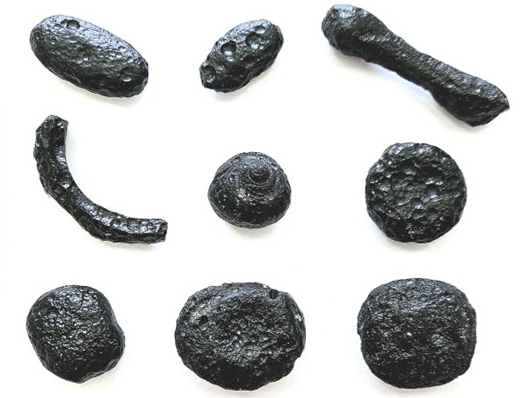
Brazil is host to a newly found field of natural glass created from meteorite impacts, according to a new study.
The natural glass is known as a tektite, which occurs after terrestrial rocks are melted when meteorites, comets, or asteroids slam into the surface of our planet, according to Encyclopedia Britannica. (The word “tektite” is derived from Ancient Greek words that mean “melted” or “molten”.)
“Tektites … are known to occur only in five distinct strewn fields on Earth,” the researchers wrote in a December 2025 article in the peer-reviewed journal Geology.
“We report on the discovery of a new tektite strewn field in northeastern Brazil. This recent finding resulted in the collection of ~500 specimens found within a strewn field at least 90 km [56 miles] long,” added the study, which was led by Álvaro Penteado Crósta, a geologist and senior professor at the Institute of Geosciences at the State University of Campinas.
Researchers suggest the impact happened roughly 6.3 million years ago, based on radioactive dating of argon isotopes. For context, that was at the end of the Miocene epoch, which is roughly about when we can start to trace humans as a distinct species.

Why are tektites so rare?
Because meteorites can strike anywhere on Earth, one would think melted glass would be more common. However, the story of the substance is a little more complicated than that.
First, we have to consider the composition of the underlying rock: shale and quartz sandstone, or some types of igneous rocks, for example. “Most current scientists theorize that tektites are formed by the rapid heating and subsequent cooling of quartz-rich soils and rocks,” according to a statement from experts with the Jackson School of Geosciences at The University of Texas.
Second, size matters: Large meteorites are more likely to produce the required melting. “The impact of large meteorites with the surface of the Earth provides enough energy to melt soils and rocks and disperse the molten ejecta of these impacts great distances, forming tektites,” the statement says..
On Earth, zones of tektites are distributed in “strewn fields” which include “specimens similar in age and chemical compositions,” and can be found either on the surface of the Earth or underwater in deep-sea sediments (known as “microtektites”).
The largest strewn field is known as the Australasian, which covers about 10% of the Earth’s surface. Other examples are in the Ivory Coast, Czech region and North America.
Distinctive name
It’s customary in the tektite community to give each type of tektite its own name, based on where it was found. An example is “modavites” in the Czech Republic, which comes from the Moldau (or Vltava) River in Bohemia.
The newly found tektites in Brazil are named “geraisites,” after the east coast Brazilian state of Minas Gerais where they were found. The geraisites are between 1 gram and 86 grams in mass and have “various shapes,” the researchers wrote, such as spherical or drop.
They look black and nontransparent at first glance, but turn gray-green and more translucent when exposed to intense light. The surfaces are marked by cavities, which are leftover bubbles that happened when the superhot material was being pummeled through the atmosphere — much like with lava, a press release noted.

Since the article was published, more geraisites have been found — at least 600 altogether. The original discovery zone was in the north of Minas Gerais, including the municipalities of Taiobeiras, Curral de Dentro and São João do Paraíso. But the zone now stretches tenfold its original size to 560 miles (900 km) in length, as finds were reported in the Brazilian states of Bahia and Piauí.
“This growth in the area of occurrence is entirely consistent with what is observed in other tektite fields around the world. The size of the field depends directly on the energy of the impact, among other factors,” study lead author Crósta stated in the press release.
The geraisites are mostly made up of silica (70% to 74%, depending on the sample) along with high concentrations of sodium and potassium oxides. Traces of chromium, nickel and other elements were found, “indicating that the original material was neither pure nor homogeneous,” the press release stated.
In some cases, it was what was lacking in the rocks that helped scientists pinpoint the tektites’ origins. Evidence of an impact comes from inclusions of a kind of glassy silica only created at very high temperatures, known as lechatelierite. The researchers also noted low water content in the samples, which are characteristic of tektites more generally.
Crósta added the researchers haven’t yet tracked down the crater from the impact, but he expected that. This is because of the six charted fields we now know of, only half of them have a known crater. The crater could have been somewhere in the São Francisco craton, which is a granitic rock in the eastern part of South America that is one of the oldest regions of the continent. But it will take more study, perhaps using satellite imagery, to see if anything buried or eroded is showing up in that region.










Related Posts


Stay Informed With the Latest & Most Important News
Previous Post
Next Post


Advertisement
-
 01Two Black Holes Observed Circling Each Other for the First Time
 -
 02From Polymerization-Enabled Folding and Assembly to Chemical Evolution: Key Processes for Emergence of Functional Polymers in the Origin of Life
 -
 03Astronomy 101: From the Sun and Moon to Wormholes and Warp Drive, Key Theories, Discoveries, and Facts about the Universe (The Adams 101 Series)
 -
 04True Anomaly hires former York Space executive as chief operating officer
 -
 05Φsat-2 begins science phase for AI Earth images
 -
 06Hurricane forecasters are losing 3 key satellites ahead of peak storm season − a meteorologist explains why it matters
 -
 07Binary star systems are complex astronomical objects − a new AI approach could pin down their properties quickly