
Now Reading: Recent Microbial Evolutionary Insights From Metagenomics
-
01
Recent Microbial Evolutionary Insights From Metagenomics


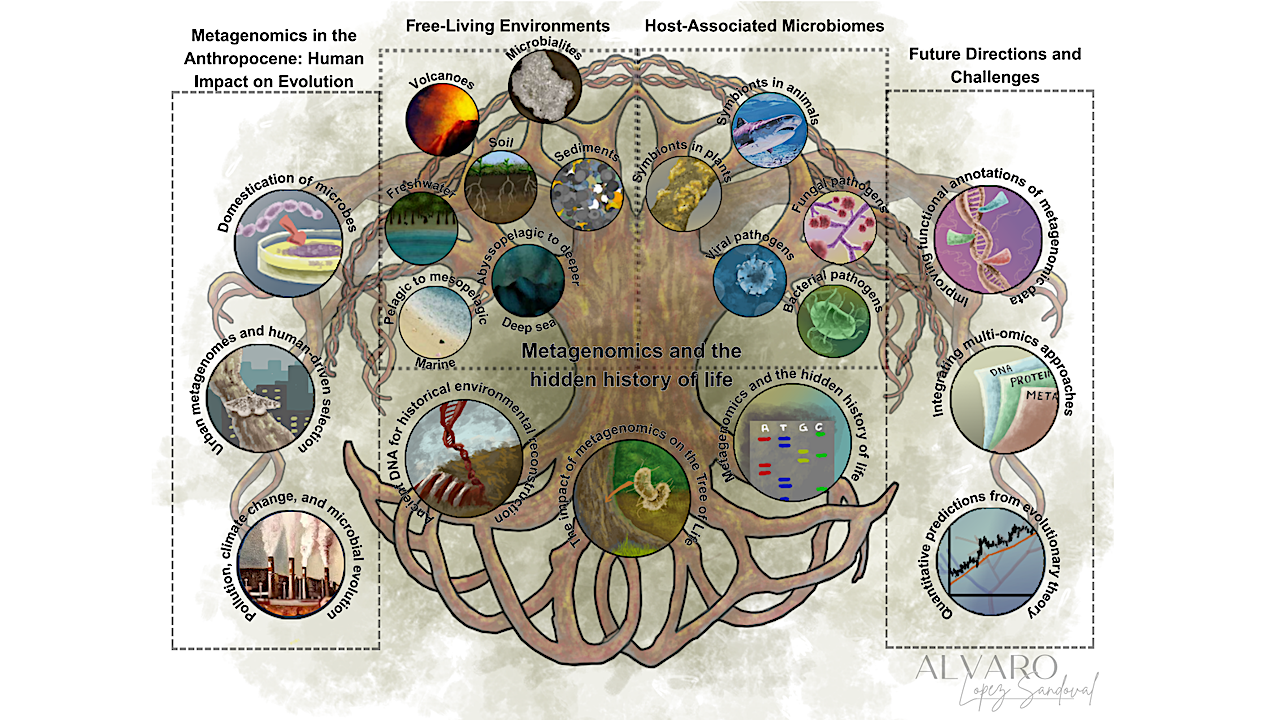
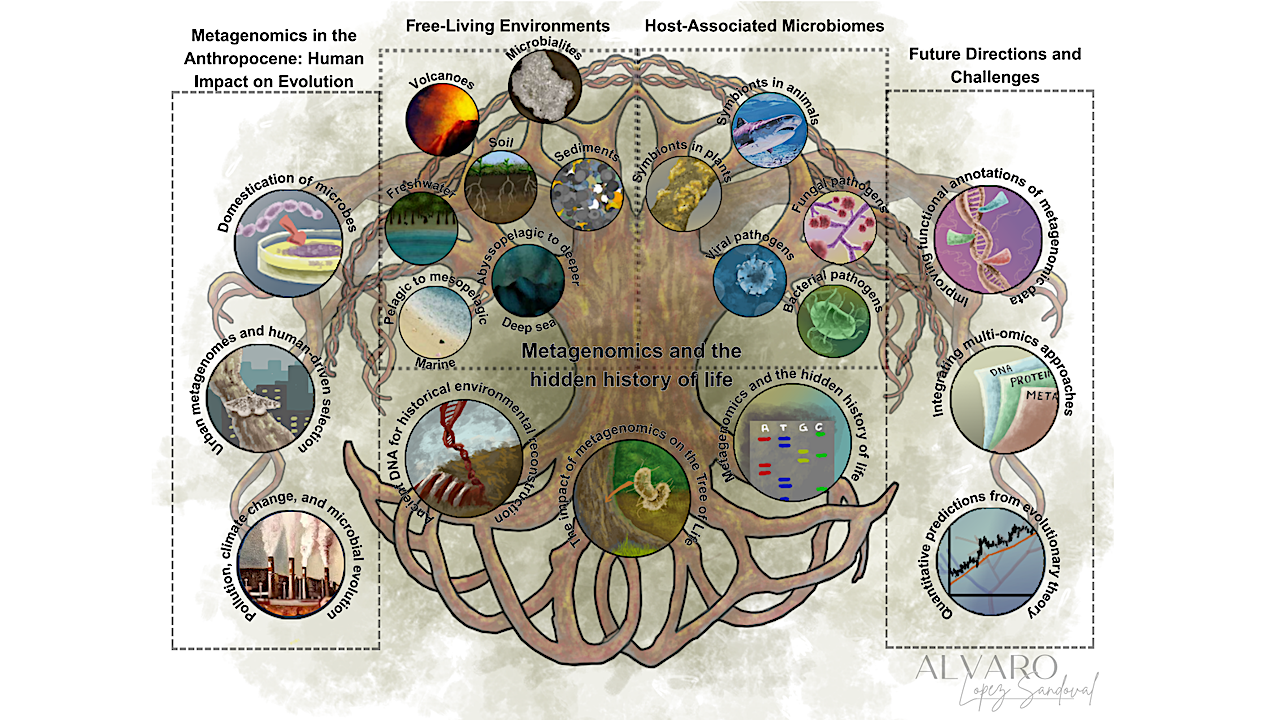
Metagenomics and the hidden history of life. Metagenomic approaches uncover microbial diversity and evolutionary processes across diverse environments. The figure is organized into four thematic sections. Center left: Free-living environments, highlighting microbial diversity and evolutionary processes in volcanoes, soils, sediments, freshwater, marine, and deep-sea habitats. Center right: Host-associated microbiomes, showcasing microbes in various hosts and the role of microbial and viral pathogens. Left: Metagenomics in the Anthropocene, emphasizing human impacts on evolution through domestication, urbanization, and climate change. Right: Future directions and challenges, focusing on advances in functional annotation, integration of multi-omics approaches, and quantitative evolutionary predictions. Branching connections represent relationships that can be studied by metagenomics. Together, the figure illustrates how metagenomics reshapes our understanding of microbial evolution, ecosystem function, and the complex interactions between microbes, hosts, and human activities. Illustration by Álvaro López-Sandoval.
Microorganisms have profoundly shaped Earth’s biological and geological history, from the origins of oxygenic photosynthesis to present-day global biogeochemical cycles.
Metagenomics—through its ability to recover genomic information directly from environmental samples—has revolutionized our understanding of microbial evolution by uncovering unbeknownst lineages, revealing functional adaptations, and reshaping our view of the Tree of Life.
By bypassing the need for cultivation, shotgun metagenomics and metabarcoding approaches have enabled researchers to investigate microbial diversity, ecology, and evolutionary processes across aquatic, terrestrial, extreme, and host-associated environments.
This review highlights recent advances in evolutionary biology driven by metagenomics, including studies on deep evolutionary branching events, microbial adaptation to extreme environments, the evolution of host-associated microbiomes, and the emergence and spread of pathogens and antimicrobial resistance. The integration of ancient DNA has expanded our ability to reconstruct past ecosystems and disease dynamics, offering insights into long-term microbial evolution.
In parallel, studies of microbial domestication and urban settings reveal how human practices have shaped microbial genomes over millennia. Despite significant progress, key challenges remain—including improving bioinformatic tools for degraded ancient DNA, resolving deep phylogenetic relationships, identifying adaptive variants, and linking genomic shifts to ecosystem-level processes.
The future of microbial evolutionary research will depend on combining longitudinal metagenomic data, experimental evolution, functional assays, and predictive modeling to better understand microbial responses to climate change and anthropogenic pressures. Together, these approaches will deepen our understanding of microbial evolution and its consequences for life on Earth—past, present, and future.
astrobiology,










Related Posts

Stay Informed With the Latest & Most Important News





Advertisement
-
 01Two Black Holes Observed Circling Each Other for the First Time
 -
 02From Polymerization-Enabled Folding and Assembly to Chemical Evolution: Key Processes for Emergence of Functional Polymers in the Origin of Life
 -
 03Astronomy 101: From the Sun and Moon to Wormholes and Warp Drive, Key Theories, Discoveries, and Facts about the Universe (The Adams 101 Series)
 -
 04True Anomaly hires former York Space executive as chief operating officer
 -
 05Φsat-2 begins science phase for AI Earth images
 -
 06Hurricane forecasters are losing 3 key satellites ahead of peak storm season − a meteorologist explains why it matters
 -
 07Binary star systems are complex astronomical objects − a new AI approach could pin down their properties quickly