
Now Reading: RedDots: Multiplanet System Around M Dwarf GJ 887 In The Solar Neighborhood
-
01
RedDots: Multiplanet System Around M Dwarf GJ 887 In The Solar Neighborhood


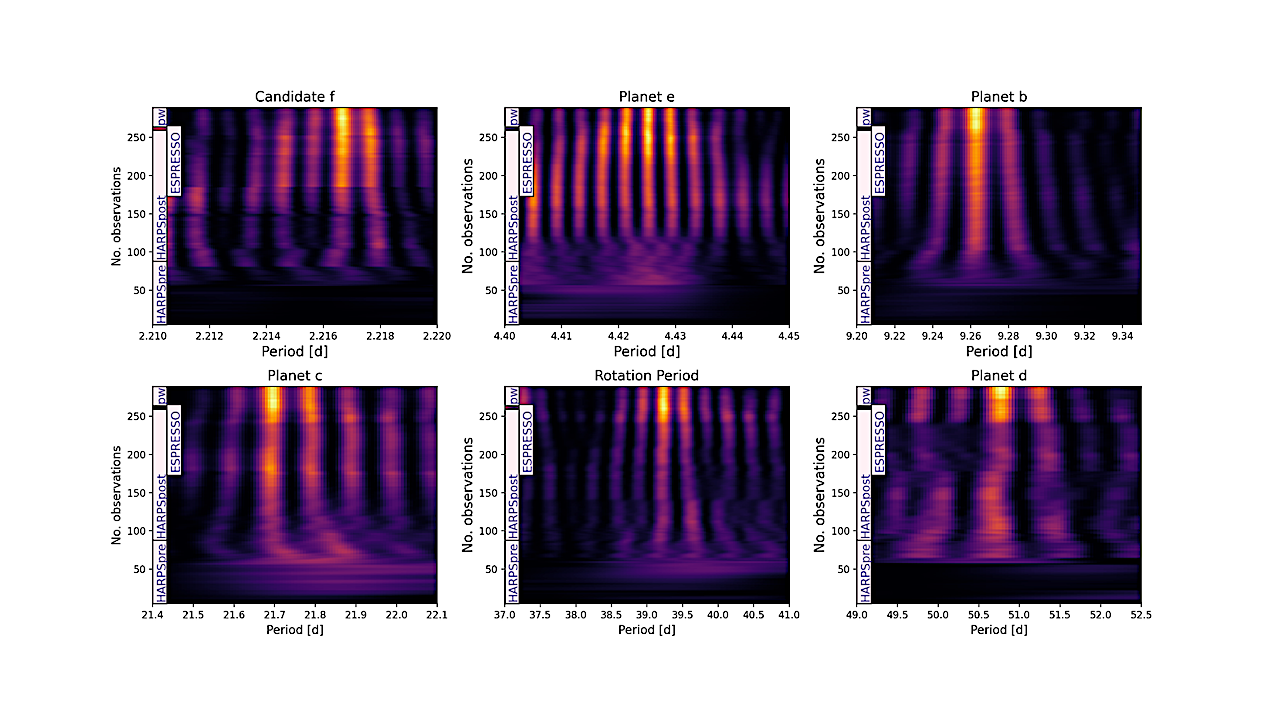
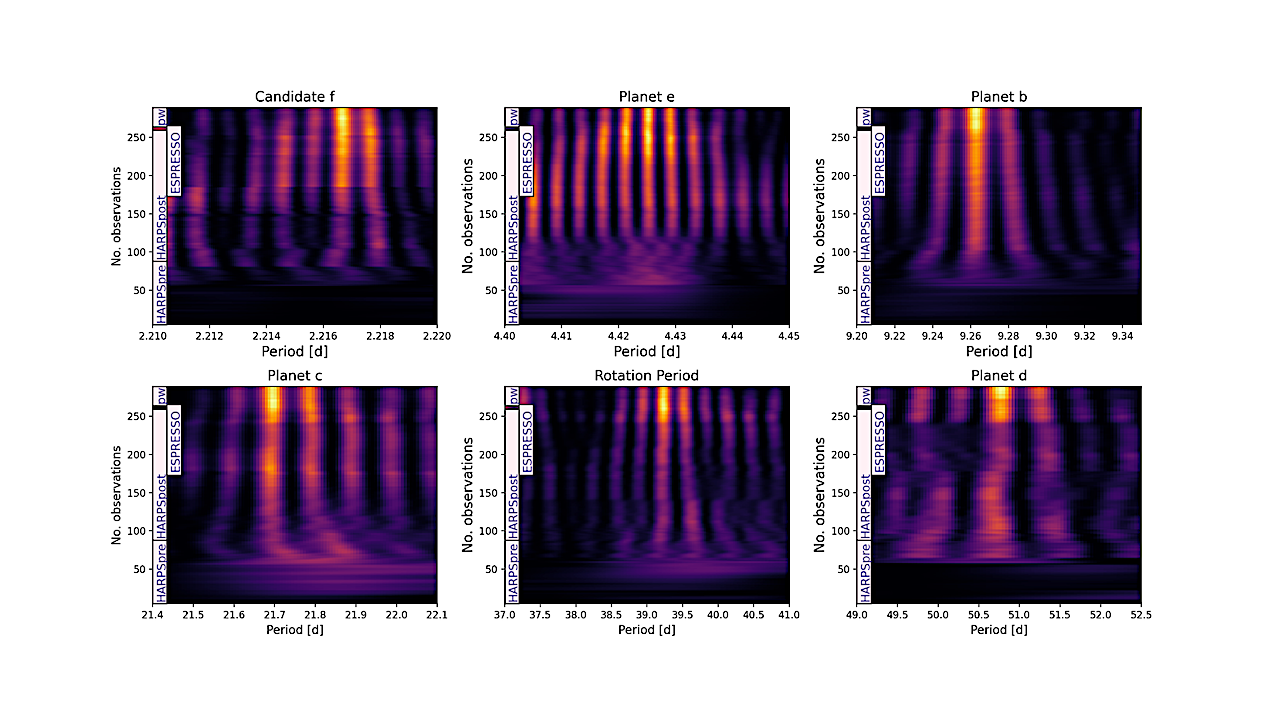
sBGLS periodograms of all planet candidates and the rotation period of the star. The apparent fringe pattern in all panels is caused by the sampling of the data in two chunks separated by approximately 13 y. — astro-ph.EP
GJ 877 is a bright M dwarf in the solar neighborhood with two currently reported nontransiting exoplanets with periods of 9 d and 21 d, along with an additional unconfirmed signal at 50 d.
We reanalyzed the system with 101 new HARPS and 12 new ESPRESSO radial velocities (RVs) secured with a cadence to confirm or refute the origin of the 50 d signal. To do so, we searched for signals related to stellar activity in photometric data and spectroscopic indicators.
We modeled the stellar activity in the RVs with Gaussian processes (GPs). With the Bayesian analysis, we confirmed a four-planet model, including the two previously known planets at periods of 9.2619±0.0005 d and 21.784±0.004 d, as well as two newly confirmed exoplanets: an Earth-mass planet, with a 4.42490±0.00014 d period and a sub-meter-per-second amplitude, and a super-Earth with a 50.77±0.05 d period located in the habitable zone (HZ).
This super-Earth is the second closest planet in the HZ, after Proxima Cen b. We found an additional signal in a 2:1 resonance with the 4.4 d planet at 2.21661±0.00010 d with an amplitude of 0.37±0.09 m/s, which could be related to an additional planet. However, other explanations of its origin are also plausible.
This signal remains a candidate, as further investigation is required to confirm its true nature. If the signal is caused by a planet, its minimum mass would be half that of Earth. We measured the stellar rotation period with the characteristic periodic timescale of the GP. We found a period of 38.7±0.5 d, which is consistent with the rotation period determined from photometry and other activity indices.
C. Hartogh, S. V. Jeffers, S. Dreizler, J. R. Barnes, C. A. Haswell, F. Liebing, A. Collier Cameron, P. Gorrini, F. Del Sordo, P. Cortés-Zuleta
Subjects: Earth and Planetary Astrophysics (astro-ph.EP)
Cite as: arXiv:2602.08929 [astro-ph.EP] (or arXiv:2602.08929v1 [astro-ph.EP] for this version)
https://doi.org/10.48550/arXiv.2602.08929
Focus to learn more
Related DOI:
https://doi.org/10.1051/0004-6361/202554984
Focus to learn more
Submission history
From: Christian Hartogh
[v1] Mon, 9 Feb 2026 17:31:17 UTC (4,499 KB)
https://arxiv.org/abs/2602.08929
Astrobiology,










Related Posts

Stay Informed With the Latest & Most Important News
Previous Post
Next Post


Advertisement
-
 01Two Black Holes Observed Circling Each Other for the First Time
 -
 02From Polymerization-Enabled Folding and Assembly to Chemical Evolution: Key Processes for Emergence of Functional Polymers in the Origin of Life
 -
 03Astronomy 101: From the Sun and Moon to Wormholes and Warp Drive, Key Theories, Discoveries, and Facts about the Universe (The Adams 101 Series)
 -
 04True Anomaly hires former York Space executive as chief operating officer
 -
 05Φsat-2 begins science phase for AI Earth images
 -
 06Hurricane forecasters are losing 3 key satellites ahead of peak storm season − a meteorologist explains why it matters
 -
 07Binary star systems are complex astronomical objects − a new AI approach could pin down their properties quickly