
Now Reading: Remember when DART struck an asteroid? New surprises!
-
01
Remember when DART struck an asteroid? New surprises!


Don’t miss this astounding 40-second video. It shows the DART spacecraft’s strike of the asteroid moon Dimorphos, in the year 2022, from the vantagepoint of a camera on the spacecraft. It was a test of our capabilities in planetary defense from asteroids that might strike us. Afterwards, we knew the strike had slightly changed the orbit of Dimorphos. Now a new study shows how the DART spacecraft also affected the orbit of the primary asteroid in this system.
- The Double Asteroid Redirection Test (DART) spacecraft crashed into Dimorphos, a moonlet of the larger asteroid Didymos, on September 26, 2022.
- The DART spacecraft impact shortened the Dimorphos-Didymos system’s solar orbit by 0.15 seconds, the first human-caused change to a body’s orbit around the sun.
- What’s more, we now know that sunlight causes asteroid Didymos to spin and fling rocks at its moonlet Dimorphos, leaving distinctive fan-shaped streaks on its surface.
A rock throwing asteroid and a changed orbital period around the sun
Remember when NASA deliberately crashed a spacecraft into a moonlet orbiting an asteroid? It happened on September 26, 2022. Planetary defense experts aimed the Double Asteroid Redirection Test (DART) spacecraft at Dimorphos, a little moon of the asteroid Didymos. It was only a test, designed to see if the moonlet’s orbit could be changed by a human-caused impact. It was … but now we’ve learned more. In early March 2026, scientists announced that the DART spacecraft also changed the orbit of the asteroid it didn’t strike.
NASA says that the DART impact on Dimorphos changed the Didymos-Dimorphos system’s 770-day orbital period around the sun by 0.15 seconds. DART is the first human-made projectile to have altered the orbit of a body orbiting the sun. Experts in planetary defense believe that skill might come in handy, if we should ever learn an asteroid is on a collision course with Earth.
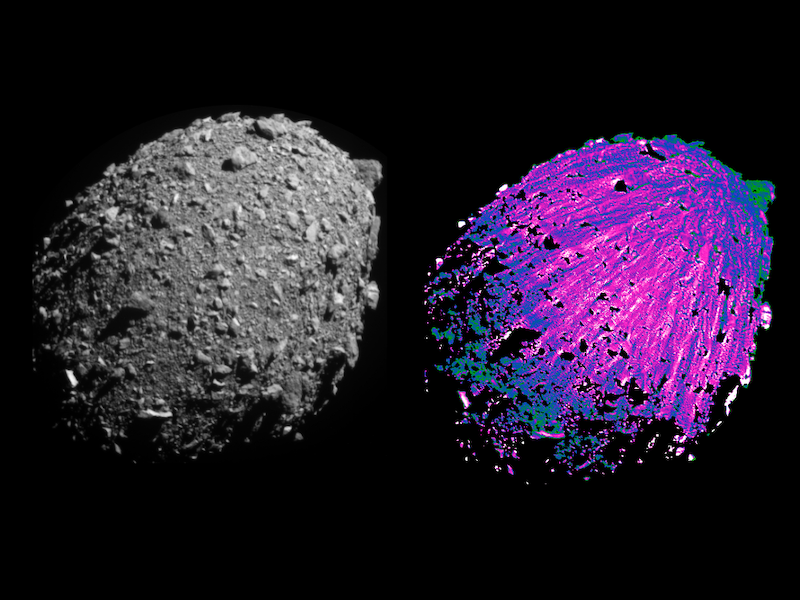
What’s more, scientists reported that Didymos has been flinging rocks at Dimorphos! Why is that happening? It’s because sunlight makes small asteroids spin fast, causing material to fly off their surfaces. When scientists analyzed images of Dimorphos from before the DART impact, they discovered fan-shaped streaks across the moonlet. Those streaks, they concluded, could only have come from Didymos’ rocks crashing into its surface.
Scientists published their report about Dimorphos’ fan-shaped streaks in the peer-reviewed Planetary Science Journal on March 6, 2026.
The study on the Didymos-Dimorphos system’s orbit around the sun was also published on March 6, 2026, in the peer-reviewed journal Science Advances.

1st study: Dimorphos pelted by rocks from Didymos
Scientists were analyzing images of Dimorphos taken before the DART impact, using sophisticated image processing techniques to remove shadows cast by boulders and other lighting effects. To their surprise, the analysis revealed fan-shaped streaks across the moonlet’s surface.
Jessica Sunshine, of the University of Maryland, is the lead author of a paper on this study. She said in a statement:
At first, we thought something was wrong with the camera, and then we thought it could’ve been something wrong with our image processing. But after we cleaned things up, we realized the patterns we were seeing were very consistent with low-velocity impacts, like throwing ‘cosmic snowballs.’ We had the first direct proof for recent material transport in a binary asteroid system.
The YORP effect
The Yarkovsky-O’Keefe-Radzievskii-Paddak effect, YORP for short, is responsible for the rock hurling. Sunlight causes small asteroids to spin fast enough to fling materials from their surface. That material can coalesce to form moonlets around the asteroids, which might explain why 15% of asteroids near Earth have been found to be binary systems. Then, over millions of years, the YORP effect changes the shape and dynamics of the binary asteroid system.
Those fan-shaped streaks on Dimorphos, the scientists say, are the first visual confirmation of the YORP effect. Moreover, models created by the team also showed how the material landed on Dimorphos. They even calculated the speed at which it left Didymos: one foot per second (30 cm per second). That’s slower than our average walking speed. Sunshine remarked:
That would explain the distinctive fan-shaped marks. Instead of even spreading, these slow-moving impacts would create a deposit rather than a crater. And they are centered on the equator as predicted from modeling material spun off the primary.
The scientists even ran laboratory experiments, dropping marbles into sand with painted gravel to represent boulders. High speed camera footage showed that the boulders blocked some of the sand, while the rest of it streaked out between them. Sunshine commented:
These new details emerging from this research are crucial to our understanding of near-Earth asteroids and how they evolve. We now know that they’re far more dynamic than previously believed, which will help us improve our models and our planetary defense measures.
2nd study: DART impact changed binary asteroid’s orbit
DART crashed into Dimorphos, the moonlet orbiting asteroid Didymos, in September 2022. Before the impact, Dimorphos orbited Didymos every 12 hours. But – soon after the impact occurred – scientists determined it had shortened the moonlet’s orbital period by 33 minutes. Now, new data show that the entire binary asteroid system’s 770-day orbit around the sun was also shortened, by 0.15 seconds.
In addition, by studying changes in Didymos’ motion before and after the impact, scientists determined that Dimorphos is less dense than they previously thought. This supports the idea that Dimorphos formed from debris cast off by the rapidly spinning Didymos.
Thomas Statler, at NASA Headquarters, did not participate in the study. But he commented, in a statement:
This is a tiny change to the orbit, but given enough time, even a tiny change can grow to a significant deflection. The team’s amazingly precise measurement again validates kinetic impact as a technique for defending Earth against asteroid hazards and shows how a binary asteroid might be deflected by impacting just one member of the pair.

DART’s crash into Dimorphos
When DART struck Dimorphos, a large cloud of rocky debris blasted away into space. That debris transferred momentum away from Dimorphos, giving it an extra kick. As a result, the force on the moonlet came not just from the impacting spacecraft, but also from debris knocked out of it.
Rahil Makadia of the University of Illinois Urbana-Champaign is the lead author of the paper on this study. He said:
The change in the binary system’s orbital speed was about 11.7 microns per second, or 1.7 inches per hour. Over time, such a small change in an asteroid’s motion can make the difference between a hazardous object hitting or missing our planet.
However, the researchers caution that an object on an earthbound trajectory needs early detection in order for humans to take action to deflect it. Scientists are planning to build a space-based telescope to survey the sky for potentially dangerous asteroids. It’s called the Near-Earth Object (NEO) Surveyor mission, due to launch sometime after September 2027.
How scientists calculated the new Didymos-Dimorphos orbit
Astronomers needed precise measurements to determine the Didymos-Dimorphos orbit around the sun. They used radar and ground-based observations to measure its changing position against the stars. Interestingly, they also used data from stellar occultations of the binary asteroid. That’s when the asteroid passes in front of a star, causing its brightness to momentarily change. Astronomers have long used this method to obtain measurements of an asteroid’s shape, speed and position.
Stellar occultations are tricky. Observers have to be at the right place at the right time, weather permitting, to capture the moment of occultation with their instruments. So the team tapped into volunteers around the globe for this job. Between October 2022 and March 2025, they collected 22 occultation observations.
Steve Chesley, of the Jet Propulsion Laboratory and a paper co-author, said:
When combined with years of existing ground-based observations, these stellar occultation observations became key in helping us calculate how DART had changed Didymos’ orbit. This work is highly weather dependent and often requires travel to remote regions with no guarantee of success. This result would not have been possible without the dedication of dozens of volunteer occultation observers around the world.
Bottom line: Two new studies of the DART asteroid mission say that Didymos is flinging rocks at Dimorphos, while the binary asteroid’s orbit around the sun has changed.
1st source: Evidence of Recent Material Transport within a Binary Asteroid System
2nd source: Direct detection of an asteroid’s heliocentric deflection: The Didymos system after DART
Read more:
When the DART mission struck an asteroid moon
NASA’s DART mission unleashed a blitz of boulders into space
When can YOU see the 1st-ever human-made meteor shower?
The post Remember when DART struck an asteroid? New surprises! first appeared on EarthSky.










Related Posts

Stay Informed With the Latest & Most Important News
Previous Post
Next Post

Advertisement
-
 01Two Black Holes Observed Circling Each Other for the First Time
 -
 02From Polymerization-Enabled Folding and Assembly to Chemical Evolution: Key Processes for Emergence of Functional Polymers in the Origin of Life
 -
 03Astronomy 101: From the Sun and Moon to Wormholes and Warp Drive, Key Theories, Discoveries, and Facts about the Universe (The Adams 101 Series)
 -
 04True Anomaly hires former York Space executive as chief operating officer
 -
 05Φsat-2 begins science phase for AI Earth images
 -
 06Hurricane forecasters are losing 3 key satellites ahead of peak storm season − a meteorologist explains why it matters
 -
 07Binary star systems are complex astronomical objects − a new AI approach could pin down their properties quickly