
Now Reading: Report identifies science objectives of human Mars exploration
-
01
Report identifies science objectives of human Mars exploration


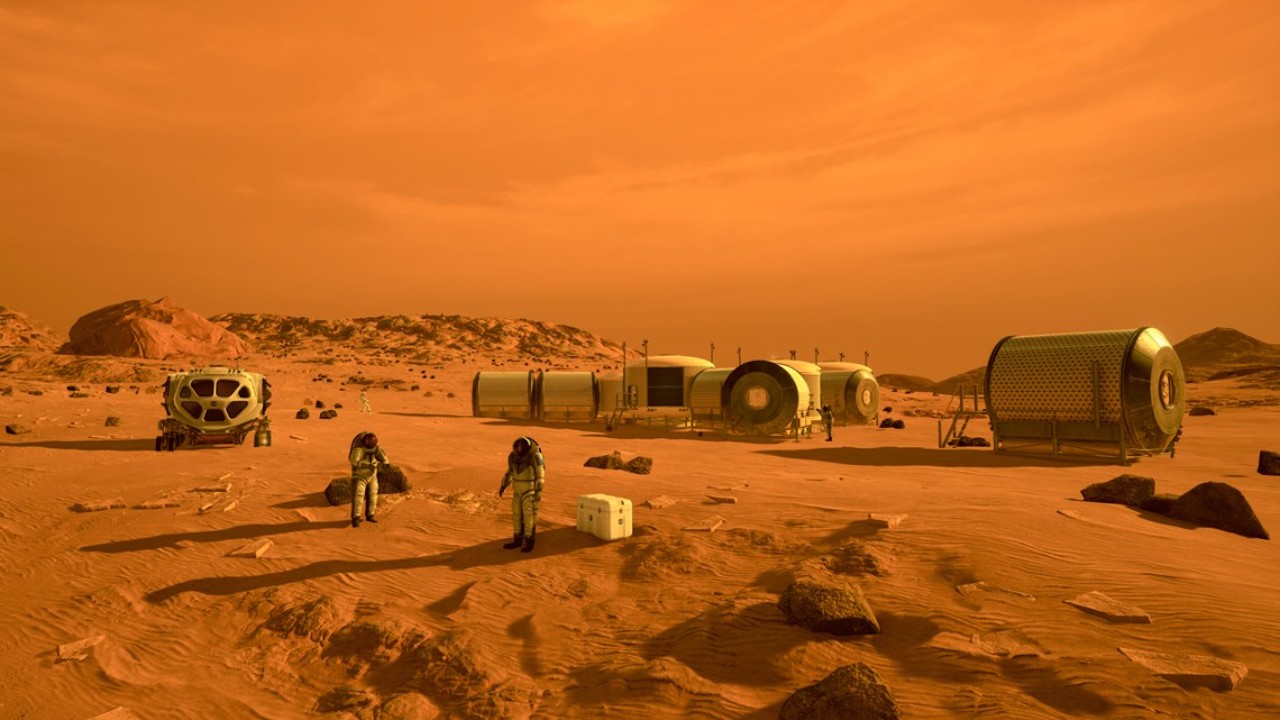

WASHINGTON — The search for past or present life should be the top science objective of future human missions to Mars, a new National Academies report concludes.
The report, A Science Strategy for the Human Exploration of Mars, identifies 11 top science objectives for human Mars missions and outlines four campaigns of missions to achieve them. NASA’s science and exploration directorates commissioned the study.
The highest-priority objective is searching for evidence of past or present life on Mars. “This is the millennia-old question: Are we alone in the universe?” said Lindy Elkins-Tanton, director of the University of California, Berkeley Space Sciences Laboratory and co-chair of the study committee, during a Dec. 9 briefing.
Other priorities range from studying Martian climate and geology to characterizing resources for future missions and assessing the effects of the Martian environment on crew health, plants and animals.
Elkins-Tanton said the committee selected the top 11 objectives from hundreds of candidates. “I don’t want you to think that the first one is an A+ and the last one is an F,” she said. “All 11 are incredibly important.”
The 11 priorities “are critically important,” added co-chair Dava Newman, an MIT professor and former NASA deputy administrator. “We can’t live without any of them.”
The objectives require human presence, Elkins-Tanton said. “The complexity of measurements and decisions that need to be made to thoroughly answer these science objectives — we don’t have a way to do them without humans being involved right now.”
The report recommends NASA study “human-agent teaming,” combining astronaut capabilities with robotics and artificial intelligence to maximize scientific output. “There’s nothing humans are going to be doing by themselves” on Mars, she said. “Everything we do is going to be done with agents.”
The report also called for an “evolution” of planetary protection requirements to allow astronauts to more effectively search for past or present life. It also recommended that any human mission be equipped with an extensive laboratory of analysis capabilities for doing research on the planet, as well as bringing back samples to Earth on every crewed mission for more extensive studies.
Four campaigns
The report outlines four notional mission campaigns to pursue the science objectives. They include both short-stay missions of about 30 Martian days, or sols (a sol is about 40 minutes longer than an Earth day), and long-stay missions of about 300 sols.
The top campaign, “Mars Science Across an Expanded Exploration Zone,” envisions missions studying terrain within about 100 kilometers of a landing site selected for scientific diversity. “We really have to do a lot of upfront work here,” Newman said. “We have to know where we’re going.”
A second campaign, “Synergy of Mars Science Measurements,” focuses on obtaining the most crucial measurements for all objectives from a single site equipped with extensive scientific infrastructure. A third campaign, “Seeking Life Beneath the Martian Icy Crust,” targets astrobiology, including drilling as deep as five kilometers into the surface.
All three use what the report calls a “30-Cargo-300” approach: an initial 30-sol crewed mission, followed by a cargo delivery mission, then a 300-sol mission.
A fourth campaign, “Investigating Mars at Three Sites,” would send three 30-sol missions to different locations. “It gives you some breadth, but maybe not depth,” Newman said.
What, not how
The report focuses on what science future missions should pursue, not how they should be carried out. It does not address technical approaches, schedules or budgets.
“In this report we’re talking about what we should do when we go to Mars, not how we should do it,” Elkins-Tanton said. “The how we should do it comes next.”
“If we relied on the how that is possible today, then our aspirations for the really best work we could do would be significantly curtailed,” she said later in the presentation. “Any answer that we would have to this question today would not be the final answer and therefore not particularly useful.”
Newman said the report does identify several “enabling technology pillars,” such as deep drilling and human-agent teaming, that should be integrated into NASA’s broader moon-to-Mars architecture.
“We think the science priorities and what we can accomplish will evolve as we learn more,” she said. “But we think this is a really good start.”










Related Posts
Stay Informed With the Latest & Most Important News


Advertisement
-
 01Two Black Holes Observed Circling Each Other for the First Time
 -
 02From Polymerization-Enabled Folding and Assembly to Chemical Evolution: Key Processes for Emergence of Functional Polymers in the Origin of Life
 -
 03Astronomy 101: From the Sun and Moon to Wormholes and Warp Drive, Key Theories, Discoveries, and Facts about the Universe (The Adams 101 Series)
 -
 04True Anomaly hires former York Space executive as chief operating officer
 -
 05Φsat-2 begins science phase for AI Earth images
 -
 06Hurricane forecasters are losing 3 key satellites ahead of peak storm season − a meteorologist explains why it matters
 -
 07Binary star systems are complex astronomical objects − a new AI approach could pin down their properties quickly