
Now Reading: Resistive MHD Simulations of Stellar Wind-Magnetosphere Coupling in TRAPPIST-1e
-
01
Resistive MHD Simulations of Stellar Wind-Magnetosphere Coupling in TRAPPIST-1e


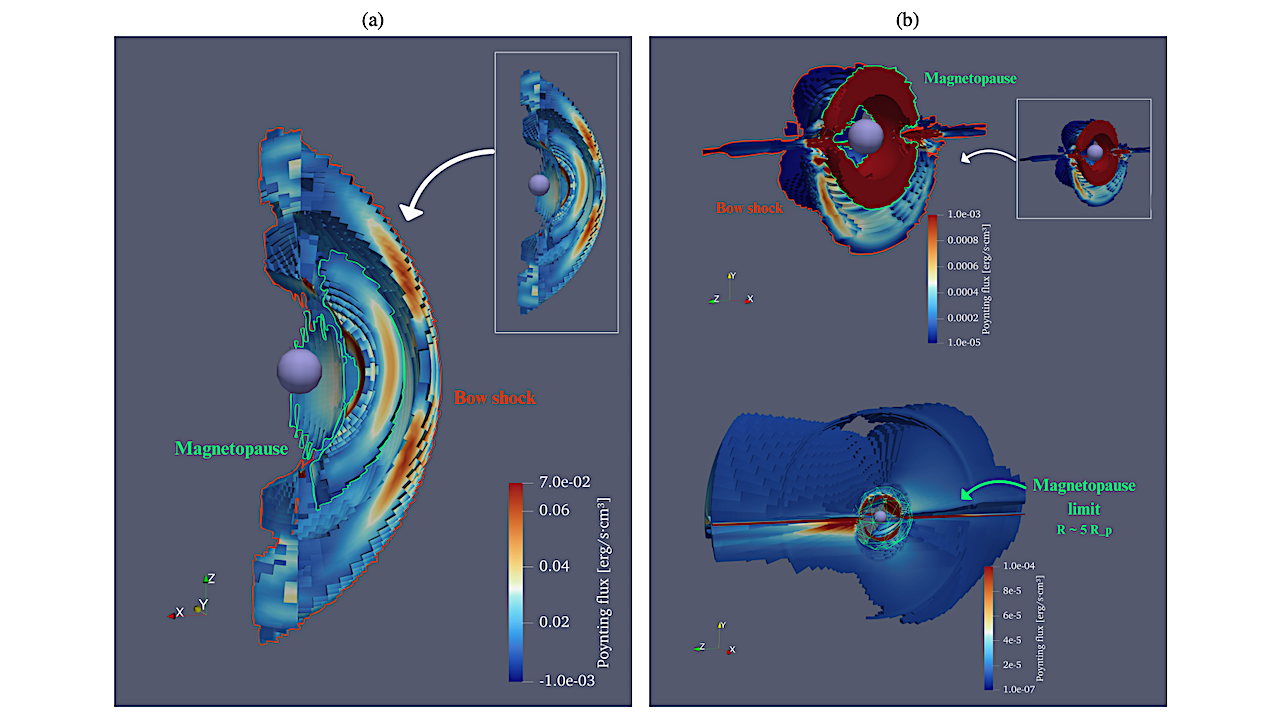
Contributions to the peak 𝑃𝑅 from the bow shock and magnetopause at 𝜂 = 5.38018 × 108cm2s−1 for Case #1 (panel a), Case #2 (top of panel b), and Case #3 (bottom of panel b). The volumetric renderings show ∇ · Stotal in erg cm−3 s−1. — astro-ph.EP
Close-in terrestrial exoplanets around M dwarfs reside in dense, magnetized winds, where non-ideal plasma coupling can strongly affect how electromagnetic energy is redistributed within the dayside interaction region.
We present three-dimensional resistive magnetohydrodynamic simulations of the TRAPPIST-1 wind interacting with a dipolar TRAPPIST-1e magnetosphere for three stellar-wind forcing cases and four prescribed magnetic diffusivities, η=(0, 538.018, 5.38018×10⁸, 5.38018×10¹²) cm2 s−1.
Energy transport is diagnosed using maps of the total energy density, the magnitude of the total Poynting flux, and the divergence of the total Poynting flux. We further estimate a radio-power proxy from the volume integral of ∇⋅Stotal over the dayside bow-shock and magnetopause layers.
Across all cases, increasing prescribed η broadens the coupling layer and shifts the dominant energy-conversion regions from thin, patchy boundary arcs to thicker, more spatially extended structures, with an increasing relative contribution from the magnetopause. The inferred radio-power proxy increases by several orders of magnitude across the explored scan.
However, because the estimated numerical magnetic diffusivity in the strongest-gradient regions is ηnum∼1015-1016 cm2 s−1, the present η scan is best interpreted as a controlled sensitivity study rather than as a direct constraint on the physical diffusivity of the TRAPPIST-1e environment.
For the adopted planetary fields (Beq=0.32-1.28 G), the maximum cyclotron frequencies are νc,max≈1.8-7.2 MHz, below the ground-based window, implying that meaningful radio constraints on TRAPPIST-1e magnetism will require space-based observations below 10 MHz or substantially stronger planetary fields than those assumed here.
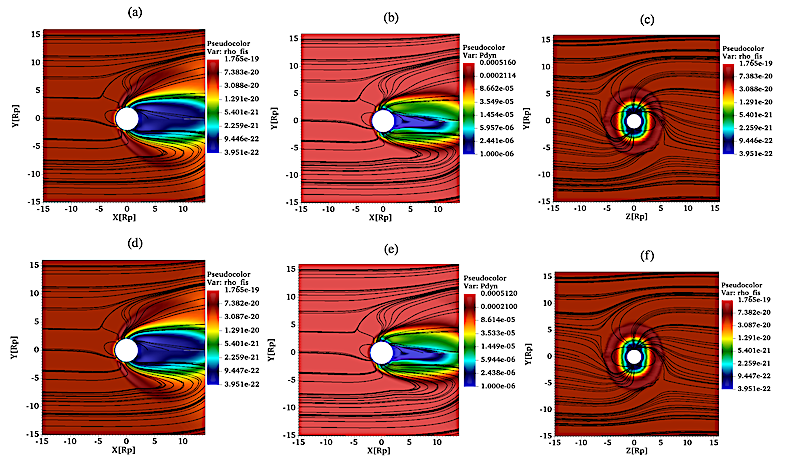
Case #2. Equatorial-plane maps of mass density 𝜌 (panels a and d; g cm−3 ) and dynamic pressure 𝑝dyn (panels b and e; dyn cm−2 ), with magnetic field lines overplotted in black. Panels c and f show meridional-plane maps of 𝜌 at 𝑥 = 1.5 𝑅p. The top row corresponds to 𝜂 = 0 cm2s −1, and the bottom row to 𝜂 = 5.38018 × 1012cm2 s−1 .
J.J. González-Avilés, N. Baltazar Pérez-Negrón, A. Segura
Comments: 10 pages, 6 figures, accepted for publication in Monthly Notices of the Royal Astronomical Society
Subjects: Earth and Planetary Astrophysics (astro-ph.EP); Solar and Stellar Astrophysics (astro-ph.SR)
Cite as: arXiv:2604.00191 [astro-ph.EP] (or arXiv:2604.00191v1 [astro-ph.EP] for this version)
https://doi.org/10.48550/arXiv.2604.00191
Focus to learn more
Submission history
From: J.J. González-Avilés
[v1] Tue, 31 Mar 2026 19:47:22 UTC (5,788 KB)
https://arxiv.org/abs/2604.00191
Astrobiology, Exoplanet, Space Weather,










Related Posts
Stay Informed With the Latest & Most Important News





Advertisement
-
 01Two Black Holes Observed Circling Each Other for the First Time
 -
 02From Polymerization-Enabled Folding and Assembly to Chemical Evolution: Key Processes for Emergence of Functional Polymers in the Origin of Life
 -
 03Astronomy 101: From the Sun and Moon to Wormholes and Warp Drive, Key Theories, Discoveries, and Facts about the Universe (The Adams 101 Series)
 -
 04True Anomaly hires former York Space executive as chief operating officer
 -
 05Φsat-2 begins science phase for AI Earth images
 -
 06Hurricane forecasters are losing 3 key satellites ahead of peak storm season − a meteorologist explains why it matters
 -
 07Binary star systems are complex astronomical objects − a new AI approach could pin down their properties quickly