
Now Reading: Revealed: 10 new insights in climate science
-
01
Revealed: 10 new insights in climate science



18/02/2026
706 views
19 likes
Each year, the world’s leading climate scientists evaluate the most critical evidence on how our planet is changing. Their assessments draw heavily on data from Earth-observing satellites – and the latest report delivers a stark warning: the planet’s energy balance is drifting further out of alignment, ocean warming is now accelerating, and the land’s capacity to absorb carbon is declining, along with other troubling trends.
Global climate indicators show growing cause for alarm. The World Meteorological Organization confirmed that 2024 was the warmest year on record. This warming coincided with record ocean temperatures and sea-level rise, rapid glacier loss, low Antarctic sea ice, and more frequent extreme weather.
Against this backdrop of intensifying change, scientists are racing not only to document what is happening, but to understand the implications and communicate them to decision-makers.
Each year, Future Earth, the Earth League and the World Climate Research Programme bring together leading researchers from around the world to assess the most urgent advances in climate research. Their mission is to curate and synthesise key messages across diverse fields of climate-change research, based on the latest relevant peer-reviewed literature to produce 10 New Insights in Climate Science.
The 2025 edition, released as both an academic paper and a science–policy report, draws on research published between January 2024 and June 2025.
This new easy-to-read guide reflects the collective effort of more than 70 researchers, incorporating input from over 150 experts worldwide – distilling the latest findings into clear, policy-relevant insights designed to support the timely uptake of new scientific evidence in decision-making through 2026 and beyond.
Sophie Hebden, ESA Climate Applications Scientist, said, “These findings are based on robust empirical data published in leading scientific journals, including data generated through ESA’s Climate Change Initiative – a major research and development programme that produces long-term global satellite data records to monitor key components of Earth’s climate system, known as Essential Climate Variables.
“Through the initiative, we transform satellite observations into high-quality data products to assess the state of the climate and know where we currently stand, to validate and improve climate models so we know where we’re heading, and to support ESA Member States with transparent information to help track progress in climate action and Paris Agreement reporting.
“Satellite datasets are a major source of information for climate scientists from around the world, with authoritative scientific assessments published periodically by the UNFCCC Intergovernmental Panel on Climate Change, and annually in the 10 New Insights in Climate Science report.”
In brief, the new insights are as follows:
1. Record-breaking warmth in 2023–2024 raises new questions
Although the shift to El Niño conditions amplified recent temperature extremes, natural variability alone cannot explain the scale of the anomalies. A sharp rise in Earth’s energy imbalance suggests that global warming may be accelerating.
In this context, the MOTECUSOMA project from ESA’s Climate Change Initiative quantifies changes to Earth’s energy imbalance using Essential Climate Variables to examine changes in climate system processes in response to rising greenhouse gas emissions.
2. Rapid ocean warming and intensifying marine heatwaves
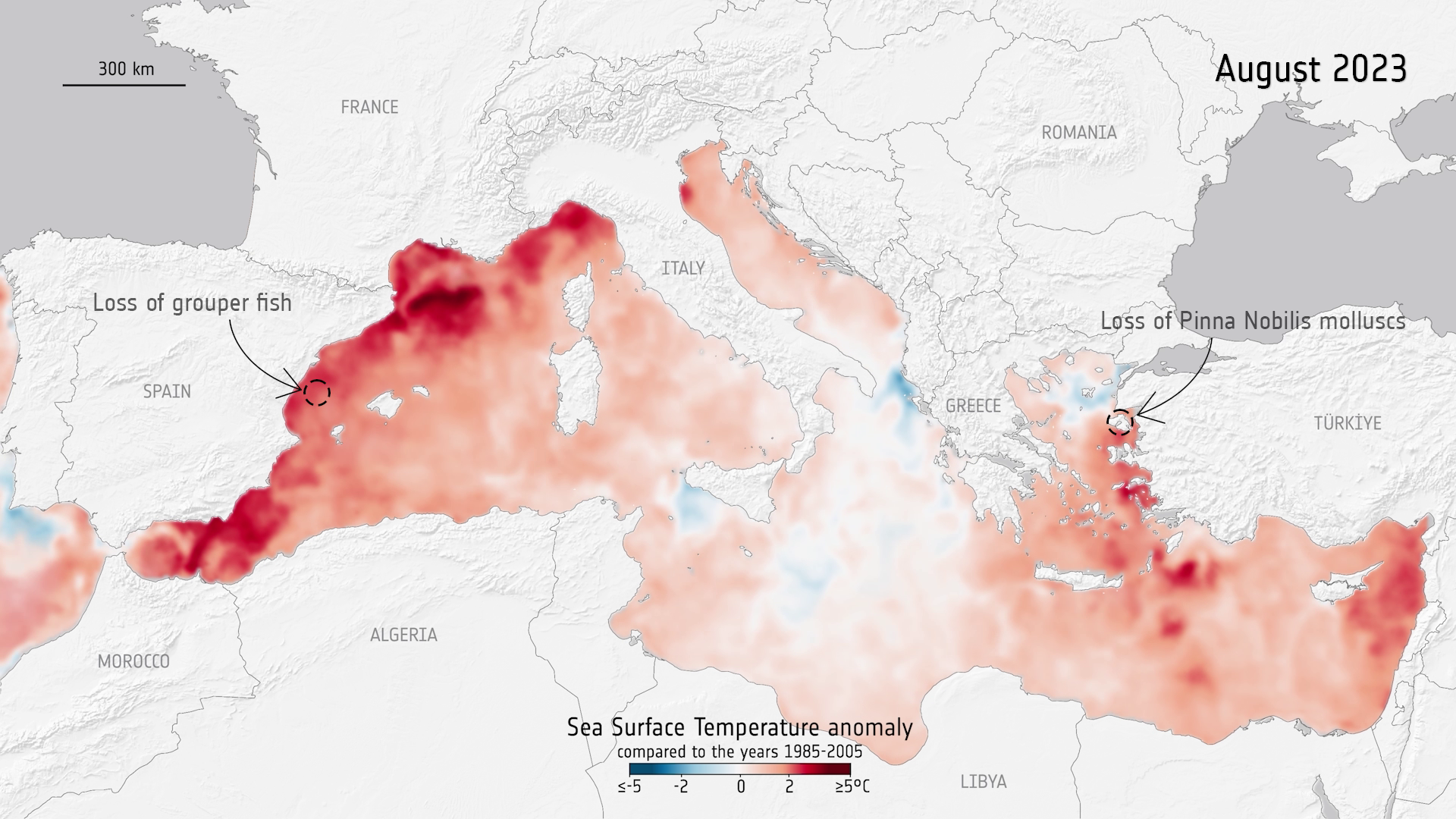
Sea-surface temperatures are rising at an unprecedented rate, and marine heatwaves are becoming more intense and prolonged. These changes are causing severe ecosystem damage, undermining coastal livelihoods, increasing extreme weather risks and weakening the ocean’s capacity to absorb carbon.
This insight is supported by data available through the Climate Change Initiative’s Sea Surface Temperature project.
The image below shows data over the last 40 years, highlighting when and where the most recent maximum sea-surface temperature was recorded. Marine heatwaves have been widespread but have hit the Atlantic, Indian and West Pacific oceans particularly hard in the last few years. The insight also summarised regional oceanic impacts, such as Mediterranean species loss in the record-breaking hot year of 2023.
3. The global land carbon sink is weakening
A significant decline in land-based carbon uptake in 2023 raises concerns that more carbon may remain in the atmosphere, shrinking the remaining carbon budget. Northern hemisphere ecosystems – once considered relatively resilient – are increasingly affected by wildfires and permafrost thaw.
This insight is largely based on datasets available through the Climate Change Initiative’s RECCAP-2 project which clarifies global carbon sources and sinks.
The image below shows carbon storage change in northern ecosystems relative to 2010, with a drop in biomass from 2016 onwards. This could signal more carbon release from vegetation to the atmosphere.
4. Climate change and biodiversity loss amplify one another
Growing evidence shows that climate change and biodiversity decline interact in a destabilising feedback loop, threatening ecosystem resilience and carbon storage. Stronger coordination across the Rio Conventions could maximise synergies, avoid fragmented policies, and prioritise the protection and restoration of biodiverse ecosystems and natural carbon sinks.
Satellite observations make substantial contributions in this area by tracking ecosystem types, extent, and dynamics through various initiatives such as ESA WEED, as well as ecosystem functioning under climate change such as ESA FORTRACK and ECOMOSAIC. The effective use of these capabilities depends on their integration with diverse complementary data sources.
5. Climate change is intensifying groundwater depletion
Groundwater is being depleted faster than in previous decades, as climate change disrupts aquifer recharge and rising socioeconomic demands increase extraction. The consequences include heightened risks to agriculture and food security, land subsidence and seawater intrusion in coastal regions.
This insight is largely based on data from the US-German GRACE mission, with more regional supporting studies using Copernicus Sentinel-1 to obtain high-resolution subsidence information.
6. Climate change is driving the global surge in dengue
Dengue fever has surged to its largest global outbreak on record. Rising temperatures are expanding mosquito habitats and extending transmission seasons, compounding the effects of urbanisation, global travel and poor waste management. Health systems are already under strain, and projections indicate further increases in risk this century.
The sixth phase of the Coupled Model Intercomparison Project (whose international project office is hosted by ESA) supports work to understand the climate-related risk factors of vector-borne diseases, and predict future outbreak likelihoods.
7. Heat stress is reducing labour productivity and incomes
Climate-driven heat stress is eroding labour productivity and income, particularly in developing countries. However, the economic impacts ripple through global supply chains and trade networks. Projected annual gross domestic product losses are substantially lower under low-emissions pathways, underscoring the economic case for more ambitious mitigation.
8. Carbon dioxide removal must scale up safely and responsibly
Carbon dioxide removal will be needed to address residual emissions and manage climate risks. However, it must complement, not replace, emission reductions. Clear international governance frameworks, sustained research and innovation, and strong environmental and social safeguards are essential to close the growing carbon dioxide removal gap and support long-term climate stability.
9. Strengthening integrity in carbon credit markets
The rapid expansion of carbon credit markets has exposed serious integrity concerns, including overestimated sequestration and weak additionality. Reliance on low-quality credits risks delaying real decarbonisation. Emerging improvements in standards, transparency and benchmarking, along with a shift toward framing credits as contributions rather than offsets, offer a pathway to more credible markets.
10. Policy packages outperform single measures
Integrated policy mixes consistently achieve greater emissions reductions than stand-alone interventions. Approaches that combine measures such as carbon pricing and fossil fuel subsidy reform tend to be particularly effective, though policy design must reflect national contexts. Coordinated cross-sector strategies and harmonised reporting can further enhance impact and shared learning.










Related Posts



Stay Informed With the Latest & Most Important News
Previous Post
Next Post



Advertisement
-
 01Two Black Holes Observed Circling Each Other for the First Time
 -
 02From Polymerization-Enabled Folding and Assembly to Chemical Evolution: Key Processes for Emergence of Functional Polymers in the Origin of Life
 -
 03Astronomy 101: From the Sun and Moon to Wormholes and Warp Drive, Key Theories, Discoveries, and Facts about the Universe (The Adams 101 Series)
 -
 04True Anomaly hires former York Space executive as chief operating officer
 -
 05Φsat-2 begins science phase for AI Earth images
 -
 06Hurricane forecasters are losing 3 key satellites ahead of peak storm season − a meteorologist explains why it matters
 -
 07Binary star systems are complex astronomical objects − a new AI approach could pin down their properties quickly