
Now Reading: RFA plans first launch this summer
-
01
RFA plans first launch this summer


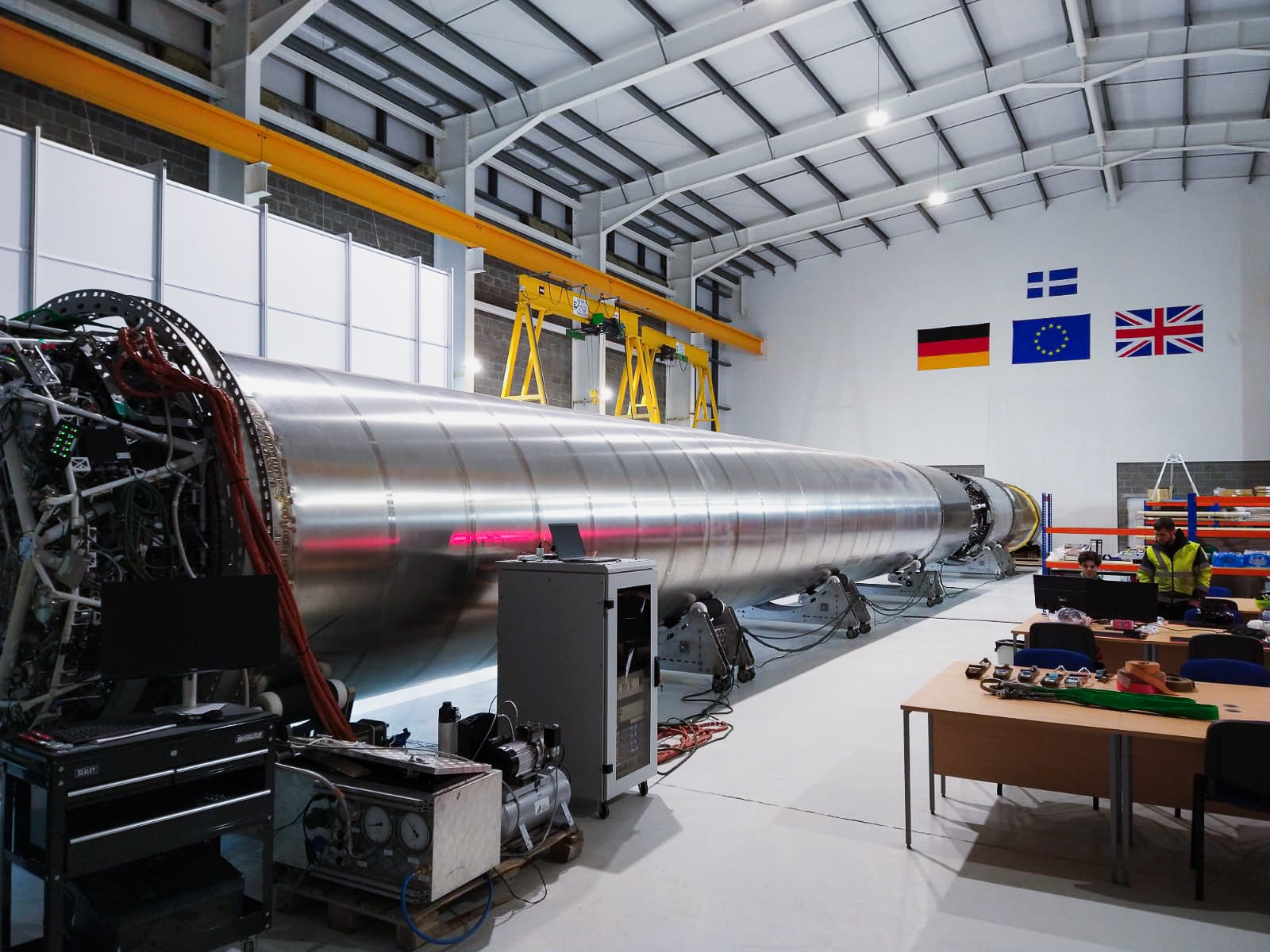

WASHINGTON — German launch startup Rocket Factory Augsburg (RFA) says it is planning its first launch for this summer after delivering two of its stages to the launch site.
RFA announced March 6 that the first and second stages of its RFA ONE rocket had arrived at SaxaVord Spaceport in Scotland, ahead of a launch planned for some time this summer.
The first stage was shipped to the spaceport directly from the company’s factory in Augsburg, Germany, while the second stage came from a test site in Esrange, Sweden, where the company performed a hot-fire test of its single engine.
While the first stage is now at SaxaVord, its nine Helix engines are not. RFA said those engines are still undergoing final acceptance testing in Sweden and will be shipped to SaxaVord once that testing is complete.
The company said integration and “further testing” of the vehicle is planned at SaxaVord before the launch, but did not elaborate. That will likely include hot-fire tests of the first stage on the launch pad once its engines are installed.
It was during similar tests in August 2024 that another RFA ONE first stage, intended for a launch then weeks away, was destroyed in a fire. The company said days after the incident that one engine suffered a “very unusual” anomaly that caused a fire to break out, spreading to others.
“Following the incident in 2024, we thoroughly reviewed, analyzed and tested everything and improved the systems to achieve even greater reliability,” Stefan Brieschenk, chief development officer at RFA, said in a statement. “The arrival of our first and second stages at the SaxaVord spaceport is proof of our team’s commitment and expertise.”
RFA is one of several startups in Europe developing small launch vehicles seeking to reach orbit in the next year. Isar Aerospace attempted the first orbital launch of its Spectrum rocket last March, but the rocket malfunctioned and crashed near its launch pad in Andøya, Norway, shortly after liftoff. The company is planning a second launch as soon as March 19.
PLD Space, which announced March 4 it raised 180 million euros ($209 million), is working on its Miura 5 small launch vehicle, which is slated for a first launch before the end of the year from French Guiana. French company MaiaSpace is also developing a small launch vehicle now expected to make its first launch from French Guiana in early 2027.
All four companies won funding from European Space Agency member states at the agency’s ministerial conference in November as part of the European Launcher Challenge. RFA received 190.5 million euros, primarily from Germany. A fifth company, Orbex, was also part of the European Launcher Challenge, but the company filed for bankruptcy in the United Kingdom in February.










Related Posts


Stay Informed With the Latest & Most Important News
Previous Post
Next Post


Advertisement
-
 01Two Black Holes Observed Circling Each Other for the First Time
 -
 02From Polymerization-Enabled Folding and Assembly to Chemical Evolution: Key Processes for Emergence of Functional Polymers in the Origin of Life
 -
 03Astronomy 101: From the Sun and Moon to Wormholes and Warp Drive, Key Theories, Discoveries, and Facts about the Universe (The Adams 101 Series)
 -
 04True Anomaly hires former York Space executive as chief operating officer
 -
 05Φsat-2 begins science phase for AI Earth images
 -
 06Hurricane forecasters are losing 3 key satellites ahead of peak storm season − a meteorologist explains why it matters
 -
 07Binary star systems are complex astronomical objects − a new AI approach could pin down their properties quickly