
Now Reading: Sandblasting on Mars
-
01
Sandblasting on Mars



07/01/2026
566 views
21 likes
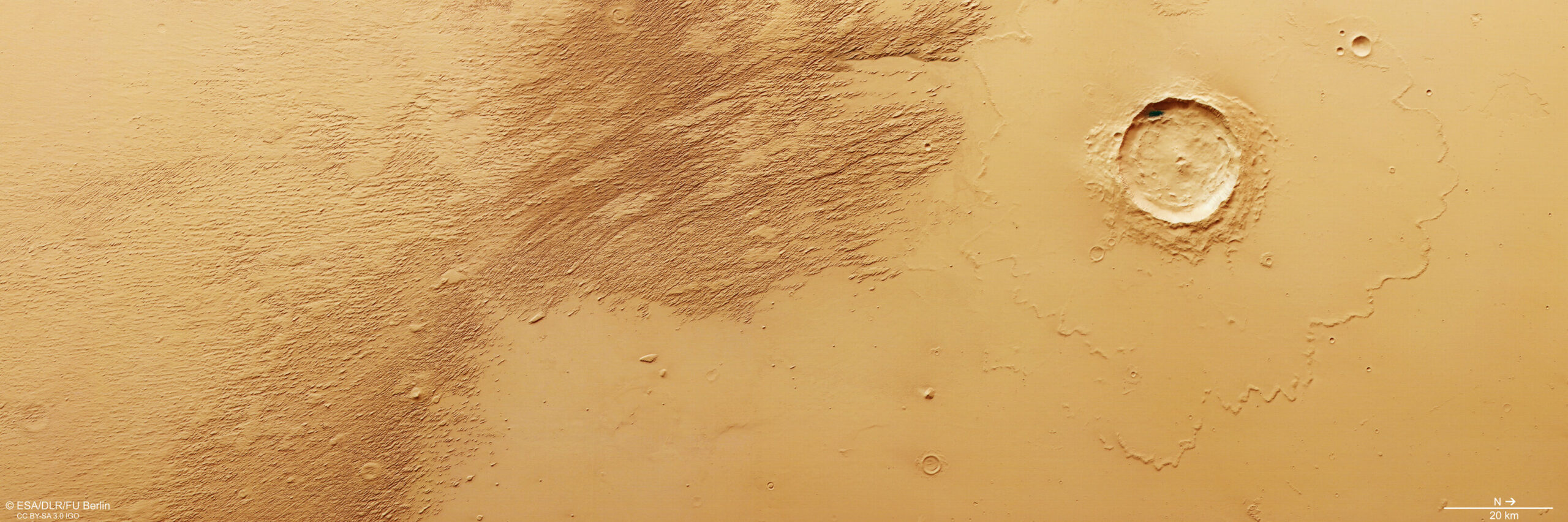
Martian winds can have quite an impact. ESA’s Mars Express has spotted them whipping up sand grains and acting as a cosmic sandblaster, carving out intriguing grooves near Mars’s equator.
The ridges, mounds, or columns left standing when the surrounding ground is eroded away are technically known as yardangs, and are common on Mars. They’re evidence of powerful martian winds acting as a cosmic sandblaster, pulling sand grains into the air and sculpting grooves in the surface that extend across tens of kilometres.
These strongly erosive, sand-laden winds dig into soft layers of sedimentary rock, finding existing cracks and wearing away the material there. Distinctive, elongated ridges or mounds remain standing as the surrounding ground is blasted away, forming an impressive landscape (seen clearly in the associated bird’s-eye view below).
In the main image, which covers a patch of ground almost the size of Belgium, the yardangs all slant in the same direction due to the prevailing wind, curving in from the bottom left (south-east). They sit at the northern end of the Eumenides Dorsum mountains, which have been seen before by Mars Express; these mountains extend far out of frame to the west (top) of an especially volcanic region known as Tharsis, and form part of the huge, immensely dusty Medusae Fossae Formation (another familiar feature).
Where features meet
This image also captures two other fascinating forces of nature we see on the Red Planet, with all three coming together to meet just left (south) of the large crater to the right.
First is the crater itself, which looks reasonably fresh and is surrounded by a large, wavy-edged blanket of material (‘ejecta’) that was thrown out during the impact that created it.
Second is a more subtle feature, visible only upon closer inspection (and marked in the annotated view): just below and beside the main bulk of yardangs lies so-called ‘platy flow’, which is somewhat reminiscent of floating ice sheets – or floes – seen here on Earth. As ancient lava moved across the terrain here, its surface crusted over. Lava continued to flow below, tugging at the solid surface, breaking it into chunks, and moving these about as solidified ‘rafts’ or ‘plates’ of lava.
As well as bordering it, the yardangs are thought to have formed atop this platy flow, indicating that they likely formed more recently.
Decades of Mars exploration
This image was captured by Mars Express’s High Resolution Stereo Camera, one of eight state-of-the-art instruments aboard the Mars orbiter.
Mars Express has been capturing and exploring Mars’s many landscapes since it launched in 2003. The orbiter has mapped the planet’s surface at unprecedented resolution, in colour, and in three dimensions for over two decades now, returning insights that have drastically changed our understanding of our planetary neighbour (read more about Mars Express and its findings here).
The Mars Express High Resolution Stereo Camera (HRSC) was developed and is operated by the German Aerospace Center (Deutsches Zentrum für Luft- und Raumfahrt; DLR). The systematic processing of the camera data took place at the DLR Institute of Space Research in Berlin-Adlershof. The working group of Planetary Science and Remote Sensing at Freie Universität Berlin used the data to create the image products shown here.










Related Posts


Stay Informed With the Latest & Most Important News
Previous Post
Next Post





Advertisement
-
 01Two Black Holes Observed Circling Each Other for the First Time
 -
 02From Polymerization-Enabled Folding and Assembly to Chemical Evolution: Key Processes for Emergence of Functional Polymers in the Origin of Life
 -
 03Astronomy 101: From the Sun and Moon to Wormholes and Warp Drive, Key Theories, Discoveries, and Facts about the Universe (The Adams 101 Series)
 -
 04True Anomaly hires former York Space executive as chief operating officer
 -
 05Φsat-2 begins science phase for AI Earth images
 -
 06Hurricane forecasters are losing 3 key satellites ahead of peak storm season − a meteorologist explains why it matters
 -
 07Binary star systems are complex astronomical objects − a new AI approach could pin down their properties quickly