
Now Reading: ‘Saros’ nails the cosmic horror and bullet-hell action assignments, but it falls short as a roguelite
-
01
‘Saros’ nails the cosmic horror and bullet-hell action assignments, but it falls short as a roguelite

‘Saros’ nails the cosmic horror and bullet-hell action assignments, but it falls short as a roguelite

Saros might be PlayStation’s first blockbuster of 2026, but it also feels like a direct answer to the more padded adventures currently flooding the gaming space. It’s fast and brutal, but players aren’t expected to be stuck on Carcosa for too long. It’s a more refined and accessible roguelite third-person shooter… but also one with less bite.
Developer Housemarque is no stranger to choosing an arcade-y rhythm and less typical structure over cinematic or sandbox approaches, and Saros could be a sequel to 2021’s Returnal, if it weren’t for the completely different setting. There’s a human protagonist stuck on a seemingly doomed, faraway world trying to break a time loop. There are lots of sci-fi guns to play with. There’s a huge mystery at the center of the adventure… the list goes on.

A big “problem” with Returnal was that a shockingly low number of players finished it even years after its release. Roguelite games are traditionally hard, but Returnal took things a bit further, as you didn’t get many permanent upgrades the more you played.
Each run was also remarkably long, even with the added shortcuts. Some of Returnal’s post-launch updates – such as the addition of co-op – softened the ruthless odyssey a bit, but it was a truly demanding roguelite that didn’t get easier the more you failed.
Come back stronger
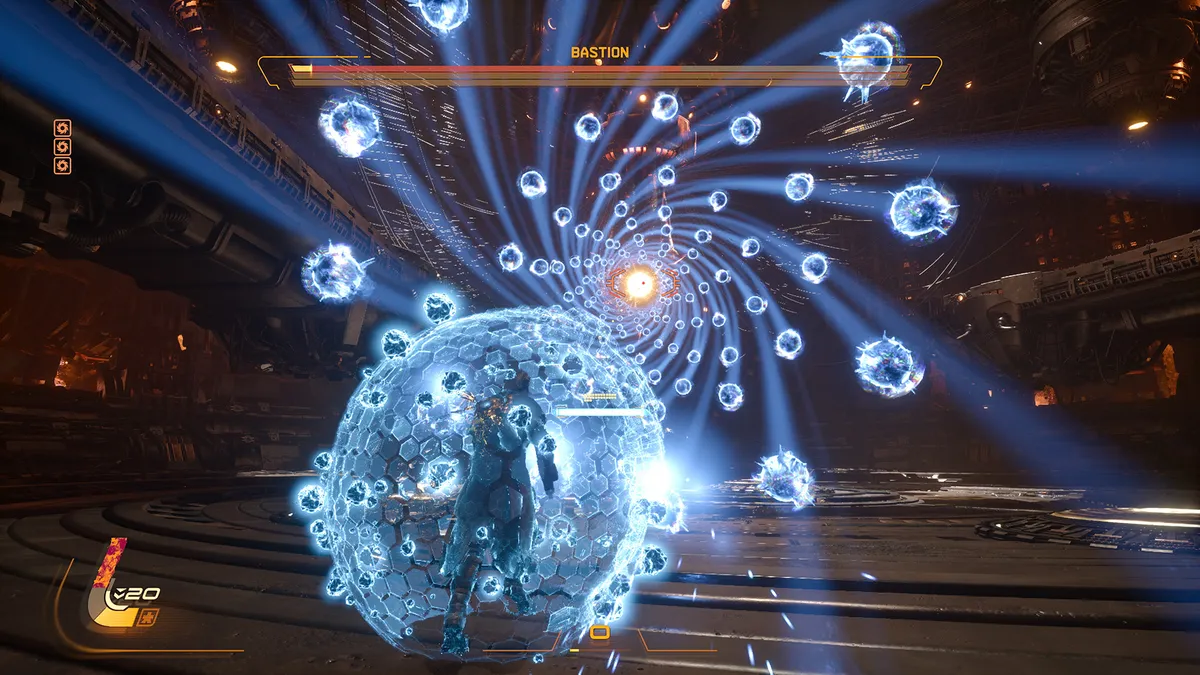
Saros takes a sledgehammer to that approach almost from the get-go. After all, “come back stronger” is the game’s tagline. It’s Housemarque directly telling players this one is safer to approach. This isn’t necessarily a bad thing; the biggest modern roguelites – like Supergiant’s Hades – are filled to the brim with meta progression. I don’t think it harms Saros too much that it can be played like a more conventional shooter if you want a cohesive story with spicy gameplay… but don’t have the time or patience to bang your head against a boss for days or weeks.
On Carcosa, a planet often bathed in the light of ominous eclipses, the Soltari megacorp (you can’t have a proper sci-fi horror story without one of those) is looking for the Lucenite resource. Its potential applications are never entirely clear, but Soltari just consumes all it touches. “This is ours now, we’ll figure out what it does later.”
In the actual game, the Lucenite allows main character Arjun Devraj — a gruff and determined Soltari enforcer played by Midnight Mass’ Rahul Kohli — to become stronger through suit upgrades at Echelon IV’s (the last of four groups sent to the planet) base of operations.
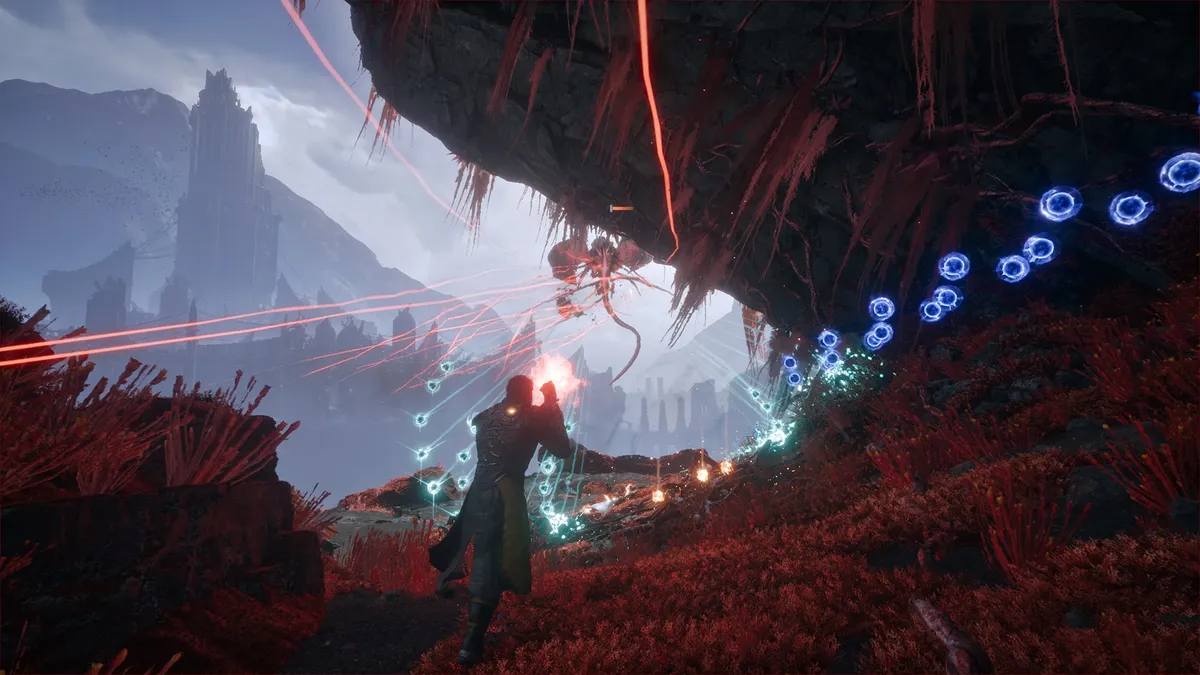
The upgrades are applied with a typical skill tree that boosts Arjun’s stats and (rarely) adds new abilities like having a “second chance” after falling in combat the first time. This is all fine, and in line with other roguelites’ school of design. Push past the second area boss, though, and you’ll also get an extra layer of help with boosts that can heavily reshape the overall experience.
From massive damage upgrades to complete health regeneration before bosses, these buffs give you a sizeable advantage in exchange for some minor negatives, like losing more Lucenite when dying or accumulating more corruption, which lowers your max health when hit by certain enemy attacks.
This is the sort of “modifiers package” that’s usually delivered after you beat the game, the way it was intended to be played, once. Here, it’s a weirdly timed crutch that makes everything after the first two biomes easier, which is an odd choice that dilutes much of what the game is going for and even the story structure. While not engaging with it is an option, the game doesn’t tell players it’s basically a misplaced difficulty options menu.
A tale of two games
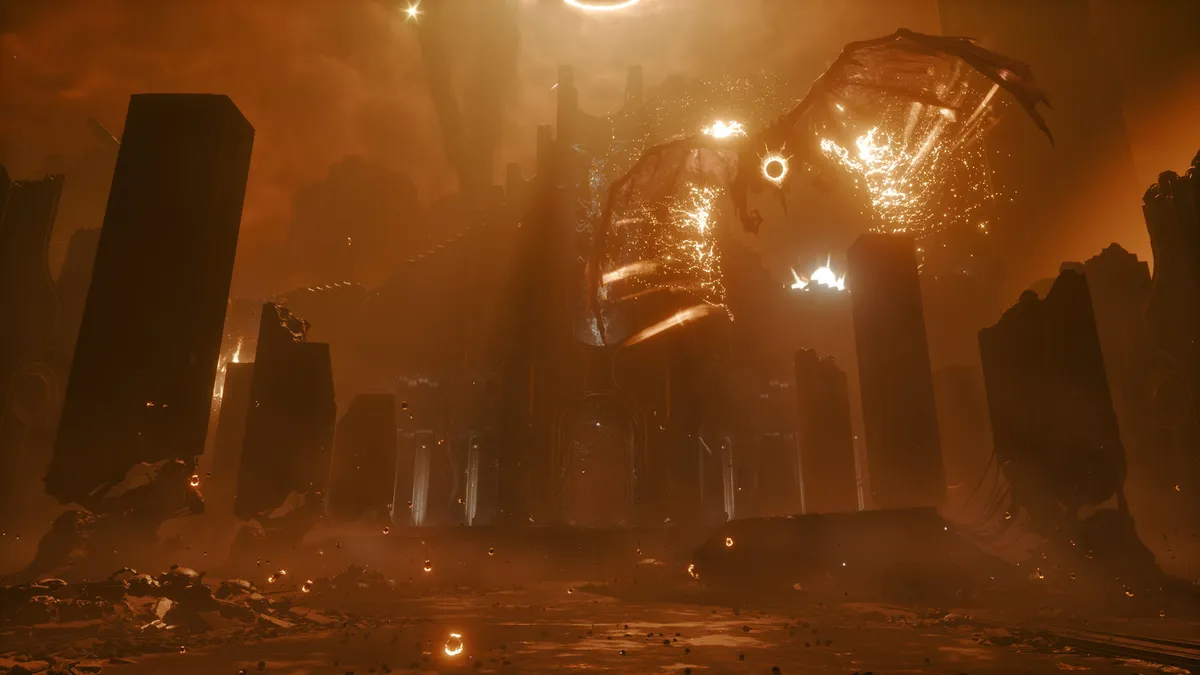
Okay, but let’s assume Saros is ideally meant to be beaten in just a handful of seamless runs, landing closer to a traditional third-person shooter than a grueling roguelite. The progression systems in place would support such a vision.
Sadly, the game’s plot — an otherwise intriguing cosmic horror tale with psychological thriller elements — gets in the way of the roguelite format that, difficulty complaints aside, worked great in Returnal. By attempting to marry up the classical storytelling of other PlayStation blockbusters with Housemarque’s in-house style of retro-ish, direct fun, Saros often ends up as lost as the Echelon IV crew.
Until you hit the credits, Saros is basically broken up into little pieces tied to the story progression. Even if you feel like you’re performing well enough and want to push onwards, you’ll be forced to return to The Passage (the base of operations) to sit and watch cutscenes that generally aren’t near the level of quality expected from first-party PlayStation studios (pre-rendered ones excluded).
Kohli proves to be a great lead who can show both restrained emotion and raw anger as required, but Saros’s greatest allure is Carcosa’s sun-bathed, hellish environments and the carnage that brings them alive with a dance of lasers, plasma beams, and whatnot.
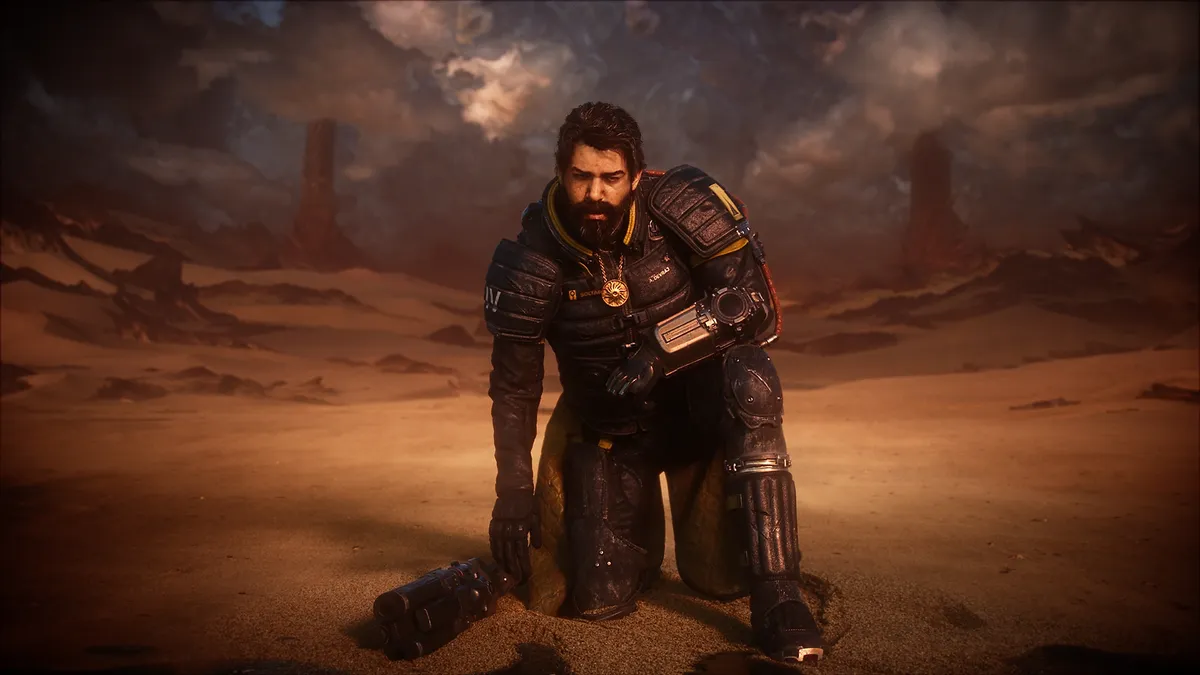
While hitting Act 3 — essentially the game’s epilogue — allows players to do longer runs with the credits rolled, the ultimate final boss requires a return to base since they’re in a different area, effectively ending the regular runs and resetting the temporal progression (artifacts, better weapons, etcetera) found during them.
It’s yet another odd choice that underlines how the game is at odds with itself, at least structurally. Updates could add more to the experience and provide alternatives, but as it stands, Saros fails to find its footing as a highly replayable, run-based adventure. Shockingly, even the level chunks and weapon selection are poorer and way more predictable than in Returnal; variance is minimal, and it’s not long before you recognize map patterns every couple of bite-sized runs or so.
Still, most of these negatives don’t matter much when you’re in the heat of the action, dashing through walls of colorful energy orbs, blocking and parrying more dangerous attacks, and unleashing hell on twisted, almost demonic monstrosities that answer to a King in Yellow (Ambrose Bierce and Robert W. Chambers are required reading here) who may or may not behind the reality-bending catastrophe afflicting Carcosa.
The kings of sci-fi action return(al)
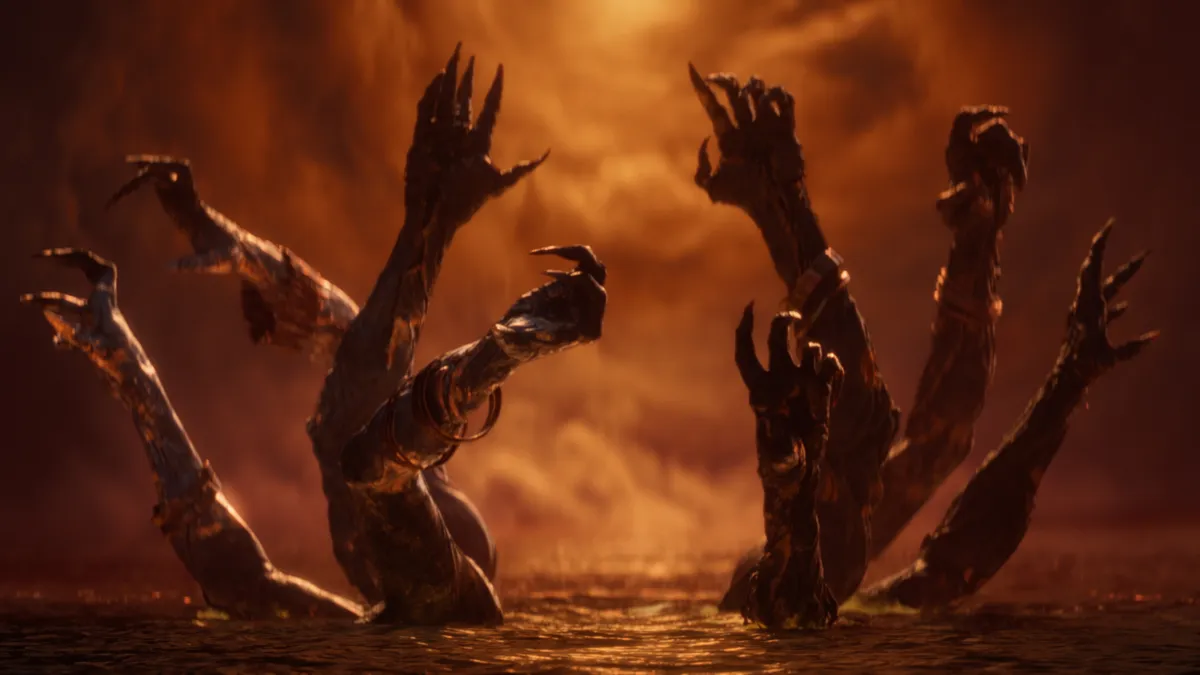
I’m sure there won’t be a big-budget action game this year that plays as well as Saros. That’s the one part where Housemarque fully delivered a straight upgrade over its past games.
Of course, Saros is also yet another stunning showcase of the PS5’s more unique features. The worn-down majesty of the environments is stunning, and it never feels cluttered or obscures the action. Likewise, the bullet hell action is pure chaos, but somehow also incredibly readable; it reminds me of Doom: The Dark Ages‘ more frenetic battles, but taken up to eleven.
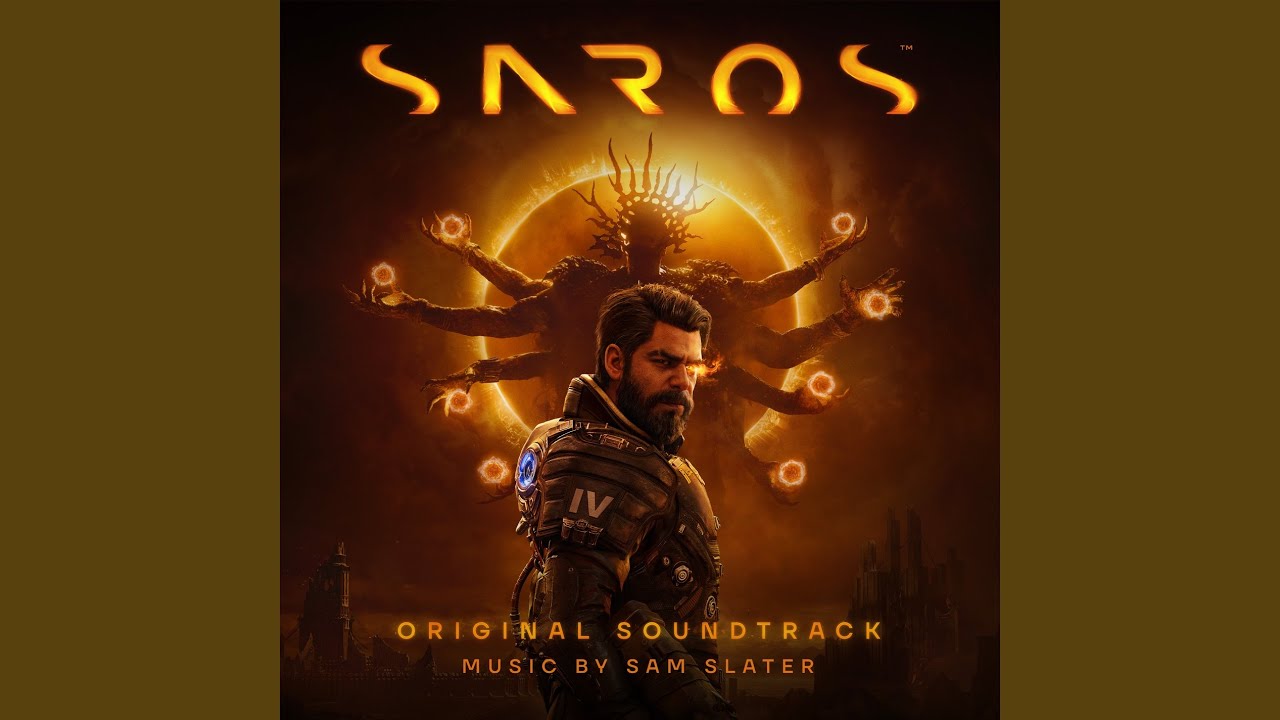
Split-second defensive and offensive decisions are informed by the system’s 3D spatial audio, which is put to great use by Housemarque alongside the DualSense’s haptic feedback and adaptive triggers. Returnal was a remarkable showcase of what the PS5 could do in the right hands, and Saros’ overall feeling and presentation has the studio telling everyone else to step their game up. Oh, and a special shoutout to Sam Slater’s absolute banger of an original soundtrack.
It’s a shame Saros’ roguelite effort is so half-hearted, but this is what happens when you try to please everyone.
While not super elegant, the story and characters are enticing enough, Kohli convinces as a tormented action hero, and Carcosa’s mythology will linger in my memory for a while. Those elements elevate the truly fantastic moment-to-moment gameplay and consistently exciting boss battles, daring to ask whether roguelite games could be more. Whether they can pose the big questions.
It just hasn’t fully come together this time around, but this is still a recommendation for sci-fi action game fans… just one with a few big caveats. Hopefully, Housemarque leveled up on this run, and their next one will be better.
Saros is available now for purchase on PS5.
Disclaimer
A PS5 review code for Saros was provided by Sony.










Stay Informed With the Latest & Most Important News
Previous Post
Next Post


Advertisement
-
 01Two Black Holes Observed Circling Each Other for the First Time
 -
 02From Polymerization-Enabled Folding and Assembly to Chemical Evolution: Key Processes for Emergence of Functional Polymers in the Origin of Life
 -
 03Astronomy 101: From the Sun and Moon to Wormholes and Warp Drive, Key Theories, Discoveries, and Facts about the Universe (The Adams 101 Series)
 -
 04True Anomaly hires former York Space executive as chief operating officer
 -
 05Φsat-2 begins science phase for AI Earth images
 -
 06Hurricane forecasters are losing 3 key satellites ahead of peak storm season − a meteorologist explains why it matters
 -
 07Binary star systems are complex astronomical objects − a new AI approach could pin down their properties quickly