
Now Reading: Science finds a place on Artemis 2
-
01
Science finds a place on Artemis 2


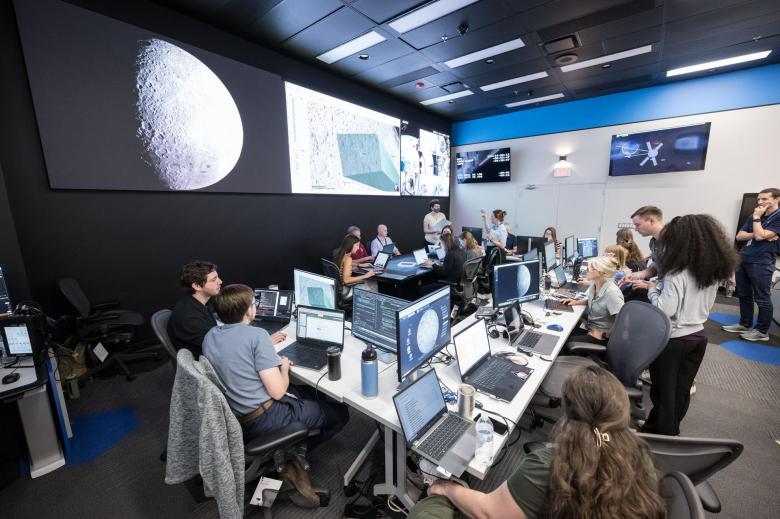
KENNEDY SPACE CENTER, Fla. — While the Artemis 2 mission is primarily a test flight, the four astronauts on board will conduct some science during the nearly 10-day mission.
At a March 29 briefing, NASA officials said preparations for the mission, the first crewed flight of the Space Launch System rocket and Orion spacecraft, are going well, with no major issues being worked. Forecasts call for an 80% chance of favorable weather for a liftoff in a two-hour window that opens at 6:24 p.m. Eastern April 1.
The mission, the first flight of humans beyond low Earth orbit since Apollo 17 in December 1972, is principally a test flight, allowing the four-person crew to test spacecraft systems and vehicle performance.
However, there will be some science on the mission as well. Much of that will be concentrated about five days into the mission when Orion swings around the moon on its free-return trajectory, passing within several thousand kilometers of the lunar surface.
“Science wasn’t in the driver’s seat to define what Artemis 2 is,” said Jacob Richardson, deputy lead of Artemis 2 lunar science at NASA’s Goddard Space Flight Center, during a panel discussion at the Goddard Space System Symposium March 12. “Instead, we are using Artemis 2 as an opportunity to get science to prepare for our later Artemis missions when science is more of a driver.”
During the close approach, astronauts will observe the moon with the naked eye along with handheld cameras. Besides photos, they will document what they see both verbally and in annotations on tablets.
“Human beings are the most sophisticated detector there is, and they’ll be giving some very nuanced verbal descriptions,” said Kelsey Young, science flight operations lead for NASA’s Artemis internal science team, at the symposium.
The images that the astronauts take will be at far lower resolution than the best images from spacecraft such as the Lunar Reconnaissance Orbiter. Given the distance of the flyby, the moon will appear about the size of a basketball held at arm’s length.

However, the observations do offer some advantages. One is the ability to take in the whole disk of the moon, including regions of the lunar farside not seen directly by the human eye before. “They’ll have this interesting perspective that enables them to contextualize the observations they see in one section of the moon to another section of the moon in the blink of an eye,” Young said.
Another advantage is preparation for future missions on the lunar surface. While crews have not been selected for later Artemis missions, astronauts have started training for such missions, ranging from a one-week “Lunar Fundamentals” course to fieldwork.
Young said that the Artemis 2 astronauts have embraced the opportunity to do lunar science after some initial skepticism. “We had a lot of questions from the crew over the first few months of training: ‘What can our observations tell you about science that orbiting spacecraft cannot?’” she recalled.
“We really rose to the challenge of convincing them that your words carry scientific weight. What you describe helps us, the lunar science community, really unlock these high-priority mysteries that we have,” she said.
The astronauts have embraced those observations. “The scientists are really excited about getting these four sets of human eyes, the best cameras in the universe, close to the moon,” Victor Glover, pilot of Artemis 2, said in a March 29 briefing. “It’s not any specific thing, but being able to observe the moon and cosmic phenomena with the human eye up close.”
One example he cited was a report by Jack Schmitt, a geologist who walked on the moon on Apollo 17, who noted that once astronauts were within about 5,000 kilometers of the moon, they were able to see traces of color in an otherwise grayscale terrain from specific minerals. “That is one of the things I am really looking forward to, being closer and seeing some of that detail.”
The April launch window has a bonus science opportunity, as the trajectory for a launch in the early days of that period would create a solar eclipse as the moon blocks the sun from the perspective of Orion.
“This is something new that we just started learning about last week,” said Jeremy Hansen, a mission specialist on Artemis 2. The mission’s science team “right away came up with some instruction for us on how we can leverage this opportunity to look for things they’re interested in on the moon.”
There will be a science team at the Johnson Space Center during the mission, coordinating the observations by the astronauts, along with a science officer in Mission Control itself. “For the first time ever, science has a seat in the control room,” said Nicky Fox, NASA associate administrator for science, at a March 26 symposium by the Universities Space Research Association and Space Policy Institute.
Artemis 2 will perform additional science beyond lunar observations. An example is A Virtual Astronaut Tissue Analog Response, or AVATAR, an experiment that will fly “organs on a chip” to study the effects of radiation and microgravity using bone marrow tissue samples taken from the four Artemis 2 astronauts.
Other experiments include movement and sleep monitors worn by the astronauts and studies of their immune systems. The German space agency DLR will provide radiation monitors for the mission like those flown on Artemis 1.
“We want to think about how we pack these small but mighty technologies into every single opportunity that we have,” Fox said. “We plan to take advantage of every human mission to be able to try to do these kinds of things.”
She added that the Artemis 2 astronauts were willing participants in AVATAR. “They actually think it’s really cool,” she said. “Victor remarked, ‘It’s like having an extra four crewmembers.’”










Related Posts
Stay Informed With the Latest & Most Important News
Previous Post
Next Post

Advertisement
-
 01Two Black Holes Observed Circling Each Other for the First Time
 -
 02From Polymerization-Enabled Folding and Assembly to Chemical Evolution: Key Processes for Emergence of Functional Polymers in the Origin of Life
 -
 03Astronomy 101: From the Sun and Moon to Wormholes and Warp Drive, Key Theories, Discoveries, and Facts about the Universe (The Adams 101 Series)
 -
 04True Anomaly hires former York Space executive as chief operating officer
 -
 05Φsat-2 begins science phase for AI Earth images
 -
 06Hurricane forecasters are losing 3 key satellites ahead of peak storm season − a meteorologist explains why it matters
 -
 07Binary star systems are complex astronomical objects − a new AI approach could pin down their properties quickly