
Now Reading: Search for Life Should Be Top Science Priority for First Human Landing on Mars, Says New Report
-
01
Search for Life Should Be Top Science Priority for First Human Landing on Mars, Says New Report

Search for Life Should Be Top Science Priority for First Human Landing on Mars, Says New Report

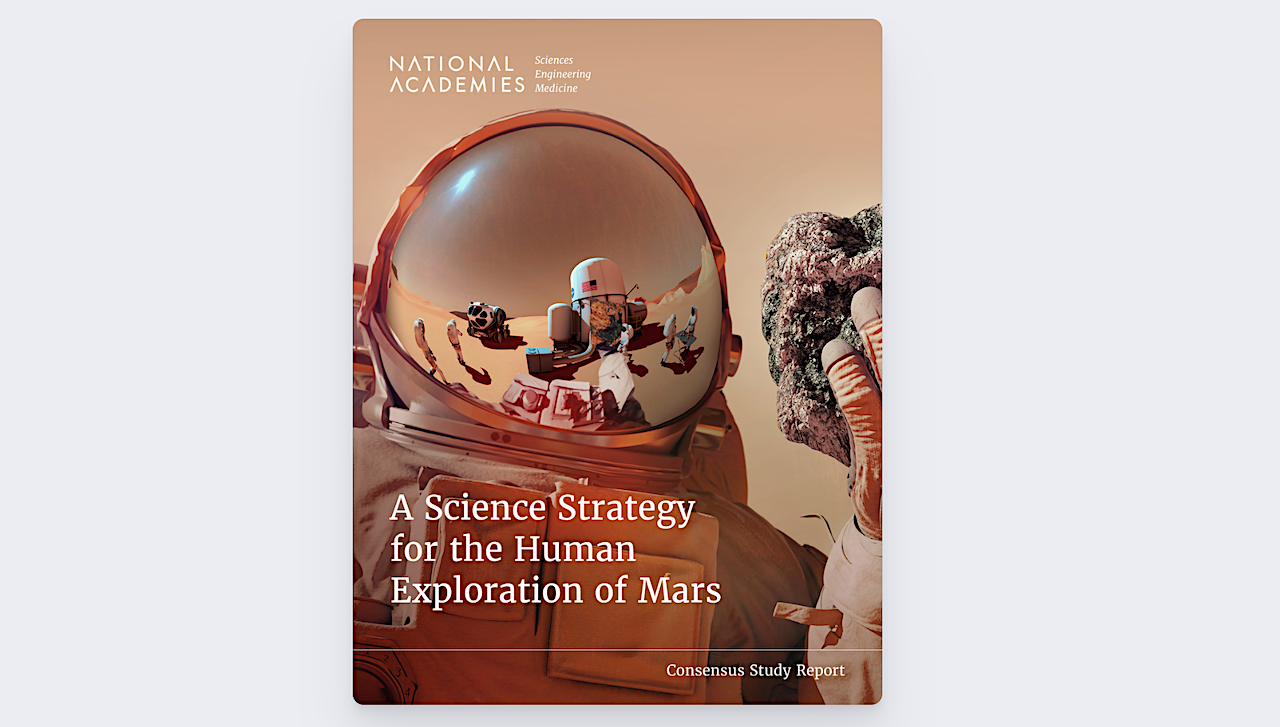
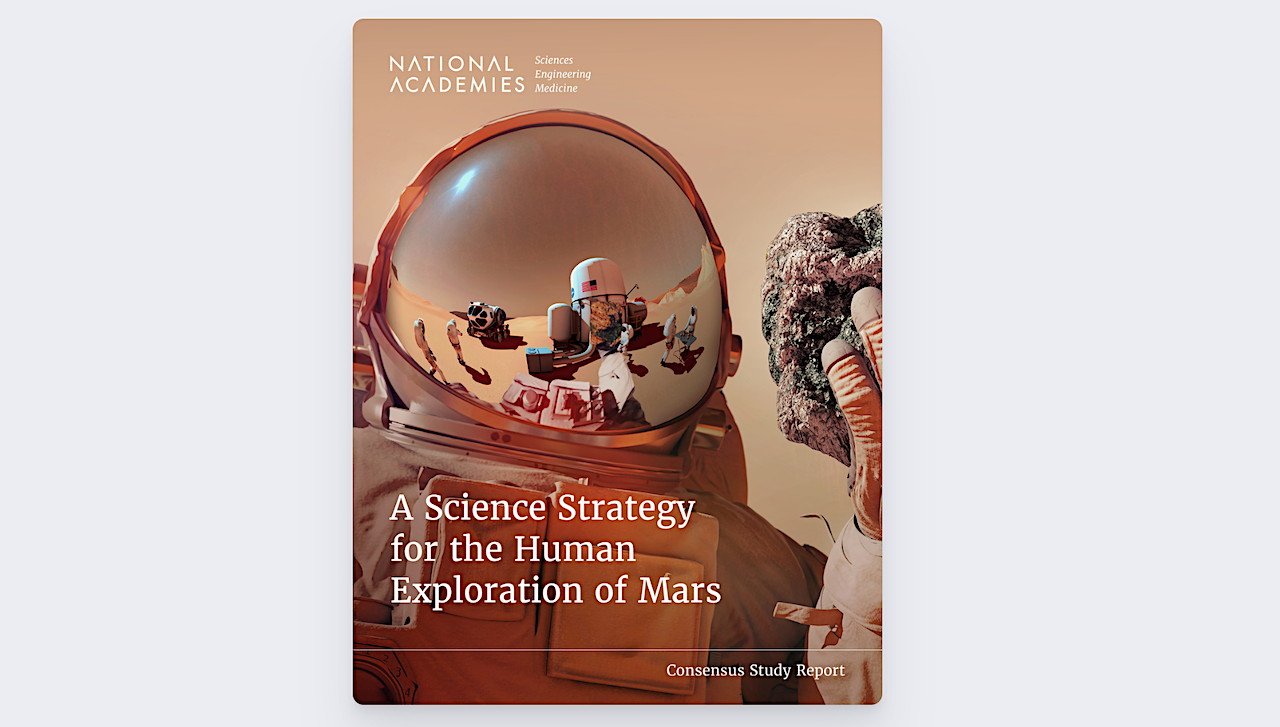
A Science Strategy for the Human Exploration of Mars
A new report from the National Academies of Sciences, Engineering, and Medicine identifies the highest priority science objectives for the first human mission to Mars, and says searching for evidence of existing or past life on Mars should be the top priority. Improving our understanding of the effects of Mars’ environment on humans, plants, and animals; water cycles; geologic records; and dust storms are also among the 11 science priorities named in the report.
The report presents four possible campaigns for human exploration of Mars, each encompassing a sequence of three missions linked to specific science objectives. For each campaign, the report describes which science objectives could be met, the likely roles of crew members, and the campaign’s strengths and weaknesses for meeting scientific goals.
“The first human landing on Mars will be the most significant moment for human space exploration since we first set foot on the moon over 50 years ago,” said Linda T. Elkins-Tanton, director of the University of California, Berkeley Space Sciences Laboratory; principal investigator, NASA Psyche mission; and co-chair of the committee that wrote the report. “Our report puts science at the center of what will be a remarkable achievement, and outlines the incredible knowledge we’ll have the opportunity to glean about our place in the universe, the potential habitability of Mars, and so much more.
Science Objectives
In order of priority, the report names the following as the science objectives that a human mission to Mars should pursue:
- Search for Life — Determine if evidence can be found on Mars of existing or extinct life, the planet’s habitability, or indigenous prebiotic chemistry.
- Water and CO2 on Mars — Characterize the planet’s water and CO2 cycles to understand how they may have evolved.
- Mars Geology — Characterize and map the geologic record to reveal Mars’ evolution.
- Impact on Crew — Determine the impact of the Martian environment on crew physiological, cognitive, and emotional health, and on team dynamics.
- Dust Storms — Determine what controls the onset and evolution of the major dust storms that make Mars’ atmosphere so variable.
- Explore Resources — Characterize the Martian environment for in situ resource utilization and processing needs, with an early focus on water and propellants, ultimately to explore materials that support permanent habitation.
- Effect of Mars on Genomes and Reproduction — Determine whether the Martian environment affects reproduction or the functional genome across multiple generations in at least one plant species and one animal species.
- Understanding Microbes — Determine if microbial population dynamics and the distribution of microbial species in biological systems are stable on Mars, and are not detrimental to astronaut health and performance.
- Martian Dust — Characterize the effects of Martian dust on the human body and on hardware.
- Plants and Animals in an Ecosystem — Determine the impact of the Martian environment on plant and animal physiology and development across multiple generations, as part of an integrated ecosystem of plants, microbes, and animals.
11.Radiation Sampling — Characterize radiation at key locations in the crew habitat and at astrobiological sampling sites, both to contextualize sample collection and improve our estimates of the risk to future missions.
Four Campaigns for Mars Science
The top-ranked campaign, which could achieve every science objective named in the report, would include a human landing lasting 30 sols (Mars days, which are slightly longer than an Earth day), an uncrewed cargo delivery, and a longer 300-sol mission. Each of these landings would occur at a single site in an exploration zone approximately 100 kilometers in diameter, and with specific features such as ancient lava flows and known dust storms. Field measurements would require a wide suite of science instruments to be brought to Mars, as well as drilling and meteorological equipment, with more detailed investigations being conducted in a Mars habitat laboratory and further study of samples brought back to Earth.
The second-ranked campaign seeks to optimize achieving the measurements that are the most needed in common across all the science objectives. This approach offers a campaign with looser needs for a specific landing site, as some measurements could be achieved at a range of possible landing sites.
The third-ranked campaign focuses on searching for life on Mars, the top-ranked science priority. This campaign would focus on selecting a site where deep drilling to liquid water would be possible — followed by core collection and initial analysis of samples on Mars. The bulk of the samples would be returned to Earth for further study of habitability and past and present life on Mars.
The fourth uses three short missions at different locations on Mars to achieve a variety of the top science objectives, and would enable exploration of widely varying environments. The report suggests three possible types of sites that could be selected for this campaign: an area with igneous and impact melt geology; a site with sedimentary rocks to search for evidence of ancient life or prebiotic processes; and glaciers located within a dust-storm-forming region of Mars.
“By imagining different ways that priority science could be pursued during actual human missions, our report shows there are many different options for humans to explore Mars and achieve great scientific breakthroughs,” said committee co-chair Dava Newman, Apollo Program Professor in the Department of Aeronautics and Astronautics at Massachusetts Institute of Technology. “Importantly, it also offers a synergistic review of science priorities enhanced by human exploration.”
Recommendations for NASA
The report offers recommendations for NASA that would help the agency lay the groundwork for meeting scientific objectives. For example, to enable many of the scientific and exploration objectives for investigating regions on Mars that could possibly support life and to protect the scientific integrity of the results, NASA should continue to collaborate on the evolution of currently limiting planetary protection guidelines, the report says. NASA should also include a surface laboratory on Mars in its mission plans, return samples to Earth from every human mission to Mars, and start a recurring summit on teaming between humans, robotic exploration tools, and artificial intelligence to support Mars missions.
The study — undertaken by the Committee for a Science Strategy for the Human Exploration of Mars — was sponsored by NASA. The National Academies of Sciences, Engineering, and Medicine are private, nonprofit institutions that provide independent, objective analysis and advice to the nation to solve complex problems and inform public policy decisions related to science, engineering, and medicine. They operate under an 1863 congressional charter to the National Academy of Sciences, signed by President Lincoln.










Related Posts
Stay Informed With the Latest & Most Important News
Previous Post
Next Post





Advertisement
-
 01Two Black Holes Observed Circling Each Other for the First Time
 -
 02From Polymerization-Enabled Folding and Assembly to Chemical Evolution: Key Processes for Emergence of Functional Polymers in the Origin of Life
 -
 03Astronomy 101: From the Sun and Moon to Wormholes and Warp Drive, Key Theories, Discoveries, and Facts about the Universe (The Adams 101 Series)
 -
 04True Anomaly hires former York Space executive as chief operating officer
 -
 05Φsat-2 begins science phase for AI Earth images
 -
 06Hurricane forecasters are losing 3 key satellites ahead of peak storm season − a meteorologist explains why it matters
 -
 07Binary star systems are complex astronomical objects − a new AI approach could pin down their properties quickly