
Now Reading: See the moon glow next to mighty Jupiter in the winter sky tonight
-
01
See the moon glow next to mighty Jupiter in the winter sky tonight


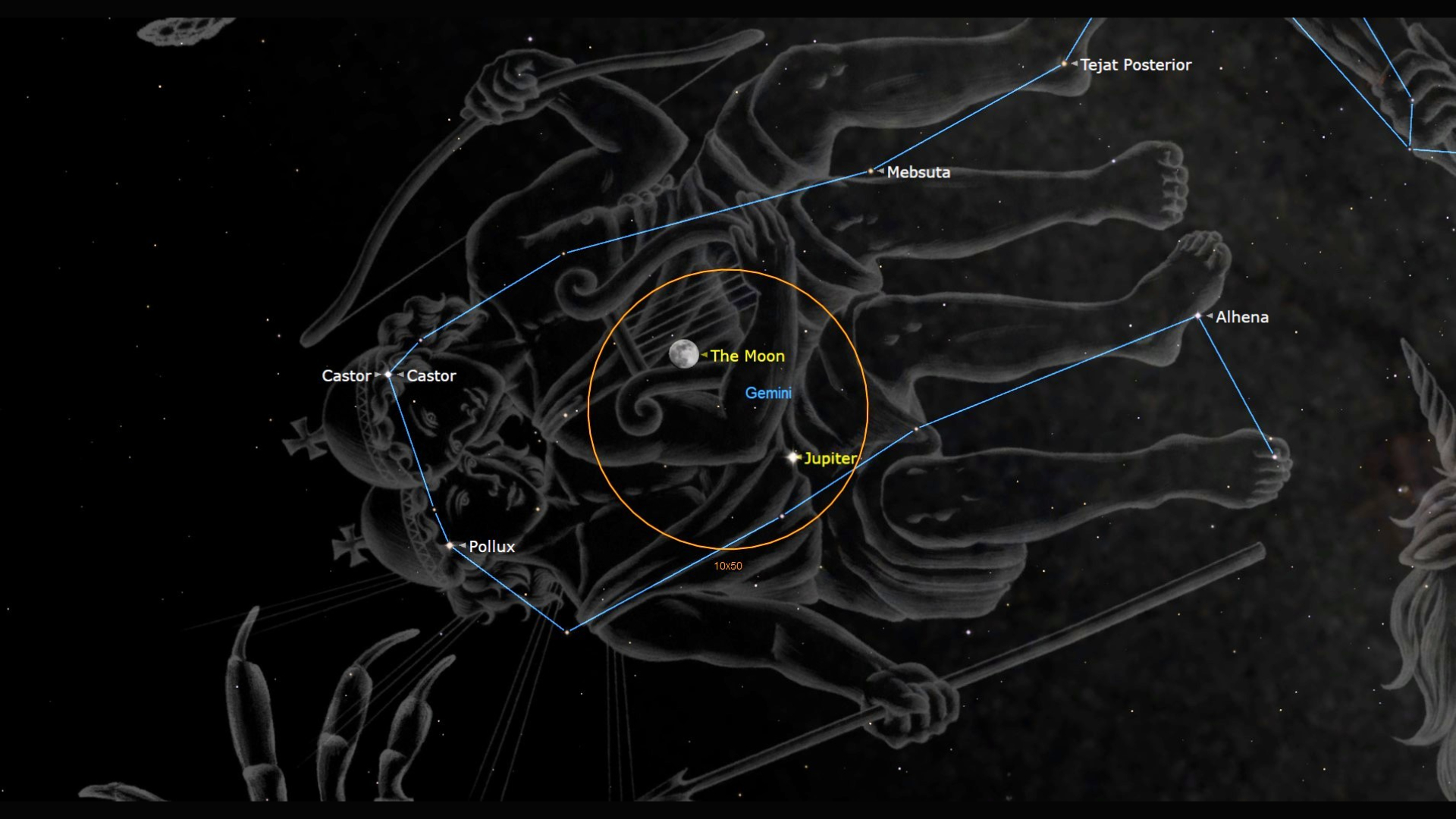
Look east at sunset on Jan. 30 to spot the near-full moon shining close to the gas giant Jupiter among the stars of the constellation Gemini.
Jupiter will appear as a steady “evening star” less than 5 degrees — roughly the width of your three middle fingers held to arm’s length — to the lower right of the lunar disk in the eastern sky, with the bright stars Castor and Pollux twinkling close to its left.
The moon and Jupiter will be close enough to fit comfortably in the field of view of a pair of 10X50 binoculars, which will help reveal the dark lunar seas and prominent craters scarring the surface of Earth’s natural satellite. Look out for bright streaks of material called “ejecta rays” leading away from impact sites on the nights surrounding each full moon phase. These reflective masses of relatively young material were deposited many millions of years ago during cataclysmic asteroid strikes that excavated vast basins on the lunar surface.

Celestron NexStar 8SE

The Celestron NexStar 8SE is one of the best motorized telescopes out there and is capable of providing spectacular views of Jupiter and the moon. For a more detailed look, you can check out our Celestron NexStar 8SE review.
A telescope with an aperture of 6 inches or more will reveal details in the roiling cloud bands lining the gas giant‘s surface, alongside the presence of its four largest “Galilean” moons, Io, Europa, Ganymede and Callisto, which line up to the right of Jupiter’s disk on Jan. 30. The moon and Jupiter will soar high overhead through the winter sky as the night wears on, before finally setting on the western horizon in the hour preceding dawn on Jan. 31.
Want to see Jupiter and the moon up close? Then be sure to check out our guide to the best telescopes for exploring the night sky, along with our guide to observing the moon and finding the historic Apollo-era landing sites.
Editor’s Note: If you would like to share your photo of the moon and Jupiter with Space.com’s readers, then please send your photo(s), comments, name and location to spacephotos@space.com.










Related Posts

Stay Informed With the Latest & Most Important News
Previous Post
Next Post

Advertisement
-
 01Two Black Holes Observed Circling Each Other for the First Time
 -
 02From Polymerization-Enabled Folding and Assembly to Chemical Evolution: Key Processes for Emergence of Functional Polymers in the Origin of Life
 -
 03Astronomy 101: From the Sun and Moon to Wormholes and Warp Drive, Key Theories, Discoveries, and Facts about the Universe (The Adams 101 Series)
 -
 04True Anomaly hires former York Space executive as chief operating officer
 -
 05Φsat-2 begins science phase for AI Earth images
 -
 06Hurricane forecasters are losing 3 key satellites ahead of peak storm season − a meteorologist explains why it matters
 -
 07Binary star systems are complex astronomical objects − a new AI approach could pin down their properties quickly