
Now Reading: Self-assembled Versus Biological Pattern Formation In Geology
-
01
Self-assembled Versus Biological Pattern Formation In Geology


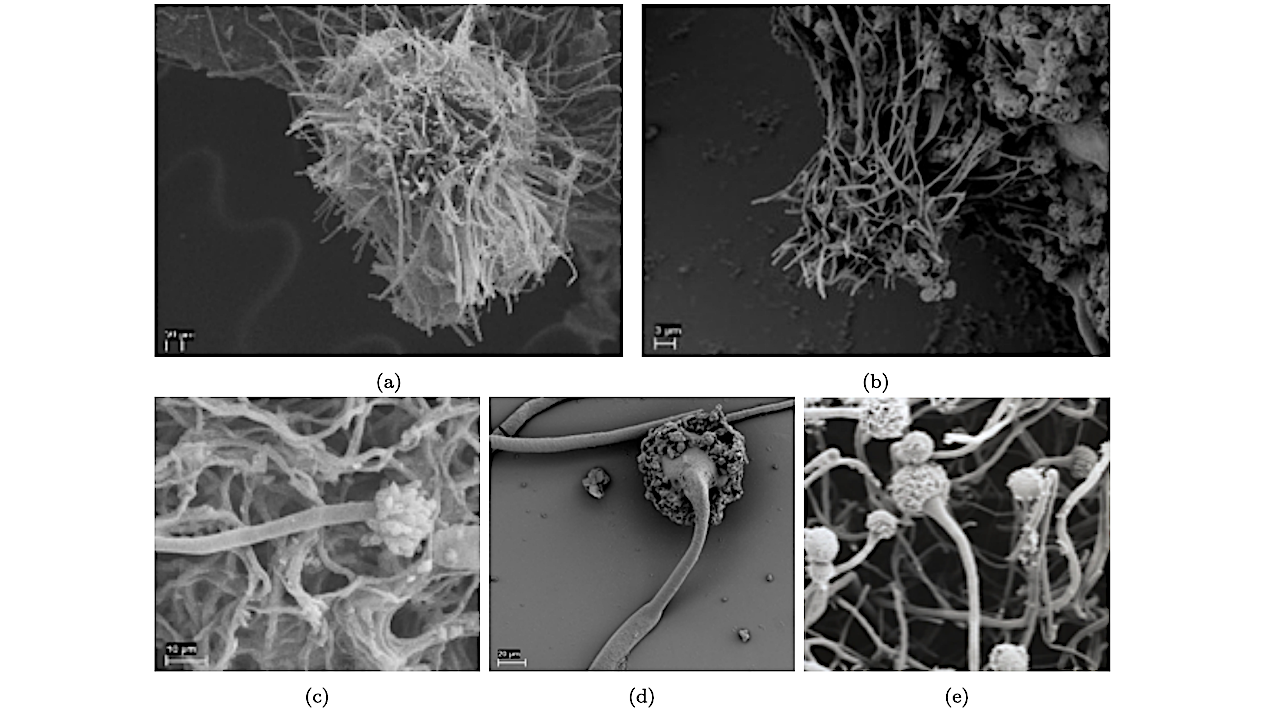
Biological and abiotic tubes. SEM images of tubular colonies of a) Aspergillus
niger feeding on straw (image: Anna Neubeck) and b) manganese oxide chemical gardens
(image: Huld et al., 2023). The A. niger tubes ranged in size between 2-5 µm in diameter,
and the manganese oxides were found in ranges between 1–20 µm in size. SEM images of
c) A. niger (image: Anna Neubeck), d) manganese oxide chemical gardens (image: Anna
Neubeck), and e) A. niger closeup (image: D. Gregory & D. Marshall, CC BY 4.0). — nlin.PS
Both abiotic self-organization and biological mechanisms have been put forward as the origin of a number of geological patterns.
It is important to comprehend the formation mechanisms of such structures both to understand geological self-organization and in order to differentiate them from biological patterns — fossils and bio-influenced structures — seen in geological systems.
Being able to distinguish the traces of biological activity from geological self-organization is fundamental both for understanding the origin of life on Earth and for the search for life beyond Earth.
Julyan H. E. Cartwright, Charles S. Cockell, Julie G. Cosmidis, Silvia Holler, F. Javier Huertas, Sean F. Jordan, Pamela Knoll, Electra Kotopoulou, Corentin C. Loron, Sean McMahon, Anna Neubeck, Carlos Pimentel, C. Ignacio Sainz-Díaz, Piotr Szymczak
Subjects: Pattern Formation and Solitons (nlin.PS); Earth and Planetary Astrophysics (astro-ph.EP); Geophysics (physics.geo-ph); Populations and Evolution (q-bio.PE)
Cite as: arXiv:2601.00323 [nlin.PS] (or arXiv:2601.00323v1 [nlin.PS] for this version)
https://doi.org/10.48550/arXiv.2601.00323
Focus to learn more
Submission history
From: Julyan Cartwright
[v1] Thu, 1 Jan 2026 12:36:04 UTC (29,869 KB)
https://arxiv.org/abs/2601.00323
Astrobiology,











Related Posts
Stay Informed With the Latest & Most Important News
Previous Post
Next Post
Previous Post
Next Post

Advertisement
-
 01Two Black Holes Observed Circling Each Other for the First Time
 -
 02From Polymerization-Enabled Folding and Assembly to Chemical Evolution: Key Processes for Emergence of Functional Polymers in the Origin of Life
 -
 03Astronomy 101: From the Sun and Moon to Wormholes and Warp Drive, Key Theories, Discoveries, and Facts about the Universe (The Adams 101 Series)
 -
 04True Anomaly hires former York Space executive as chief operating officer
 -
 05Φsat-2 begins science phase for AI Earth images
 -
 06Hurricane forecasters are losing 3 key satellites ahead of peak storm season − a meteorologist explains why it matters
 -
 07Binary star systems are complex astronomical objects − a new AI approach could pin down their properties quickly