
Now Reading: “She flies satellites. One day, I can too.”
-
01
“She flies satellites. One day, I can too.”



09/03/2026
379 views
25 likes
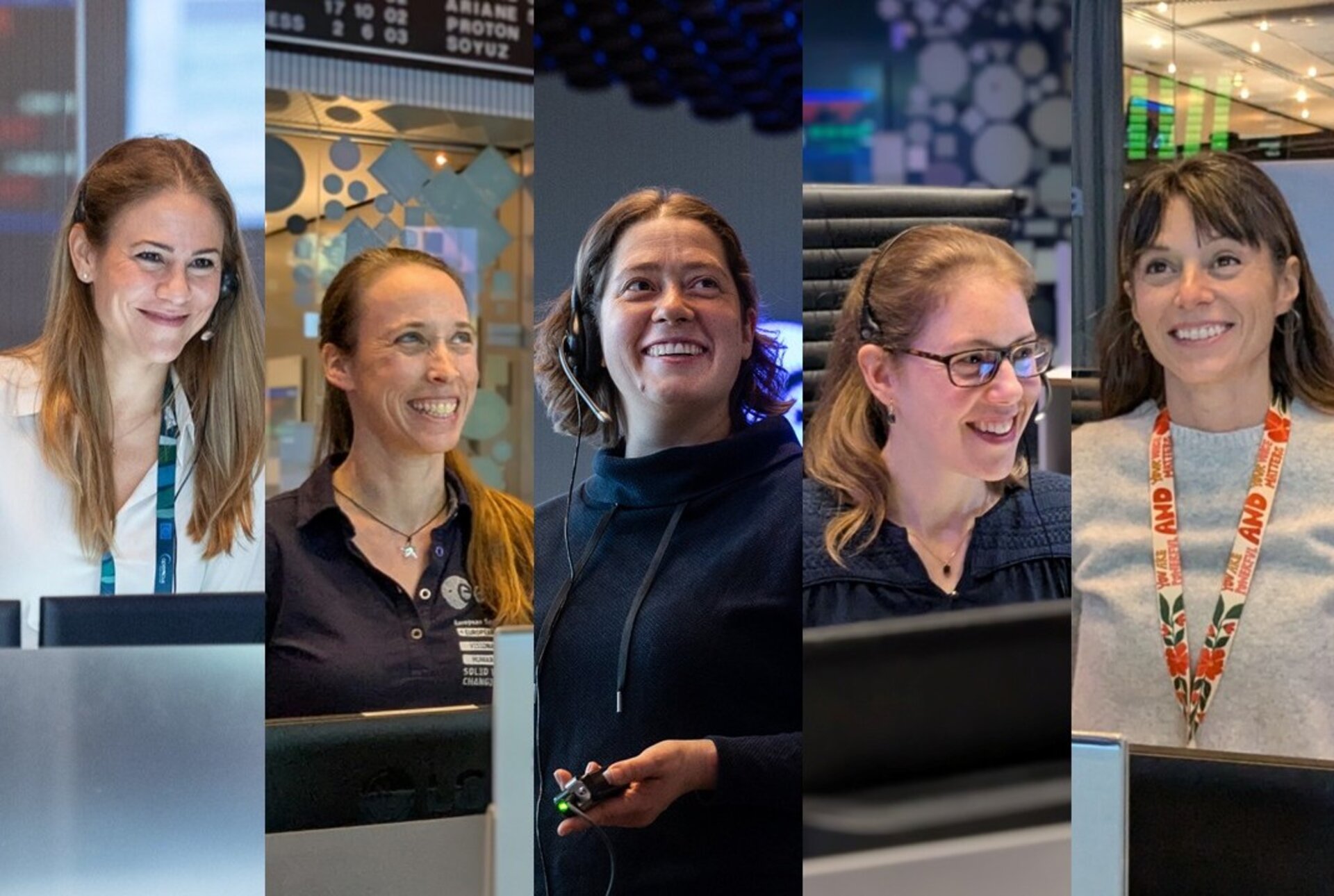
At ESA’s European Space Operations Centre (ESOC), teams work around the clock to fly spacecraft across the Solar System and monitor Earth from orbit. Among them are women leading spacecraft operations, managing teams and helping shape the culture of ESA’s mission control.
In celebration of the International Day of Women and Girls in Science (11 February) and International Women’s Day (8 March), five women from ESOC share their experiences of leading spacecraft operations and pursuing careers in STEM:
- Angela Dietz – Spacecraft Operations Manager (SOM) for Jupiter Icy Moons Explorer (Juice);
- Gabriela Ansteeg – SOM for EarthCARE;
- Sara Melloni – SOM for ExoMars’ Rosalind Franklin Rover;
- Jutta Hübner – SOM for Integral; and
- Isabel Rojo – Head of the EarthCARE, SMOS and FORUM Unit.
These five interviewees represent only a fraction of the many women across ESOC whose expertise, dedication and diverse roles contribute in countless ways to the success of ESA’s missions and of ESOC as a whole.
Essential skills for flying spacecraft
Interviewees described the diverse skillsets they rely on daily at ESOC, from anticipating problems and maintaining a strategic overview to staying calm under pressure, not to mention technical and problem-solving skills.
But the real engine of mission operations? As Gabriela puts it: “Mission operations are all about the people.”
“Interpersonal and communication skills are a huge part of the job,” says Angela, “because you work with so many different partners and interfaces. Computers can’t solve the kind of problems we face in our job. You need people working together to do that.”
“We are not just taking a spacecraft to another planet,” says Sara. “We are building a group of people who work in synergy to go there.”
Isabel explains her approach to human-centred leadership: “The art is in using your skills as careful ingredients. Each situation requires something different – sometimes more efficiency, sometimes more cooperation. It is not just the output that defines the recipe, but the individuals who are part of each situation.”
Simultaneously, interviewees emphasise how diverse teams strengthen collaboration, while inclusion is vital for mission success. “The more diverse a team is, the more creative, because each team member has a different view on each topic,” says Jutta.
“If we don’t work together, we will make mistakes because each person specialises in a different aspect,” explains Angela. “We cannot leave somebody aside.”
When flying spacecraft is a team sport, inclusion is a performance advantage that catalyses better outcomes in mission control.
Inclusion and representation at ESOC
Our interviewees describe ESOC as an environment that has enabled them to thrive.
“We talk about diversity a lot at ESA and we have a better gender ratio than in other industries,” says Gabriela. “Guidelines against discrimination are taken very seriously, and the working atmosphere at ESOC is very good.”
“At ESOC, women are not considered differently,” explains Isabel. “But we are still underrepresented.”
Sara adds personal context: “When I studied aerospace engineering at university, we were only about ten women out of maybe 100. Today at ESOC, I see a much higher ratio of women. In my unit, three of the four staff are women.”
Angela shares: “I had very good female managers, who I learned a lot from.” She adds that previous cohorts at ESOC helped introduce more diverse teams. “I benefited from that, because I arrived when this change was already in progress. Today, it’s much more visible.”
Gabriela, who joined ESOC later than our other interviewees, takes this observation one step further: “My managers always expressed their confidence in my ability to take on demanding tasks. Isabel Rojo was one of them.”
Yet personal experience is only one layer of the conversation. Even when women do not feel individually disadvantaged, systemic imbalances remain.
“Awareness is what is needed,” says Isabel. “Seeing different paths – and different people – makes it easier to imagine yourself and your potential progression in this field. Sometimes people don’t visualise themselves in certain roles because they’ve never seen someone like them do it.”
Role modelling from the ground up
Several interviewees pointed out that visibility begins long before someone arrives in mission control.
“Visibility has to come from the bottom,” says Jutta. “If you want change, you must start earlier. For example, if a mother feels she isn’t good at maths, she might tell her daughter, ‘You don’t have to be good at maths because I’m not.’ Even within the household there are many layers of influence long before you reach institutions like ESOC.”
Angela echoes this in her own family: “My two daughters are interested in maths and science. I encourage them, ‘This is the thing you can do well and like to do, so go for it.’” Gabriela agrees that visibility for girls is essential, which is why she regularly supports the annual Girls’ Day at ESOC.
Across interviews, visibility frequently emerged in connection with role modelling.
“I can show others one way of doing this job. I try to lead by example. I think this is the strongest way to support others,” says Isabel.
Jutta agrees: “You don’t always realise when you’re a role model. But if you show that you can fly a satellite, other women – and kids – might think, ‘If she can fly a satellite, I can too.’”
Normalising visibility of women in mission operations
A theme that recurred throughout the interviews was that visibility alone is not enough. If visibility shows what is possible, normalisation ensures that what is possible is not surprising.
Jutta emphasises that representation must extend beyond symbolic moments: “If we only talk about women on special days, it becomes artificial. Inclusion should be part of everyday life, not something switched on once a year.”
Sara advocates that to normalise women in STEM, we must be cautious about over-spotlighting. “I was awarded a ‘Best woman in STEM’ prize at university, but there was no equivalent for men,” Sara says. “Why is it strange that I have good grades because I am a woman?”
She continues: “Measures intended to improve women’s representation can provoke polemics, especially when they’re misused or seen as unfair. That can create frustration and cast doubt on women’s credibility. We need to talk about diversity – yet how we talk about it matters. A sustained approach involving people of all genders helps avoid these tensions.”
True normalisation requires frequent, inclusive storytelling that goes beyond annual visibility campaigns.
“Realise that women flying spacecraft is not exceptional,” says Gabriela. “It’s normal.”
Overcoming the self-selection barrier
Visibility and normalisation help break a common pattern: self-selection – deciding a path isn’t “for me” before even trying.
“Sometimes if women feel they don’t fit the job description 100%, they don’t apply,” explains Jutta. “Men, on the other hand, may say, ‘I fit 50% of the job description – sure, I’ll apply and see how it goes.”
Others recognised hesitation in their own journeys, including Angela. “As a kid, working in ESOC’s control room was my dream job, but I always thought the likelihood of getting a job here was very small,” she says. “That’s why I studied physics instead of aerospace engineering.” Her message today: “Just apply, even if you think it’s unlikely that you’re going to make it.”
However, even when interest is there, some women may hesitate because they can already imagine the obstacles ahead.
“I think some women are afraid of the obstacles they might face in environments where they feel underrepresented, or they feel like they have to be artificially tough there, and that sometimes makes STEM environments unattractive to candidates,” says Gabriela. “Don’t let underrepresentation make you doubt yourself, or it will hold you back.”
Support that lifts everyone strengthens the mission
Our interviewees experiences reflect a broader shift across the space sector: diverse teams strengthen mission operations and help bring new perspectives to complex challenges.
“We still have things to improve, that’s why we are talking about this,” says Gabriela. “The more women we have at a place like ESOC, the more feedback and data we have about what to improve to attract even more women.”
Individual efforts accumulate, gradually shaping more inclusive environments and creating advantages that translate into smarter operations. The trajectory of who sees themselves in mission control is changing – and representation matters because it helps people see themselves in extraordinary places.
“The beauty is that we are going to Mars,” Sara says. “And in the office next door there’s a team flying a spacecraft to a different planet, or maybe a comet. At ESA, we get to be part of the teams doing amazing things with spacecraft.”
“We need everyone. We need talented women,” says Angela. Because diversity makes better missions.
A special thanks to all the participants and everyone helping make ESA a more inclusive environment.
Stay tuned with ESA Operations as we continue to spotlight the talented people across ESOC. In the coming months, we’ll introduce you to different members of the ESOC workforce, the engineers, scientists, analysts, and support teams whose expertise supports spacecraft operations, ground station networks, and space safety activities and helps keep Europe’s missions running smoothly every day.










Related Posts
Stay Informed With the Latest & Most Important News
Previous Post
Next Post
Previous Post
Next Post


Advertisement
-
 01Two Black Holes Observed Circling Each Other for the First Time
 -
 02From Polymerization-Enabled Folding and Assembly to Chemical Evolution: Key Processes for Emergence of Functional Polymers in the Origin of Life
 -
 03Astronomy 101: From the Sun and Moon to Wormholes and Warp Drive, Key Theories, Discoveries, and Facts about the Universe (The Adams 101 Series)
 -
 04True Anomaly hires former York Space executive as chief operating officer
 -
 05Φsat-2 begins science phase for AI Earth images
 -
 06Hurricane forecasters are losing 3 key satellites ahead of peak storm season − a meteorologist explains why it matters
 -
 07Binary star systems are complex astronomical objects − a new AI approach could pin down their properties quickly