
Now Reading: Slowing Planetary Rotation Influences Ocean Nutrient Cycling And Oxygenation
-
01
Slowing Planetary Rotation Influences Ocean Nutrient Cycling And Oxygenation


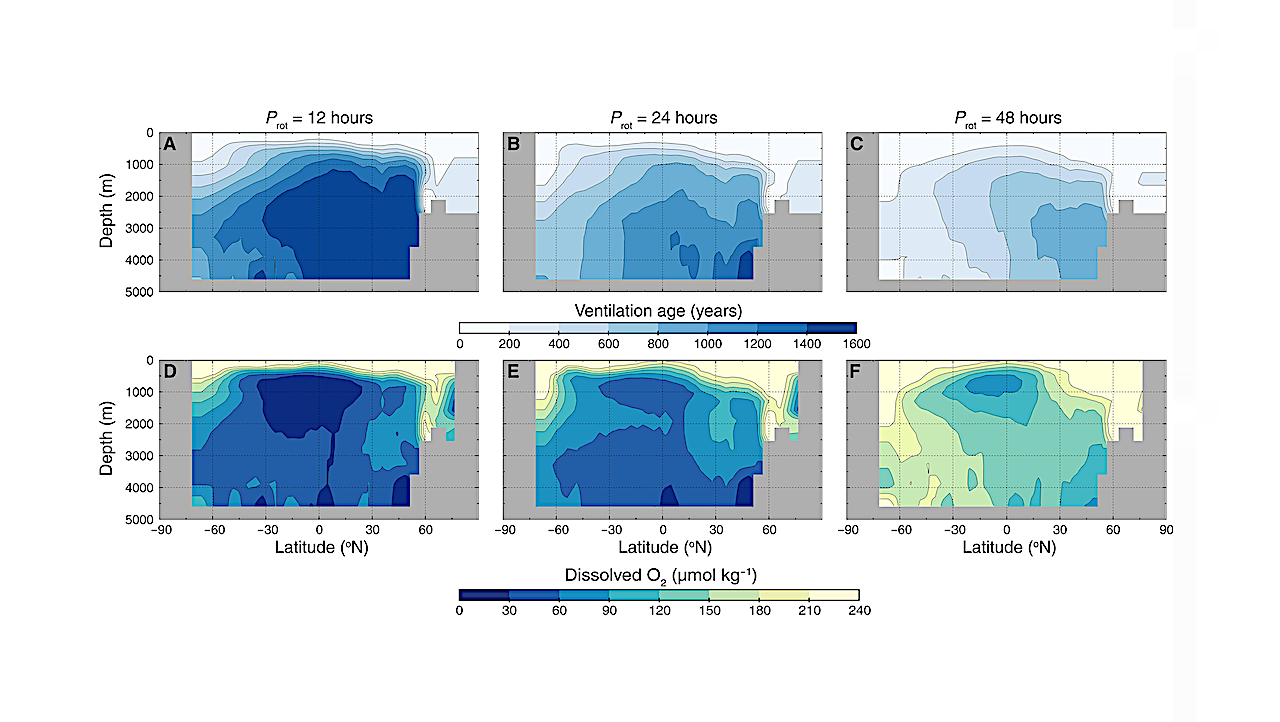

The top row (A to C) shows longitudinally averaged cross sections of ventilation age, where younger ventilation ages represent water parcels that have more recently interacted with the ocean-atmosphere interface. The bottom row (D to F) shows longitudinally averaged cross sections of dissolved O2. Sites of deepwater formation—cold, dense, and highly oxygenated water sinking through the water column—are clearly visible in the North Atlantic (NADW) and at the South Pole (AABW). All simulations are run with 100% PAL atmospheric pO2. — Science via PubMed
Marine habitability for complex life on Earth and Earth-like planets requires bioavailable nutrients and dissolved oxygen. The cycling of nutrients and oxygen is controlled by physical ocean circulation.
However, our understanding of how circulation has varied through time and space is incomplete for Earth and unconstrained for Earth-like exoplanets. Earth’s rotation has slowed over time, affecting ocean circulation by modifying the Coriolis effect. We use a three-dimensional Earth system model to explore how slowing planetary rotation influences ocean circulation and biogeochemistry.
We show that slower rotation enhances wind-driven upwelling and global circulation. Nutrient recycling is consequently more efficient, increasing photosynthetic productivity. Additionally, enhanced ocean oxygenation improves habitability for aerobic life under a well-oxygenated atmosphere.
However, under a poorly oxygenated atmosphere, slowing rotation increases oxygen fluxes from the ocean to the atmosphere. Therefore, Earth’s rotational history may have been a long-term background control on surface oxygenation and the evolution of animals.
Astrobiology,











Related Posts
Stay Informed With the Latest & Most Important News
Previous Post
Next Post
Advertisement
-
 01Two Black Holes Observed Circling Each Other for the First Time
 -
 02From Polymerization-Enabled Folding and Assembly to Chemical Evolution: Key Processes for Emergence of Functional Polymers in the Origin of Life
 -
 03Astronomy 101: From the Sun and Moon to Wormholes and Warp Drive, Key Theories, Discoveries, and Facts about the Universe (The Adams 101 Series)
 -
 04True Anomaly hires former York Space executive as chief operating officer
 -
 05Φsat-2 begins science phase for AI Earth images
 -
 06Hurricane forecasters are losing 3 key satellites ahead of peak storm season − a meteorologist explains why it matters
 -
 07Binary star systems are complex astronomical objects − a new AI approach could pin down their properties quickly