
Now Reading: SLS/Orion rolls to pad for Artemis 2
-
01
SLS/Orion rolls to pad for Artemis 2


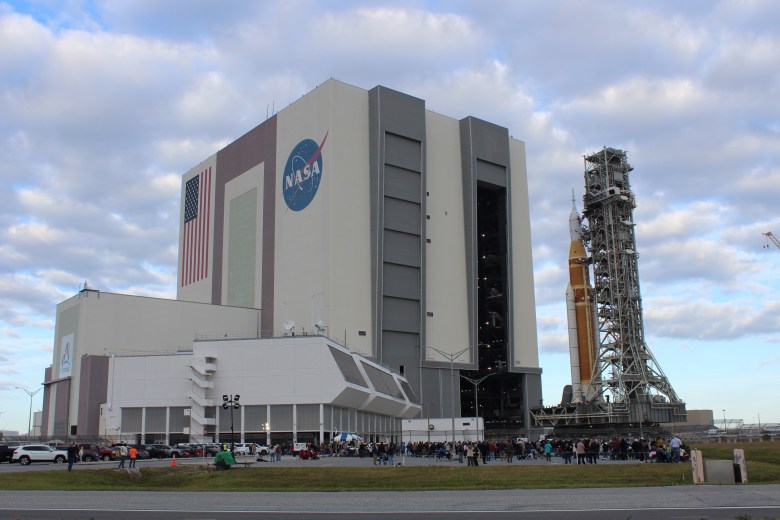
KENNEDY SPACE CENTER, Fla. — NASA’s Space Launch System rocket and Orion spacecraft rolled to the launch pad for the Artemis 2 mission Jan. 17, though uncertainty remains about when the mission will be ready to launch.
The SLS, mounted on its mobile launch platform, began rolling out of the Vehicle Assembly Building at 7:04 a.m. Eastern. The rocket was expected to arrive at Launch Complex 39B up to 12 hours later.
The rollout marks the start of the final phase of preparations for Artemis 2, the first crewed SLS/Orion mission and the first human spaceflight beyond low Earth orbit since December 1972. Four astronauts — Reid Wiseman, Victor Glover, Christina Koch and Jeremy Hansen — will fly around the moon on the 10-day mission.
Once at the pad, crews plan to perform technical checkouts and testing of the vehicle, including radio-frequency interference tests that cannot be conducted inside the VAB. The Artemis 2 astronauts will also rehearse emergency egress procedures at the pad.
The most significant test will be the wet dress rehearsal, during which the SLS will be loaded with liquid oxygen and liquid hydrogen propellants and proceed through a practice countdown that will stop at T-minus 29 seconds.
NASA conducted three wet dress rehearsals ahead of the Artemis 1 launch in 2022 and later scrubbed two launch attempts because of issues such as hydrogen leaks. At a Jan. 16 briefing, agency officials said they were confident lessons learned from Artemis 1 would improve the odds of a successful rehearsal for Artemis 2.
“Why do we think we’ll be successful in Artemis 2? It’s the lessons that we learned,” said Charlie Blackwell-Thompson, Artemis launch director. “Artemis 1 was a test flight, and we learned a lot in that campaign getting to launch.”
There will be some new elements for Artemis 2, primarily involving Orion crew systems. “We have tested those things offline to ensure that they’re not influenced by the cryogenic environment of tanking,” Blackwell-Thompson said. “I believe that we’ll be ready for wet dress.”
“There’s nothing in particular through the pad flow that I would look at and say this is the driver to wet dress,” she said. “Now it’s just getting out to the pad.”

Setting a launch date
The wet dress rehearsal will be the key factor in setting a launch date. While NASA is targeting a launch window from Feb. 6 to 11, the agency has not announced a formal launch date and will not do so until after the rehearsal.
“We have zero intention of communicating an actual launch date until we get through wet dress,” NASA Administrator Jared Isaacman said during a briefing held during the rollout Jan. 17.
At the earlier briefing, NASA officials said the wet dress rehearsal could take place as late as Feb. 2, raising questions about whether the vehicle would be ready to support a launch attempt in the February window. If Artemis 2 does not launch by Feb. 11, the next opportunity would come in early March.
“We need to get through wet dress. We need to see what lessons we learn as a result of that,” Blackwell-Thompson said. “And that will ultimately lay out our path toward launch.” If the rehearsal is completed without major issues, she said, “there are opportunities within February that could be achievable.”
NASA has not disclosed how long it would take to prepare for launch after the wet dress rehearsal, assuming no significant problems. “Once we get through that, we’ll need a couple of days to assess how things went,” said Lakiesha Hawkins, acting deputy associate administrator for exploration.
“We have put ourselves in a position, though, that if things go well, we’ll be able to move forward and do what we call ‘roll and go,’” she said, or “move right into a posture to be able to launch.”
“There are so many factors that feed into it,” Hawkins said of selecting a launch date. “Everything is on the table right now.”
A complicating factor is NASA’s consideration of moving up the Crew-12 launch to the International Space Station, currently scheduled for no earlier than Feb. 15. The early return of Crew-11 from the station Jan. 15 prompted the agency to examine accelerating launch preparations.
Although Isaacman has said the Artemis 2 and Crew-12 launch campaigns are independent, officials acknowledged potential conflicts. “There absolutely are constraints,” said Jeff Radigan, Artemis 2 lead flight director. These include access to the Tracking and Data Relay Satellite network and shared resources at launch sites.
“It’s not prudent for us to put both of those up at the same time, but we have to ensure that both of them are ready to go,” he said. NASA will continue preparations for both until either one of them encounters problems that would delay its launch, “or we’ll have to pick one.”
One change from Artemis 1 is that the vehicle will not need to roll back to the VAB if it does not launch during the upcoming window. NASA has added work platforms to the mobile launch platform to allow retesting of flight termination system hardware at the pad, work that previously required a rollback.
“It allows us to stay out at the pad for two launch periods,” Blackwell-Thompson said. “We’ll get two launch periods when we go out.”
Officials also said they are mindful of external pressures that could contribute to “launch fever,” including public and political interest in the mission and the possibility that President Trump could attend a launch attempt.
“Political pressure is, in my mind, one source of interest and enthusiasm around that mission,” Hawkins said. “One thing that the agency is very keenly focused on is making sure we do the right thing and the safe thing for the crew.”
John Honeycutt, chair of the Artemis 2 mission management team, emphasized that point. “I think I’ve got a good eye for launch fever,” he said at the Jan. 16 briefing. “I’m not going to tell the agency we’re ready to go fly until we’re ready to go fly.”
“As chair of the MMT, I’ve got one job, and it’s the safe return of Reid, Victor, Christina and Jeremy,” he said. “I consider that a duty and a trust, and it’s one I intend to see through.”










Related Posts
Stay Informed With the Latest & Most Important News
Previous Post
Next Post


Advertisement
-
 01Two Black Holes Observed Circling Each Other for the First Time
 -
 02From Polymerization-Enabled Folding and Assembly to Chemical Evolution: Key Processes for Emergence of Functional Polymers in the Origin of Life
 -
 03Astronomy 101: From the Sun and Moon to Wormholes and Warp Drive, Key Theories, Discoveries, and Facts about the Universe (The Adams 101 Series)
 -
 04True Anomaly hires former York Space executive as chief operating officer
 -
 05Φsat-2 begins science phase for AI Earth images
 -
 06Hurricane forecasters are losing 3 key satellites ahead of peak storm season − a meteorologist explains why it matters
 -
 07Binary star systems are complex astronomical objects − a new AI approach could pin down their properties quickly