
Now Reading: Smile arrives at Europe’s Spaceport
-
01
Smile arrives at Europe’s Spaceport



09/03/2026
274 views
6 likes
The Smile spacecraft has arrived at Europe’s Spaceport in French Guiana. During the coming weeks, the spacecraft will go through final preparations for its launch on a Vega-C rocket between 8 April and 7 May.
Following a two-week journey from the Netherlands, the Maritime Nantaise Colibri cargo ship carrying Smile docked in Kourou, French Guiana on Thursday 26 February.
Smile team members Bruno Bras and Chris Runciman sent a joint statement upon arrival in French Guiana:
“A memorable adventure aboard the MN Colibri ship. Cold, wavy seas at departure gave way to warm, calm waters on arrival. Our objective was to safeguard the spacecraft environment and ensure continuous instrument purge. The journey felt both long and quick: far across the Atlantic, yet completed in two weeks, always at ‘school-zone speed’ (our running joke on board).”
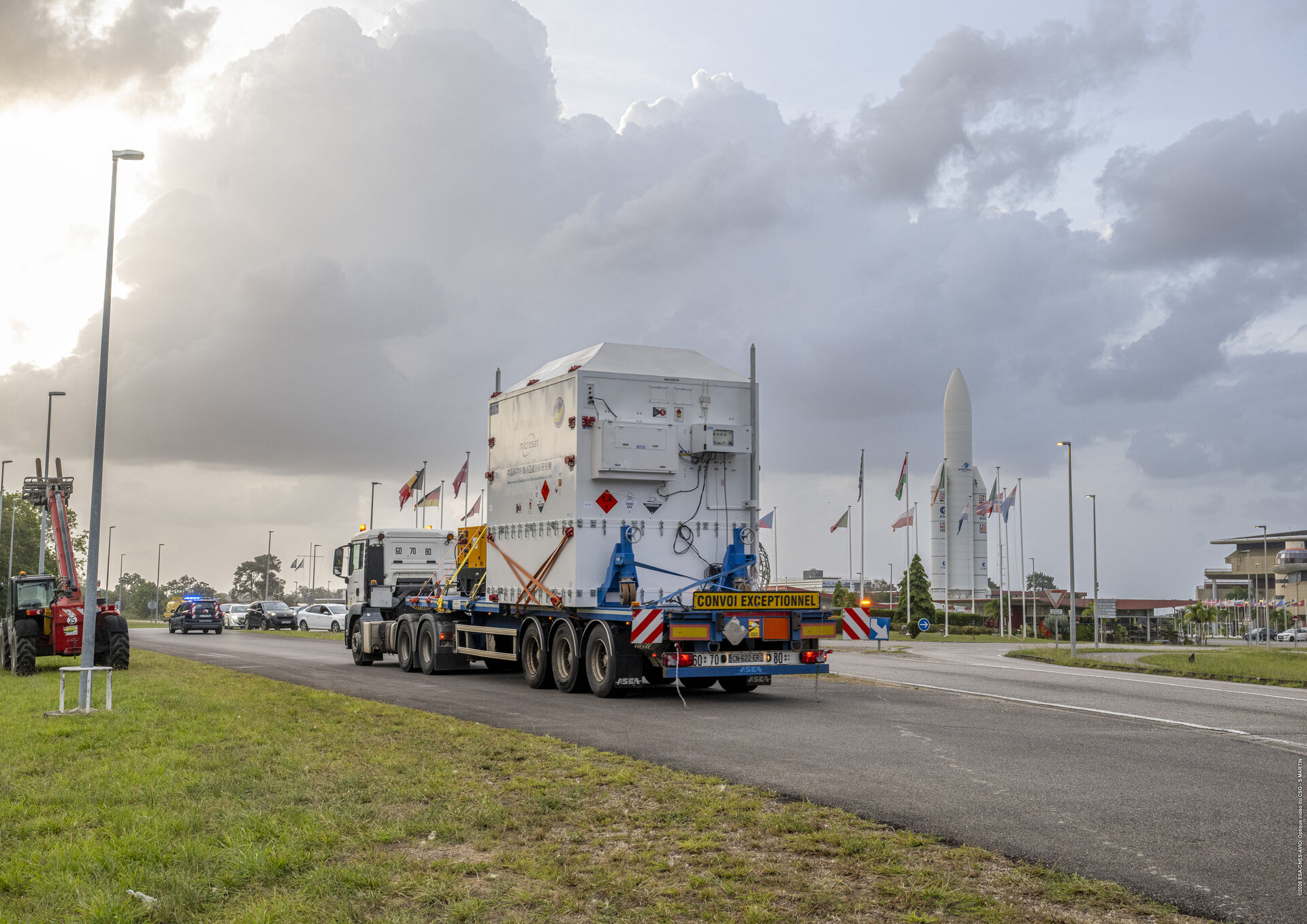
Following the docking, the containers carrying the spacecraft and accompanying equipment were carefully unloaded. They were then taken by lorry to the Spaceport, which lies just a few kilometres away from the town of Kourou.
The first task for the onsite team was to unpack the spacecraft – opening the box that it was shipped inside and gently placing it onto a dedicated platform.
Next up, Smile will go through a full health check to ensure that it wasn’t damaged during the long journey, and then ‘swallow’ 1500 kg of energising propellant for its journey in space, before finally meeting the rocket that will carry it to space.
Vega-C getting ready to launch Smile
Smile travelled to Europe’s Spaceport with another friend onboard: the Vega-C upper stage. This part of the rocket will stay attached to Smile until the last moment before dropping it off in a very precise orbit around Earth. Vega-C is a four-stage rocket with each stage expending its fuel and separating one-by-one to push Smile away from Earth’s surface.
Launch technicians have already started building the Vega-C rocket on the launch pad. Vega-C is built up in the same order each stage will fire after liftoff. First comes the P120C first stage, then the second stage Zefiro-40, and the third stage Zefiro-9. These stages run on solid propellant and provide most of the thrust needed to launch the 2300-kg spacecraft. Photos from these preparations are available here.
The fourth or ‘upper’ stage of Vega-C provides precision propulsion to drop Smile off into a low-Earth orbit. From there, the spacecraft will take over to bring itself to its final, very elliptical, operational orbit that goes 121 000 km above the North Pole to collect data, before coming 5000 km above the South Pole to deliver it to waiting ground stations.
For the latest updates on the launch preparations, visit our dedicated page.
About Smile
Smile (the Solar wind Magnetosphere Ionosphere Link Explorer) is a joint mission between the European Space Agency (ESA) and the Chinese Academy of Sciences (CAS).
Smile will use four science instruments to study how Earth responds to the solar wind from the Sun. In doing so, Smile will improve our understanding of solar storms, geomagnetic storms and the science of space weather.
ESA is responsible for providing Smile’s payload module (which carries three of the four science instruments), one of the spacecraft’s four science instruments (the soft X-ray imager, SXI), the launcher, and the Assembly Integration and Testing facilities and services. ESA contributes to a second science instrument (the ultraviolet imager, UVI) and the mission operations once Smile is in orbit.
CAS provides the other three science instruments and the spacecraft platform, and is responsible for operating the spacecraft in orbit.
Smile is part of ESA’s Cosmic Vision programme, principally contributing to answering the question ‘How does the Solar System work?’
For more information, visit: https://www.esa.int/Science_Exploration/Smile
About Vega-C
Europe’s Vega-C rocket can launch 2300 kg into space, such as small scientific and Earth observation spacecraft. At 35 m tall, Vega-C weighs 210 tonnes on the launch pad and reaches orbit with three solid-propellant-powered stages before the fourth liquid-propellant stage takes over for precise placement of satellites into their desired orbit around Earth.
Complementing the Ariane family to launch all types of payloads into their desired orbits, Vega-C ensures that Europe has versatile and independent access to space. ESA leads the Vega-C programme, working with Avio as prime contractor and design authority.
For more information, visit: https://www.esa.int/Enabling_Support/Space_Transportation/Vega/Vega-C










Related Posts
Stay Informed With the Latest & Most Important News
Previous Post
Next Post

Advertisement
-
 01Two Black Holes Observed Circling Each Other for the First Time
 -
 02From Polymerization-Enabled Folding and Assembly to Chemical Evolution: Key Processes for Emergence of Functional Polymers in the Origin of Life
 -
 03Astronomy 101: From the Sun and Moon to Wormholes and Warp Drive, Key Theories, Discoveries, and Facts about the Universe (The Adams 101 Series)
 -
 04True Anomaly hires former York Space executive as chief operating officer
 -
 05Φsat-2 begins science phase for AI Earth images
 -
 06Hurricane forecasters are losing 3 key satellites ahead of peak storm season − a meteorologist explains why it matters
 -
 07Binary star systems are complex astronomical objects − a new AI approach could pin down their properties quickly