
Now Reading: Smile spacecraft arrives in French Guiana for final launch preparations ahead of Vega-C mission
-
01
Smile spacecraft arrives in French Guiana for final launch preparations ahead of Vega-C mission

Smile spacecraft arrives in French Guiana for final launch preparations ahead of Vega-C mission

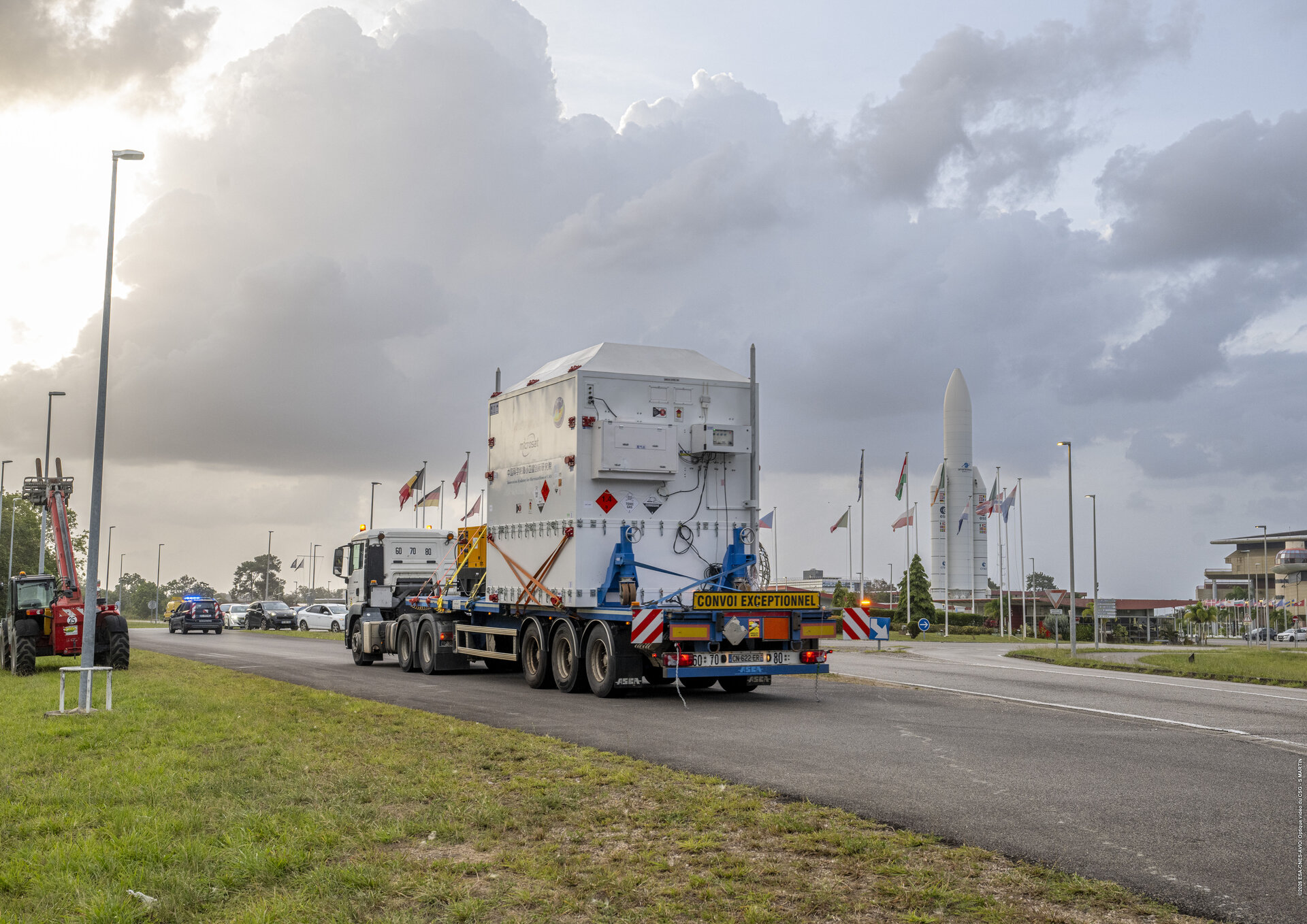

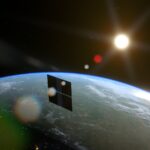
The Smile spacecraft has successfully arrived at Europe’s Spaceport in French Guiana, where it’s set to undergo final preparations for its forthcoming launch. The mission, which is scheduled to take place on a Vega-C rocket, is anticipated to occur sometime between April 8 and May 7.
After a two-week sea voyage from the Netherlands, the cargo ship MN Colibri reached Kourou on February 26. Members of the Smile team, Bruno Bras and Chris Runciman, shared their experiences of the journey, noting a dramatic transition from chilly, tumultuous waters at departure to warm, still conditions upon arrival. They emphasized their commitment to preserving the spacecraft’s environment and maintaining instrument functionality throughout the trip.
Upon docking, the containers holding the spacecraft and associated equipment were meticulously unloaded and transported by truck to the nearby Spaceport. The first action on site involved unpacking the spacecraft and placing it on a specialized platform. Next on the agenda is a thorough health assessment to verify that there were no damages incurred during the transportation. Following this check, the spacecraft will be filled with 1,500 kilograms of propellant in preparation for its space mission.
Smile traveled alongside the Vega-C upper stage, which will remain attached until just before deploying the spacecraft into its intended orbit. The Vega-C rocket is structured in four stages, each expending its fuel sequentially to propel Smile from Earth’s surface. Technicians have begun assembling the rocket on the launch pad, with the initial stage being the P120C, followed by the Zefiro-40 and Zefiro-9 stages, all designed to provide the initial thrust needed for the 2,300-kilogram spacecraft.
The fourth stage of Vega-C has a vital role, delivering precise propulsion to position Smile into a low-Earth orbit. From this orbit, Smile will travel to an operational trajectory that peaks at 121,000 kilometers above the North Pole and dips to 5,000 kilometers over the South Pole, where it will relay data back to ground stations.
Smile, short for Solar wind Magnetosphere Ionosphere Link Explorer, is a collaborative effort between the European Space Agency (ESA) and the Chinese Academy of Sciences (CAS). The mission will use four scientific instruments to investigate how Earth reacts to solar wind emissions from the Sun. Through this exploration, the mission aims to enhance our understanding of solar storms, geomagnetic events, and broader space weather phenomena.
ESA is tasked with delivering Smile’s payload module, housing three of its scientific instruments, and handling mission operations post-launch. The CAS will provide three additional instruments and oversee the spacecraft’s operations in orbit. Smile is a key component of ESA’s Cosmic Vision program, which seeks to explore fundamental questions about the workings of the Solar System.
In parallel, the Vega-C rocket, with a total height of 35 meters and launching capacity of 2,300 kilograms, stands as Europe’s reliable vehicle for deploying various scientific and Earth observation missions into space. The rocket is engineered to provide flexible launch options, ensuring robust access for Europe to the space frontier.










Related Posts
Stay Informed With the Latest & Most Important News
Previous Post
Next Post
Advertisement
-
 01Two Black Holes Observed Circling Each Other for the First Time
 -
 02From Polymerization-Enabled Folding and Assembly to Chemical Evolution: Key Processes for Emergence of Functional Polymers in the Origin of Life
 -
 03Astronomy 101: From the Sun and Moon to Wormholes and Warp Drive, Key Theories, Discoveries, and Facts about the Universe (The Adams 101 Series)
 -
 04True Anomaly hires former York Space executive as chief operating officer
 -
 05Φsat-2 begins science phase for AI Earth images
 -
 06Hurricane forecasters are losing 3 key satellites ahead of peak storm season − a meteorologist explains why it matters
 -
 07Binary star systems are complex astronomical objects − a new AI approach could pin down their properties quickly