
Now Reading: Solar array deal sheds more light on South Korea’s defense constellation
-
01
Solar array deal sheds more light on South Korea’s defense constellation


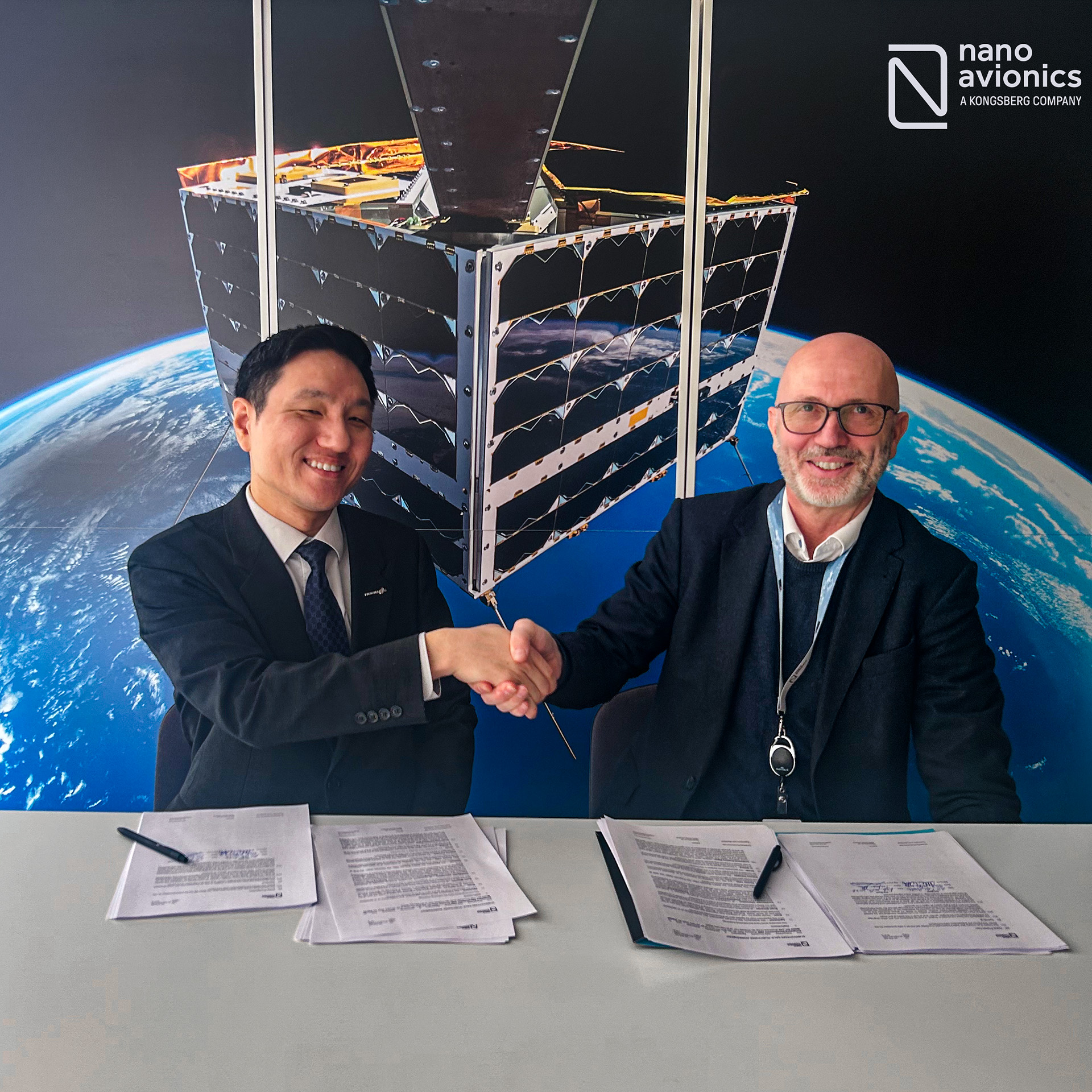

TAMPA, Fla. — South Korea’s plans for a national security constellation are coming into sharper focus after a March 18 solar array supply deal set the stage for a first demonstrator as early as the second half of 2027.
Lithuania-based small satellite specialist Kongsberg NanoAvionics announced a multi-million-euro contract to provide kilowatt-class solar arrays to Flexell Space, a South Korean space energy startup, for the low Earth orbit (LEO) network.
The deal adds to details emerging around the secretive program led by South Korean conglomerate Hanwha Systems, which recently partnered with Canada’s MDA Space and Telesat to develop next-generation LEO capabilities. MDA, a builder of communications and Earth observation satellites, is also developing Telesat’s Lightspeed LEO broadband constellation as part of the operator’s push to expand beyond geostationary orbit.
Under the agreement with NanoAvionics, Flexell will conduct final inspection and acceptance testing of the solar arrays before they are integrated into satellites being developed by Hanwha Systems.
“The first satellite is expected to be launched as early as the second half of 2027 or the first half of 2028,” Flexell founder and CEO Taehun Ahn said via email.
“It will operate as a demonstration and verification satellite for approximately one year.”
Ahn declined to provide further details about the constellation for security reasons.
Landmark contract for Lithuania
NanoAvionics CEO Atle Wøllo told SpaceNews the deal marks the satellite bus maker and mission integrator’s largest single order for solar arrays by contract value, though it is far from the only one.
“As we have grown our backlog of satellite bus orders to more than 300 units, our sales of subsystem products have also increased,” he said, pointing to an order last year for more than 50 power system components for an undisclosed constellation customer.
Wøllo said the solar array design for South Korea will use many of the same tried-and-tested materials the company has already flown on multiple customer satellites.
“However, the arrays we are building for Hanwha are larger and more powerful than what we have integrated onto our microsatellite buses in the past,” he added.
Flexell development boost
NanoAvionics is also exploring integrating Flexell’s next-generation solar cells into its cubesat and microsatellite platforms as part of the contract.
Flexell is developing Copper Indium Gallium Selenide (CIGS) and perovskite-based solar cells designed to reduce costs while maintaining performance comparable to traditional gallium arsenide technologies. Ahn said mass production is targeted for the second half of 2027.
Hanwha previously outlined plans in 2021 to deploy up to 2,000 satellites for commercial connectivity applications, including linking cargo drones and passenger aircraft.
However, Ahn said that the effort has since diverged from the defense-focused program tied to the NanoAvionics deal.










Related Posts

Stay Informed With the Latest & Most Important News
Previous Post
Next Post



Advertisement
-
 01Two Black Holes Observed Circling Each Other for the First Time
 -
 02From Polymerization-Enabled Folding and Assembly to Chemical Evolution: Key Processes for Emergence of Functional Polymers in the Origin of Life
 -
 03Astronomy 101: From the Sun and Moon to Wormholes and Warp Drive, Key Theories, Discoveries, and Facts about the Universe (The Adams 101 Series)
 -
 04True Anomaly hires former York Space executive as chief operating officer
 -
 05Φsat-2 begins science phase for AI Earth images
 -
 06Hurricane forecasters are losing 3 key satellites ahead of peak storm season − a meteorologist explains why it matters
 -
 07Binary star systems are complex astronomical objects − a new AI approach could pin down their properties quickly