
Now Reading: South African Telescope Detects Natural Radio Emission – And No Signal Of Technological Origin – From Interstellar Visitor 3I/ATLAS
-
01
South African Telescope Detects Natural Radio Emission – And No Signal Of Technological Origin – From Interstellar Visitor 3I/ATLAS

South African Telescope Detects Natural Radio Emission – And No Signal Of Technological Origin – From Interstellar Visitor 3I/ATLAS

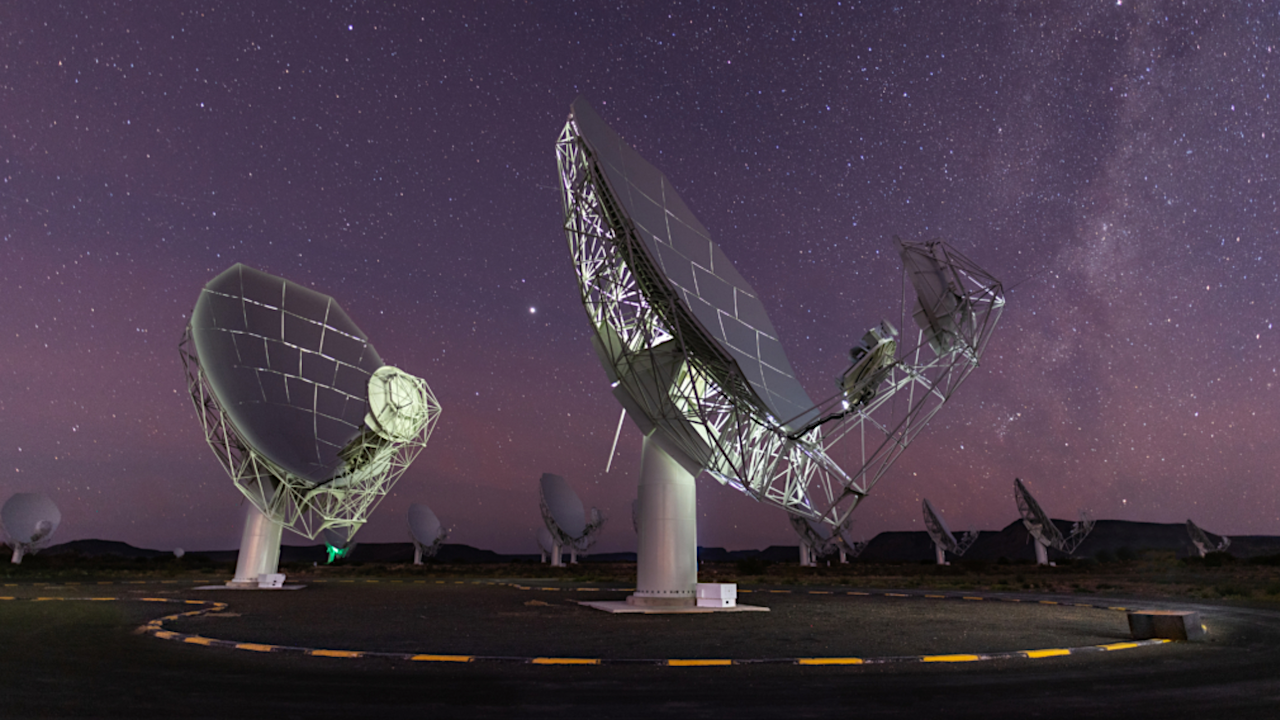
South Africa’s MeerKAT telescope. Credit: South African Radio Astronomy Observatory (SARAO).
Since its discovery on 1 July 2025 by the Asteroid Terrestrial-impact Last Alert System (ATLAS), the object known as 3I/ATLAS has captured the popular imagination, being only the third known example of an object of interstellar origin (hence, ‘3I’) to pass through our Solar System.
While many signs pointed to it being a comet, its interstellar origin fuelled all kinds of speculation, including thoughts of an artefact from an extra-solar civilization! An international team led by researchers at the University of Cape Town, the South African Radio Astronomy Observatory (SARAO), Rhodes University and the KTH Royal Institute of Technology (Sweden), has now used the powerful MeerKAT radio telescope in South Africa to learn more about this interstellar visitor.
Comets, typically consisting mostly of water ice, have a tell-tale sign that can be detected by radio telescopes – the hydroxyl maser[1]. As a comet approaches the Sun, heat boils off the ice, and solar ultraviolet (UV) light splits the water into hydrogen (H) and hydroxyl (OH).
The UV light can then ‘pump’ the OH molecules to occupy different energy states, making them either absorb or emit radio signals at very specific frequencies, which lie in MeerKAT’s operational range. The pumping process is most efficient when a comet is moving at particular velocities relative to the Sun. As the comet approaches the Sun and later departs, there are optimal time intervals for detecting OH. Crucially, in some of these ‘windows’ we can expect to see the OH spectral lines in absorption, and in others in emission.
3I/ATLAS appears to be relatively small as comets go (with size estimates ranging from a few hundred meters to a few kilometres across), and hasn’t approached the Sun particularly closely (at its closest approach it was still farther than the Earth). Any potential signal was expected to be weak, making it a challenging target to observe. However, MeerKAT is a uniquely capable instrument for the job.
Firstly, it is the world’s most sensitive and versatile telescope in this wavelength regime. Secondly, it can observe quite close to the Sun (including where optical telescopes cannot go at all) – and the amount of hydroxyl produced by 3I/ATLAS is expected to be highest when it is closest to the Sun.
MeerKAT has a third ace up its sleeve – the BLUSE instrumentation installed and operated by the Breakthrough Listen project, which runs in parallel with the standard instrumentation whenever the telescope observes, and sifts through its data for specific narrowband signals that signpost technological (as opposed to natural) origin, the so-called technosignatures.
Two observations on 20 and 28 September 2025 yielded no detection of hydroxyl (although in one of them MeerKAT did serendipitously see a hydroxyl maser from a Mira-type variable star, which happened to be in the same field of view, confirming that the telescope was working as expected). Finally, on 24 October the team detected hydroxyl absorption from 3I/ATLAS in the 1665 and 1667 MHz transitions, at the expected velocity for the hydroxyl maser.
At that time, 3I/ATLAS was more than 350 million kilometers from the Earth. This was followed by detection of more absorption on 4 and 6 November, followed by emission on 11-12 November – exactly as expected! “Detecting the hydroxyl signal is an important confirmation that 3I/ATLAS is behaving like a comet,” says Professor Mykola Ivchenko from KTH Sweden.
Contemporaneously with these observations, the Breakthrough Listen team meticulously analyzed the BLUSE data from observations on 5 November, and confirmed that no narrowband signals between 900 and 1670 MHz were detected from the direction of 3I/ATLAS. Given the distance to the comet at the time, this corresponds to a power limit of 0.17 W, which is less than the emission from a cell phone. (In practical terms, this limit means that MeerKAT with BLUSE is sensitive enough to detect a cell phone at hundreds of millions of kilometres!)
In conclusion, MeerKAT observations confirm that 3I/ATLAS is acting as a comet and do not detect signals from it of technological origin. “We’re happy that we are contributing, alongside colleagues around the world, to a fuller understanding of this remarkable natural phenomenon – a comet likely formed in another stellar system that is briefly passing through our own”, said SARAO chief scientist Fernando Camilo.
The study was led by Professor DJ Pisano (UCT), Distinguished Professor Oleg Smirnov (Rhodes University & SARAO), Sarah Buchner (SARAO), Prof Mykola Ivchenko and Dr Lorenz Roth (KTH Royal Institute of Technology, Sweden), Dr Chenoa Tremblay (SETI Institute / Breakthrough Listen), and was made possible by the entire SARAO and Breakthrough Listen teams.
The MeerKAT telescope is operated by the South African Radio Astronomy Observatory, which is a facility of the National Research Foundation, an agency of the Department of Science, Technology and Innovation.
Astrobiology, SETI, Technosignatures,










Related Posts

Stay Informed With the Latest & Most Important News





Advertisement
-
 01Two Black Holes Observed Circling Each Other for the First Time
 -
 02From Polymerization-Enabled Folding and Assembly to Chemical Evolution: Key Processes for Emergence of Functional Polymers in the Origin of Life
 -
 03Astronomy 101: From the Sun and Moon to Wormholes and Warp Drive, Key Theories, Discoveries, and Facts about the Universe (The Adams 101 Series)
 -
 04True Anomaly hires former York Space executive as chief operating officer
 -
 05Φsat-2 begins science phase for AI Earth images
 -
 06Hurricane forecasters are losing 3 key satellites ahead of peak storm season − a meteorologist explains why it matters
 -
 07Binary star systems are complex astronomical objects − a new AI approach could pin down their properties quickly