
Now Reading: Space Force seeks market answers on in-orbit refueling
-
01
Space Force seeks market answers on in-orbit refueling


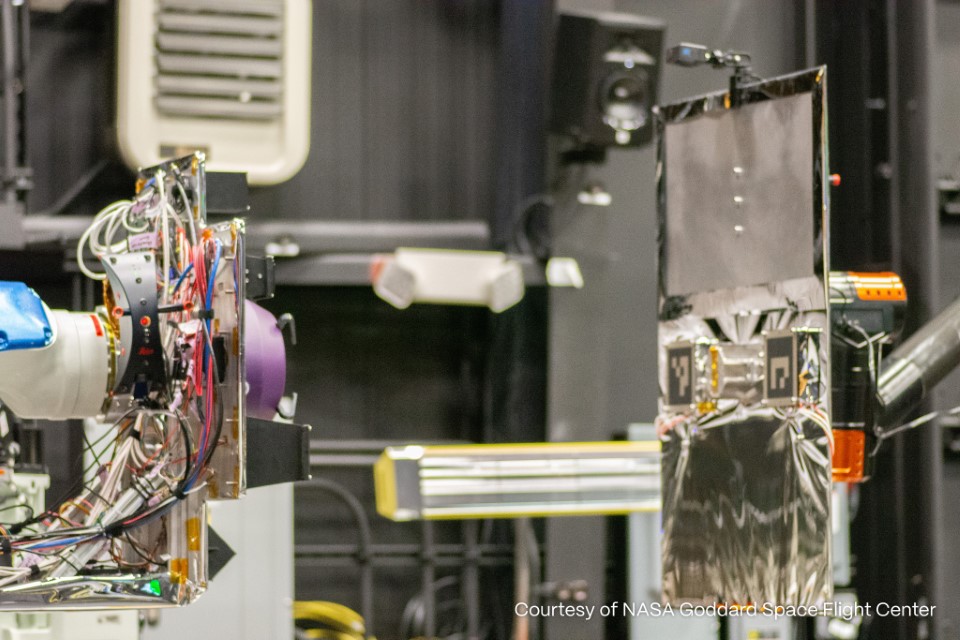

WASHINGTON — As it plans for a future in which satellites can be refueled in orbit, the U.S. Space Force has taken a step that signals intent without yet committing to a full logistics network.
Earlier this month, the service sought industry input through a request for information issued by the Servicing, Mobility and Logistics program office within Space Systems Command. The RFI asks for “technical concepts and approaches to refueling services for prepared clients in orbit,” with an expectation that solutions could be operational by 2030.
“The RFI is a very positive step,” said Clare Martin, senior vice president of Astroscale U.S..
Astroscale is building a refueling vehicle, partially funded by the Space Force, and preparing for its first mission in geostationary orbit. The spacecraft, called Provisioner, will attempt hydrazine refueling operations of a U.S. military satellite.
In 2024, the service selected two refueling ports — RAFTI and PRM — as its preferred hardware interfaces for spacecraft that may one day receive fuel on orbit. The move provides satellite manufacturers and servicing companies with clearer guidance on how to design vehicles that can connect in space.
But selecting ports is the beginning, not the end, of the effort.
An interface standard does not ensure that tankers will exist in sufficient numbers, that propellant types will align across programs or that pricing will be competitive with simply replacing a satellite. Nor does it answer how refueling vehicles would operate in a contested environment. The Space Force still lacks visibility into whether a commercial refueling market will mature on its own or require sustained government underwriting.
Two interfaces selected
Astroscale’s Provisioner is equipped with RAFTI, short for Rapidly Attachable Fluid Transfer Interface, developed by Orbit Fab.
The second selected port, PRM, or Passive Refueling Module, was developed by Northrop Grumman.
By selecting two interfaces, Martin said, the Space Force is acknowledging that multiple technical approaches may coexist. The goal is to reduce fragmentation without locking in a single vendor.
Although Provisioner uses RAFTI, “as a company, we are interface agnostic,” Martin said. “We try not to get locked into the widget and focus instead on providing the solution.”
Leading up to the selection, the Space Force “put a lot of time and work into assessing them and their capability,” she said, adding that RAFTI and PRM are the most mature options. “They’ve specified those interfaces, but they’ve left the rest up to industry to determine how you would interact with them.”
From an acquisition standpoint, the selection is meant to enable future service contracts. If multiple national security satellite programs converge on compatible ports, the government could buy refueling “as a service” rather than paying to integrate a bespoke solution for each mission.
The RFI suggests the Space Force is looking beyond demonstration missions toward a broader architecture. “It is a good sign that the work they’re doing now is going to move beyond this initial phase and into the future,” Martin said.
That next phase involves questions that extend well beyond a docking port.
Companies like Astroscale, Northrop Grumman and others are developing shuttles that would travel between a client satellite and a propellant depot. For PRM-equipped spacecraft, Northrop has developed an Active Refueling Module to transfer fuel. Orbit Fab has developed a nozzle system known as GRIP to interface with RAFTI.
The architecture itself remains unsettled. “You could have a client vehicle go straight to a depot. You could have a depot come to a client. Or you can have the service shuttle move between the two,” Martin said.
Building that ecosystem requires coordination across suppliers. “In order to give us the building blocks from which we can build our services, we’ll need to look at how we actually source the fuel. Where do you get the hydrazine from? We’ll need to work with the actual launch providers themselves, understand whether you need to go direct, whether you can do geostationary transfer, availability of launches, size of launch vehicle,” she said. “So it’s a whole industry solution that would be required.”
Astroscale’s launch timeline is yet to be determined, though integration and testing are under way. “We’ll be ready to launch this year,” Martin said.
Space Force officials have said the mission will deploy two small satellites equipped with the RAFTI port. One satellite will attempt to dock with an Orbit Fab propellant depot. The second will dock with Astroscale’s fuel shuttle.










Related Posts

Stay Informed With the Latest & Most Important News




Advertisement
-
 01Two Black Holes Observed Circling Each Other for the First Time
 -
 02From Polymerization-Enabled Folding and Assembly to Chemical Evolution: Key Processes for Emergence of Functional Polymers in the Origin of Life
 -
 03Astronomy 101: From the Sun and Moon to Wormholes and Warp Drive, Key Theories, Discoveries, and Facts about the Universe (The Adams 101 Series)
 -
 04True Anomaly hires former York Space executive as chief operating officer
 -
 05Φsat-2 begins science phase for AI Earth images
 -
 06Hurricane forecasters are losing 3 key satellites ahead of peak storm season − a meteorologist explains why it matters
 -
 07Binary star systems are complex astronomical objects − a new AI approach could pin down their properties quickly