
Now Reading: Space Force top buyer says rapid commercial innovation is reshaping military space strategy
-
01
Space Force top buyer says rapid commercial innovation is reshaping military space strategy

Space Force top buyer says rapid commercial innovation is reshaping military space strategy

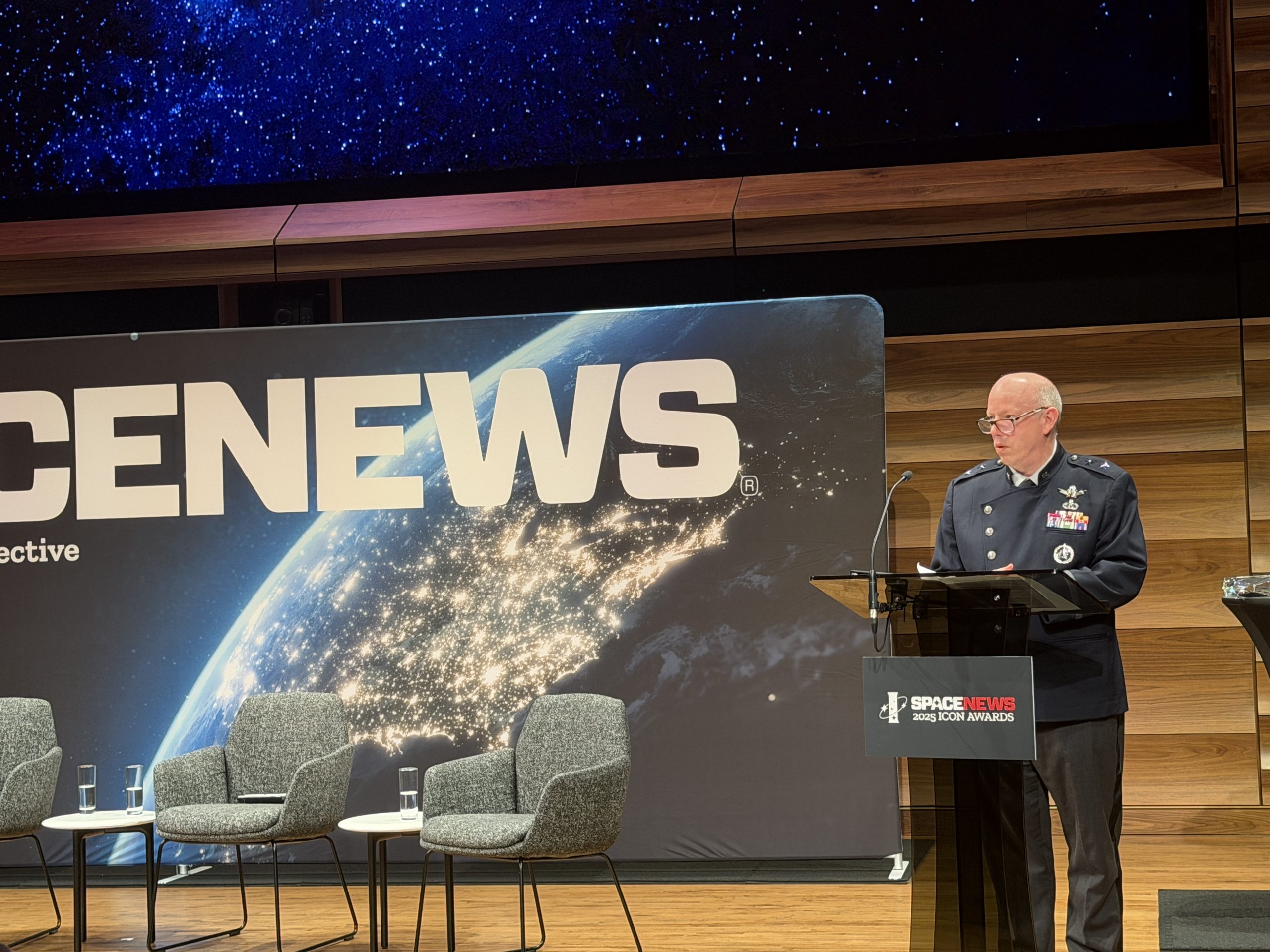

WASHINGTON — Maj. Gen. Stephen Purdy, the U.S. Space Force’s top acquisition officer, told an audience of space industry executives Dec. 2 that the Pentagon’s future in orbit will depend on how effectively it harnesses private-sector innovation.
Speaking at the 2025 SpaceNews Icon Awards, Purdy said the pace of progress outside government is setting the agenda for how the service develops technology for space operations and space warfare.
“I’ve met with 150 companies this year, which seems like a lot, but actually … is probably about the right number,” Purdy said. The remark captured a central theme of his talk: the Space Force cannot build the future of military space power without constant engagement with private industry.
“You all have been innovating to amazing levels this year,” he told the audience, adding that emerging companies are “moving at tremendous speeds. We have to stay engaged to understand that.”
Purdy noted that many of the technologies that now populate the Space Force’s early-stage development pipeline are funded through the Small Business Innovation Research program, the federal seed fund that for decades has underwritten commercial experimentation across the defense and aerospace sector.
The program’s authority expired Sept. 30, and Congress has yet to renew it. That lapse has already halted new SBIR solicitations and awards across the Defense Department, including the Space Force.
Through SBIR, “we have been able to build a vibrant industry,” Purdy said, urging lawmakers to restore the program. He called on Congress to “get back into an authorization pathway,” saying “I’m really hopeful for that. I think space has shown that we can take that authority and take that funding and use it for really good measures.”
The House has approved a simple one-year extension. The Senate is pushing the INNOVATE Act, a bill that would add new oversight tools, including limits designed to curb “SBIR mills,” or firms that repeatedly win early-stage awards without producing deployable technology. So far, neither chamber has found a compromise, leaving agencies in limbo.
The Space Force relies heavily on SBIR because it views commercial space as a fast-moving proving ground. Under the Space Force’s model, early phase SBIR contracts give startups small injections of capital. Companies that show real technical traction can then compete for Tactical Funding Increase (TACFI) and Strategic Funding Increase (STRATFI) agreements. These programs require firms to bring private capital to the table, pairing government funds with venture investment to accelerate development and reduce risk.
‘Copy and paste’ of commercial-style procurement
Purdy also spoke about the Space Force’s efforts to replicate recent successes in launch procurement across other mission areas. The Pentagon, he noted, has taken notice of how the service structured the National Security Space Launch program to bring new entrants into national security missions while preserving reliability for the most sensitive payloads.
“We’re actually adopting that commercial model to multiple other mission areas,” Purdy said. “And the senior folks in the Department of War and OMB really like that approach. So we’re looking to copy and paste that one.”
The newest version of that framework, NSSL Phase 3, uses a two-lane contracting strategy. Lane 1 is built for commercial-style missions that can tolerate more schedule or performance variability, giving newer or nontraditional providers a realistic path to compete. Lane 2 is reserved for the most demanding national security payloads, which require strict certification and proven reliability.
The structure is meant to reduce the government’s reliance on a small number of providers while keeping guardrails in place for missions the Pentagon cannot afford to lose.
Leadership transition ahead
Purdy commented that his time in the acting civilian acquisition post is nearing its statutory limit. Leaders in an acting capacity can serve only 12 months in the role. Once a civilian nominee is appointed, he will return to his position as military deputy in the Space Force’s acquisition office.
Purdy is using his final weeks in the acting role to push for continued changes to the Space Force’s acquisition process, aligning the service with a broader Pentagon effort to overhaul how the department buys and fields new defense technologies. “We’ve got a lot more work to do,” he said. “We really view space acquisition as on a wartime footing.”










Related Posts



Stay Informed With the Latest & Most Important News
Previous Post
Next Post





Advertisement
-
 01Two Black Holes Observed Circling Each Other for the First Time
 -
 02From Polymerization-Enabled Folding and Assembly to Chemical Evolution: Key Processes for Emergence of Functional Polymers in the Origin of Life
 -
 03Astronomy 101: From the Sun and Moon to Wormholes and Warp Drive, Key Theories, Discoveries, and Facts about the Universe (The Adams 101 Series)
 -
 04True Anomaly hires former York Space executive as chief operating officer
 -
 05Φsat-2 begins science phase for AI Earth images
 -
 06Hurricane forecasters are losing 3 key satellites ahead of peak storm season − a meteorologist explains why it matters
 -
 07Binary star systems are complex astronomical objects − a new AI approach could pin down their properties quickly