
Now Reading: Space Force’s acquisition arm races to rebuild contracting workforce after civilian cuts
-
01
Space Force’s acquisition arm races to rebuild contracting workforce after civilian cuts

Space Force’s acquisition arm races to rebuild contracting workforce after civilian cuts


WASHINGTON — Space Systems Command, the primary acquisition and space development arm of the U.S. Space Force, is moving to hire contracting and procurement specialists as it tries to recover from the loss of hundreds of civilian professionals last year following broader federal staffing reductions under the Trump administration.
Those reductions, driven by voluntary early retirement and deferred resignation programs, hit particularly hard in acquisition and contracting roles just as the Pentagon is pushing the military services to move faster and adopt new procurement approaches. Space Force leaders now say the resulting workforce gap is emerging as a central constraint on their ability to execute modernization plans.
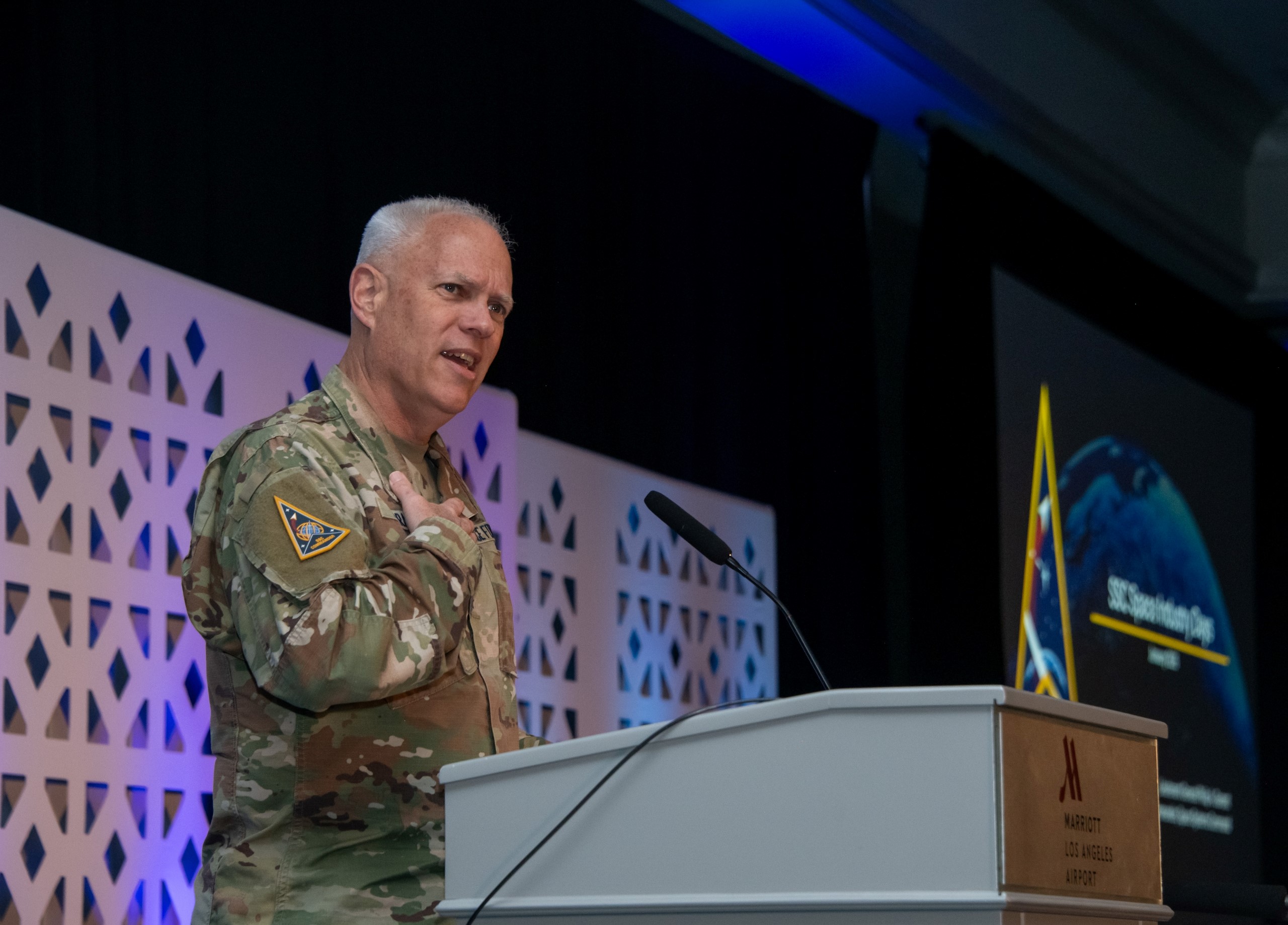
The Space Systems Command, as well as the entire Department of the Air Force, is “getting after the need for more contracting resources, especially in light of acquisition reform guidance,” Lt. Gen. Philip Garrant, commander of SSC, said Jan. 22 at the AFCEA Space Industry Days conference in Los Angeles.
The Pentagon’s acquisition reform guidance released in November calls on the department to develop procurement talent capable of executing reforms intended to speed modernization and make greater use of commercial technology. But Garrant said the combination of last year’s downsizing and a protracted government shutdown in the fall has made it difficult to refill vacant positions. One potential remedy, he said, is expanded authority to hire remote workers, which would widen the candidate pool beyond traditional government hubs.
‘My greatest challenge’
“I will offer that is my greatest challenge as the commander of SSC,” Garrant said of the contracting workforce shortages. “That’s what worries me the most.”
The concern could intensify if defense funding grows sharply in the coming years. President Trump has floated a $1.5 trillion defense budget for 2027, a level that would likely translate into new starts and expanded portfolios for the Space Force.
“If you’ve been listening to the president, he’s talking about a one and a half trillion dollar top line for the Department of War in 2027,” Garrant said. “The Space Force is going to get a significant part of that, and SSC in particular, is going to get a number of new programs.”
Garrant emphasized that it is too early to speculate about which programs might be expanded, noting that those decisions would rest with the Pentagon. His immediate concern, he said, is ensuring that any new program offices can be staffed without draining resources from existing ones.
“My top priority is to resource those brand new program offices without harming the existing program offices,” he said. “We lost a number of contracting officers through voluntary early retirement and deferred resignation programs last year, and we are seeking relief on some of our remote contracting officers.”
SSC is considering hiring contractors to work as buyers to help ease the workload, but Garrant described that as a stopgap rather than a durable fix. “The problem with contracting buyers, while you get a great pool of seasoned professionals to do the work, you’re not developing your next generation of contracting officers.”
Programs move at slower pace
The shortage has already had measurable effects. Garrant said insufficient contracting capacity slows procurement timelines, running counter to Pentagon directives to accelerate acquisition. During the government shutdown, he said, programs continued to move forward but at a slower pace.
“It’s not trivial, and I will tell you, during the shutdown, we saw real impacts,” he said. “The work got done, but it took longer.”
To rebuild the pipeline, SSC is recruiting college graduates interested in starting government careers and reaching out to military spouses who could work remotely without special waivers. The command is also seeking broader exemptions to allow remote hiring across more positions.
“We are working to try to get an exception to continue to do remote hiring” more broadly, Garrant said.
“I would love to hire more,” he added. “My ability to get military contracting officers is pretty limited, because they have to support the Air Force as well. We would love to hire civilians.”
Geography adds another layer of difficulty. SSC’s main operations are in Los Angeles, a competitive and expensive labor market for technical professionals. To expand hiring options, the command has opened offices in Huntsville, Alabama; Albuquerque, New Mexico; Colorado Springs, Colorado; Boston; and Washington, D.C.
“If I’m successful in getting an exemption for remote hiring, then all things are possible,” Garrant said.
He noted that recent developments have at least reopened the door to rebuilding the workforce. “The good news,” he said, “is we have been given all of the authority to restart all of our hiring, both on the Air Force and Space Force side, for our civilians. So we are aggressively hiring against our vacancies, prioritized by mission area, prioritized by location. I will continue to beat the drum that contracting is my priority.”
Problems executing programs
Outside analysts say the contracting gap represents a structural risk for the Space Force as its budgets grow. American Enterprise Institute senior fellow Todd Harrison highlighted the issue in remarks last week on a call with industry analysts hosted by Vertical Research Partners.
Harrison argued that the Space Force’s modernization risk in 2026 is not a lack of funding but an execution gap driven by a shrinking acquisition workforce managing increasingly complex programs.
“What I would say about space right now is they are flush with funding in the Space Force for space programs, and the challenge is really execution,” Harrison said.
The problem, he added, is that the workforce needed to move that money has contracted. “The way I think of it is they’re almost choking on funding, and how to move forward with these programs.”
Space Force leaders told Congress last year that the service shed nearly 14 percent of its civilian workforce overall — roughly 780 personnel — through early retirements, voluntary resignations and hiring freezes, a significant blow to its acquisition and program support base.
The bottleneck matters because contracting officers are the ones who “get the money moving and the programs flowing,” Harrison said. Without a rebuilt procurement workforce, he warned, additional funding or new program starts could further strain the system rather than accelerate delivery.










Related Posts


Stay Informed With the Latest & Most Important News
Previous Post
Next Post



Advertisement
-
 01Two Black Holes Observed Circling Each Other for the First Time
 -
 02From Polymerization-Enabled Folding and Assembly to Chemical Evolution: Key Processes for Emergence of Functional Polymers in the Origin of Life
 -
 03Astronomy 101: From the Sun and Moon to Wormholes and Warp Drive, Key Theories, Discoveries, and Facts about the Universe (The Adams 101 Series)
 -
 04True Anomaly hires former York Space executive as chief operating officer
 -
 05Φsat-2 begins science phase for AI Earth images
 -
 06Hurricane forecasters are losing 3 key satellites ahead of peak storm season − a meteorologist explains why it matters
 -
 07Binary star systems are complex astronomical objects − a new AI approach could pin down their properties quickly