
Now Reading: Space Ionizing Radiation Triggers The Formation Of Peptides And Organophosphates On Olivine Surfaces
-
01
Space Ionizing Radiation Triggers The Formation Of Peptides And Organophosphates On Olivine Surfaces

Space Ionizing Radiation Triggers The Formation Of Peptides And Organophosphates On Olivine Surfaces

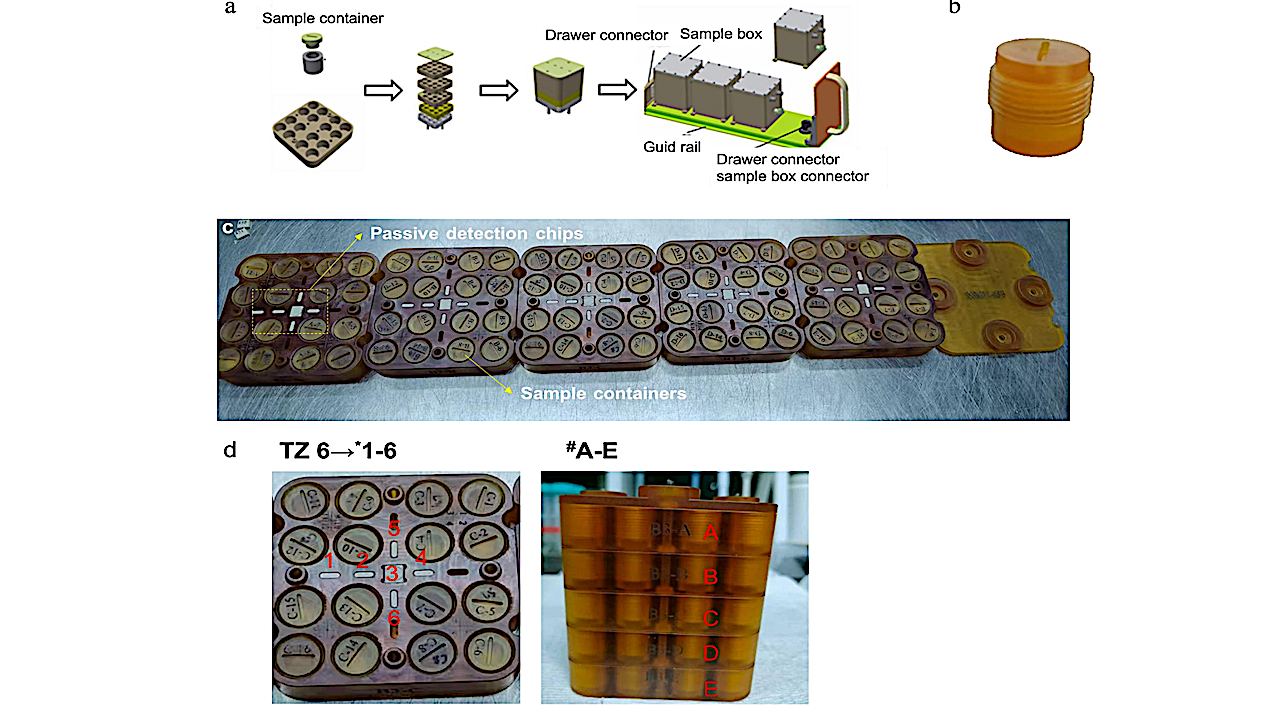

The schematic diagram of the Space Radiobiological Exposure Facility. — Nature Communications
Bioorganic molecules, such as amino acids, nucleobases, and sugars, are widely distributed in space.
Here, we utilized the Chinese Space Station to carry out an investigation on the solid-state condensation reactions of these “prebiotic organic molecules” under the combined effects of ionizing radiation and forsterite. Cumulative low-dose ionizing radiation can trigger dipeptide formations and phosphorylation of riboses.
Dipeptide yields increased 41-fold due to the synergistic effect of forsterite plus sodium trimetaphosphate (P3m). P3m is activated upon irradiation to phosphorylate nucleosides into nucleotides. Under ionizing radiation, forsterite can promote hydroxyapatite to serve as an accessible phosphorus source for activating amino acids to form peptides.
These findings indicate that complex biomolecules can be formed abiotically in space through ionizing radiation activation with the assistance of forsterite in certain radiation – resistant environments distant from planetary surfaces.
It implies that apart from transporting prebiotic organic molecules to Earth, space can also provide opportunities for the in-situ assembly of ordered biomolecules from these disordered materials.
Space ionizing radiation triggers the formation of peptides and organophosphates on olivine surfaces, Nature Communications (open access)
Astrobiology, Astrochemistry, Astrogeology,











Related Posts
Stay Informed With the Latest & Most Important News
Previous Post
Next Post


Advertisement
-
 01Two Black Holes Observed Circling Each Other for the First Time
 -
 02From Polymerization-Enabled Folding and Assembly to Chemical Evolution: Key Processes for Emergence of Functional Polymers in the Origin of Life
 -
 03Astronomy 101: From the Sun and Moon to Wormholes and Warp Drive, Key Theories, Discoveries, and Facts about the Universe (The Adams 101 Series)
 -
 04True Anomaly hires former York Space executive as chief operating officer
 -
 05Φsat-2 begins science phase for AI Earth images
 -
 06Hurricane forecasters are losing 3 key satellites ahead of peak storm season − a meteorologist explains why it matters
 -
 07Binary star systems are complex astronomical objects − a new AI approach could pin down their properties quickly