
Now Reading: Space sustainability will evolve into a data-driven system
-
01
Space sustainability will evolve into a data-driven system



If you stayed in a hotel last night, there’s a good chance you saw that familiar placard in the bathroom: “Help save the planet — hang your towel and we won’t wash it.” At a recent panel, I asked the audience how many had seen that sign. Most hands went up. Then I asked them to keep their hands raised if they believed the hotel put that sign there because it genuinely wanted to save the planet. Every hand went down!
And that, I told them, is how governments feel about Kessler syndrome. It’s a dynamic we see across the space domain.
We like to invoke the image of a runaway chain reaction of collisions, but our behavior shows we don’t treat it as imminent. It’s the orbital equivalent of the towel card: something we acknowledge rhetorically, gesture toward symbolically, but rarely invest in solving materially. And nothing illustrates that better than what happened on Intelsat-33E.
The sustainability wake-up call we ignored
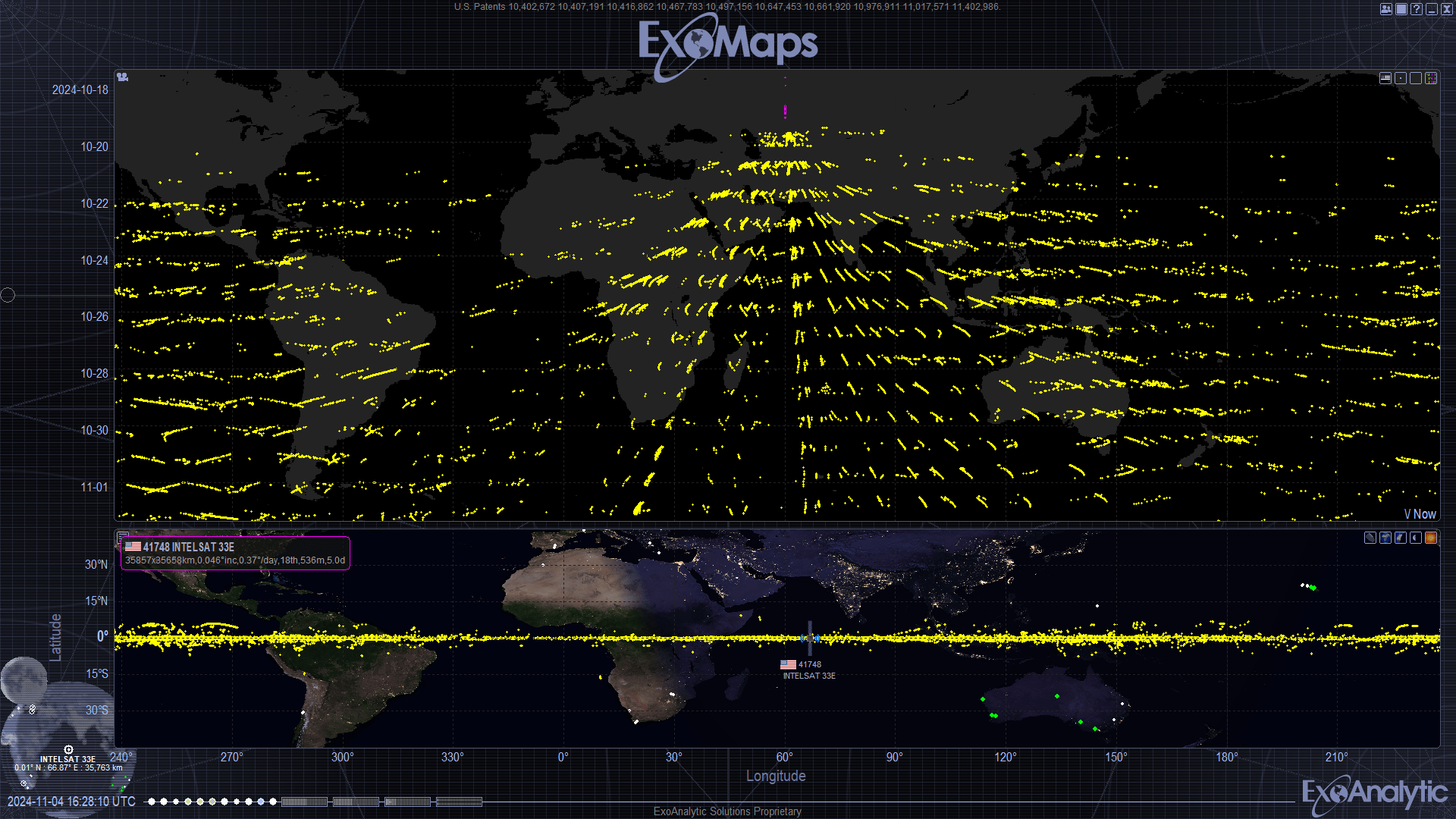
IS-33E failed suddenly aaround 4:32 UTC on Oct. 19, 2024. ExoAnalytic and others confirmed a major breakup event. Over the following two weeks, our sensors tracked hundreds of debris fragments, and we now assess the total population to exceed 1,000 pieces. This was not a hypothetical Kessler cascade — it was a real, present-day GEO fragmentation with real risk to operators across longitudes.
And yet, not one government approached us to request a full debris characterization or to fund a detailed assessment. No coalition was formed. No coordinated response was initiated. No regulatory body called for a deeper investigation.
If Kessler Syndrome were truly treated as an urgent threat, IS-33E would have triggered the orbital equivalent of a national transportation safety investigation. Instead, it landed somewhere between polite interest and institutional silence.
This is not because space agencies or operators don’t care. It’s because modern “sustainability” is still treated as a narrative, not a system. The global spaceflight community has more commitments, guidelines and charters than ever before — but the IS-33E example proves we have far fewer mechanisms to generate, share and act upon the data that sustainability actually depends on.
Sustainability is a data problem first
For all the lofty language surrounding norms and responsible behavior, the foundational truth is simple: Space sustainability is a data problem, a coordination problem and a persistence problem.
You cannot manage what you cannot see. You cannot coordinate what you cannot characterize. You cannot sustain what you cannot monitor continuously.
And in 2025, we saw how fragile the system is: Megaconstellations are growing faster than global sharing frameworks. Space weather storms forced thousands of unplanned maneuvers, exposing coordination gaps. Untracked debris continues to rise even as tracked catalog numbers increase. ISAM and debris-removal missions show extraordinary promise — but also dual-use ambiguity when not persistently monitored.
Sustainability frameworks like ESA’s Zero Debris Charter, NASA’s Space Sustainability Strategy and the EU Space Act represent real progress — but they don’t yet ensure the operational visibility required to enforce their own goals. This is why 2026 cannot be just another year of ambition. It must be the year we begin treating sustainability like engineering, not marketing.
What 2026 must demand
If the space community wants sustainability to mean something in 2026, three shifts must occur.
Zero Debris and the EU Space Act are encouraging, but only if supported by persistent, high-fidelity SDA capable of measuring progress and detecting deviations. We need fewer surprises. Fewer unannounced failures. Fewer blind spots in storms. Fewer “mystery objects” triggered by incomplete data. And megaconstellation operators must share more — especially during solar events.
Debris removal missions must demonstrate transparency to avoid misinterpretation. Civil space tracking management systems must integrate commercial SDA at speed. Sustainability cannot rely on the assumption that everyone will do the right thing. It must rely on knowledge, shared early, persistently and without ambiguity. Sustainability is achieved when surprises are rare, transparency is normal and safety is not an aspiration but an observable condition.
If 2024 taught us anything, it’s that we can no longer afford sustainability as a towel-card gesture. If 2025 taught us anything, it’s that policy momentum without operational visibility is insufficient. And if 2026 is going to be different, it will be because we finally treated sustainability not as a slogan, but as a system — built on data, coordination and persistent truth.
Clinton Clark is chief growth officer at ExoAnalytic Solutions.
Ralph “Dinz” Dinsley is general manager at 3S Northumbria.
This article was first published in the January 2026 issue of SpaceNews Magazine.
SpaceNews is committed to publishing our community’s diverse perspectives. Whether you’re an academic, executive, engineer or even just a concerned citizen of the cosmos, send your arguments and viewpoints to opinion (at) spacenews.com to be considered for publication online or in our next magazine. If you have something to submit, read some of our recent opinion articles and our submission guidelines to get a sense of what we’re looking for. The perspectives shared in these opinion articles are solely those of the authors and do not necessarily represent their employers or professional affiliations.










Related Posts
Stay Informed With the Latest & Most Important News
Previous Post
Next Post

Advertisement
-
 01Two Black Holes Observed Circling Each Other for the First Time
 -
 02From Polymerization-Enabled Folding and Assembly to Chemical Evolution: Key Processes for Emergence of Functional Polymers in the Origin of Life
 -
 03Astronomy 101: From the Sun and Moon to Wormholes and Warp Drive, Key Theories, Discoveries, and Facts about the Universe (The Adams 101 Series)
 -
 04True Anomaly hires former York Space executive as chief operating officer
 -
 05Φsat-2 begins science phase for AI Earth images
 -
 06Hurricane forecasters are losing 3 key satellites ahead of peak storm season − a meteorologist explains why it matters
 -
 07Binary star systems are complex astronomical objects − a new AI approach could pin down their properties quickly