
Now Reading: SpaceX and Amazon spar over satellite deployments
-
01
SpaceX and Amazon spar over satellite deployments


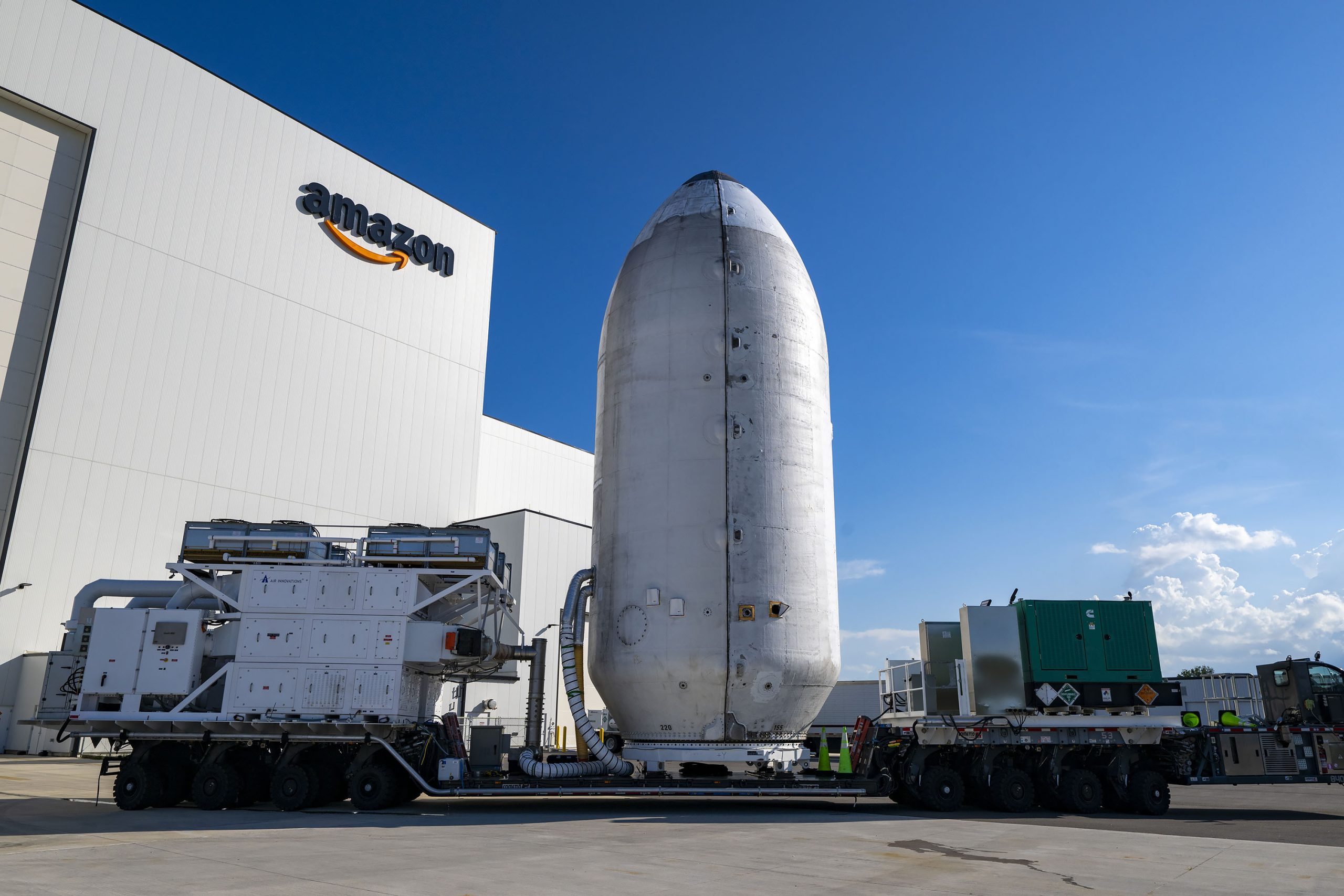

WASHINGTON — Amazon says it will revise deployment plans for its broadband satellite constellation while denying claims from SpaceX that its current approach represents a space safety risk.
In an April 1 letter to the Federal Communications Commission, SpaceX alleged that Amazon was violating the orbital debris mitigation plan included in its FCC license by launching satellites into higher altitudes, putting them close to SpaceX’s Starlink constellation.
According to SpaceX, Amazon has been deploying satellites into orbits 50 to 90 kilometers higher than the conditions of its license, which call for deployments after launch “at or near” 400 kilometers altitude. After checkouts in that lower orbit, each satellite would then maneuver to its higher operational orbit.
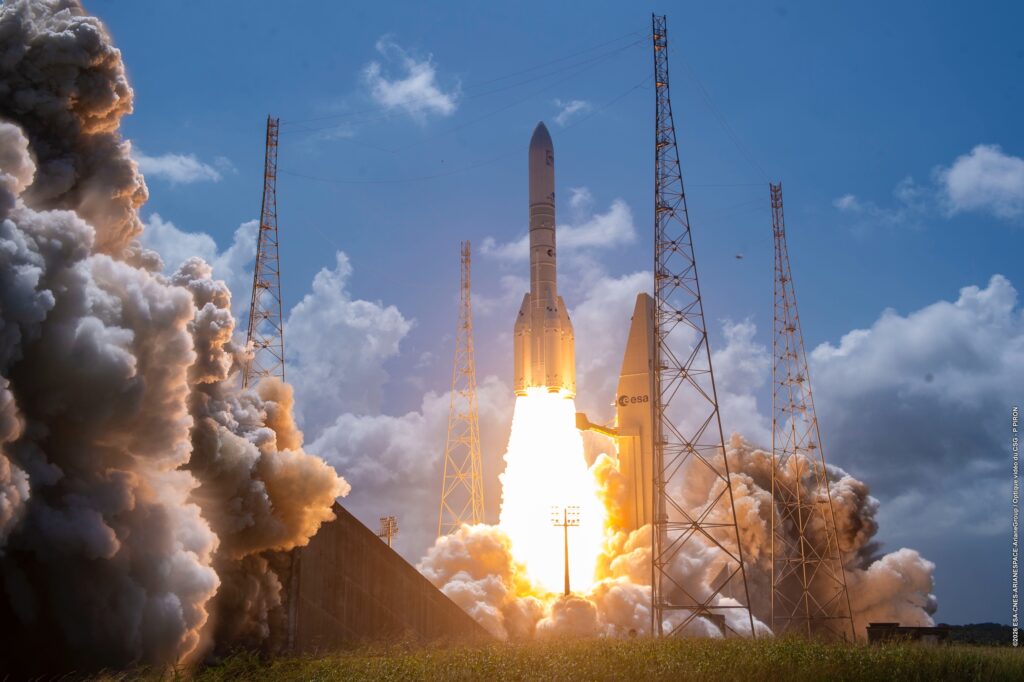
SpaceX said that issue took place on eight previous launches but came to a head on a Feb. 12 launch of 32 Amazon Leo satellites on an Ariane 6. Those deployments took place at an altitude “sufficiently high that it led to unmitigable collision risks with dozens of operational spacecraft,” SpaceX stated.
Amazon did not update its debris mitigation plan or provide ephemerides, or predicted maneuver plans, for those satellites. That lack of coordination, SpaceX claimed, “significantly increased the risks to all satellite operations near the 480 km insertion altitude as well as to inhabited spacecraft.”
SpaceX said on that launch alone Starlink satellites had to perform 30 collision avoidance maneuvers within hours. “Amazon must therefore swiftly ensure its launch plans comport with its authorization before it creates irreparable harm,” it concluded.
Amazon, in a response filed with the FCC April 2, said that the FCC license does not require it to deploy satellites at exactly 400 kilometers but instead provides “some flexibility” to meet mission requirements.
Amazon added that SpaceX did not raise an issue with a higher insertion altitude when Amazon satellites launched on three Falcon 9 rockets in 2025. Those satellites were deployed to initial altitudes of 460 kilometers.
“SpaceX only began raising the issues described in its letter within the last several months, after lowering the altitude of its Starlink constellation to 475, 480, and 485 km,” Amazon stated. SpaceX announced at the beginning of the year it would move thousands of its Starlink satellites from orbits around 550 kilometers down to 480 kilometers, a shift it billed as improving space safety.
“The issues raised by SpaceX do not involve violation of Commission rules or industry standards,” Amazon argued in its letter. “Amazon Leo’s launch and insertion parameters comply with industry standards and best practices.”
“Amazon Leo has nevertheless taken SpaceX’s concerns and risk posture seriously, attempting to work with SpaceX to find mutually acceptable solutions,” it stated. However, it noted that changing the deployment altitudes of satellites requires up to a year of assessment with launch providers to complete various technical analyses.
“When it became clear that changing near-term Ariane launch parameters would cause multi-month delays, Amazon Leo proposed a solution that would maintain Amazon Leo’s deployment schedule while still addressing SpaceX’s concerns. SpaceX declined this proposal and has not proposed alternative solutions,” Amazon wrote. It did not disclose details about that proposed solution.
Amazon said it is working with Arianespace to modify deployment plans, with a lower target insertion orbit planned for the fourth Ariane 6 launch of Amazon Leo satellites.
“Similarly, Amazon Leo is working with its other launch providers to determine if they can lower insertion altitudes without impacting Amazon Leo’s schedule,” it stated. That presumably includes SpaceX: Amazon revealed in an FCC application at the end of January for an extension of its looming deadline to deploy half its 3,232-satellite constellation that it purchased 10 additional Falcon 9 launches in late 2025.
Amazon announced March 23 it is working to accelerate deployment of the constellation, with a goal of 20 launches a year carrying up to 48 satellites at a time. The next Amazon Leo launch, on a United Launch Alliance Atlas 5, is scheduled for April 4, while the second Ariane 6 launch of Amazon Leo satellites is scheduled for April 28.










Related Posts
Stay Informed With the Latest & Most Important News
Previous Post
Next Post



Advertisement
-
 01Two Black Holes Observed Circling Each Other for the First Time
 -
 02From Polymerization-Enabled Folding and Assembly to Chemical Evolution: Key Processes for Emergence of Functional Polymers in the Origin of Life
 -
 03Astronomy 101: From the Sun and Moon to Wormholes and Warp Drive, Key Theories, Discoveries, and Facts about the Universe (The Adams 101 Series)
 -
 04True Anomaly hires former York Space executive as chief operating officer
 -
 05Φsat-2 begins science phase for AI Earth images
 -
 06Hurricane forecasters are losing 3 key satellites ahead of peak storm season − a meteorologist explains why it matters
 -
 07Binary star systems are complex astronomical objects − a new AI approach could pin down their properties quickly