
Now Reading: SpaceX launches second Falcon 9 rocket to return to a landing in The Bahamas
-
01
SpaceX launches second Falcon 9 rocket to return to a landing in The Bahamas

SpaceX launches second Falcon 9 rocket to return to a landing in The Bahamas

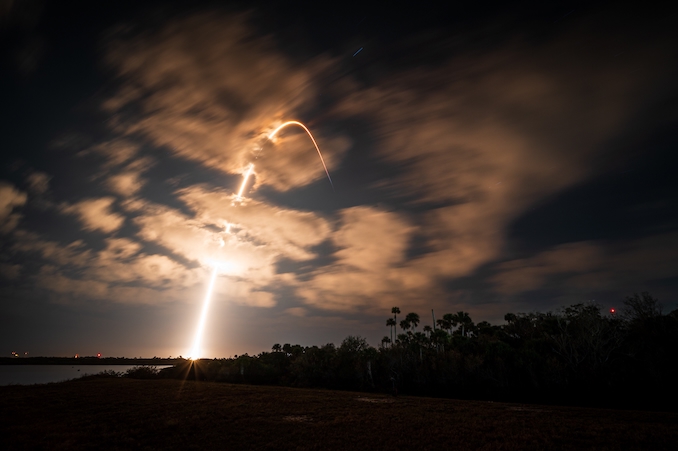
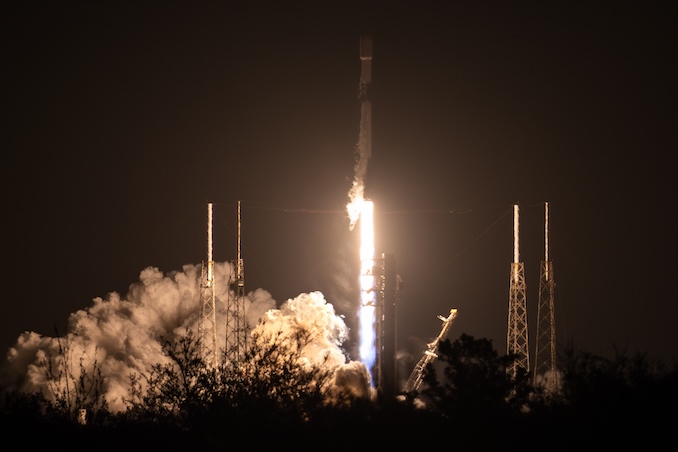
Update Feb. 19, 9:34 p.m. EST (0234 UTC): SpaceX confirms successful landing on the droneship.
For just the second time, a Falcon 9 booster returned to Earth on a drone ship stationed among the islands of the Bahamas during a mission to deploy 29 Starlink satellites for SpaceX’s satellite internet service.
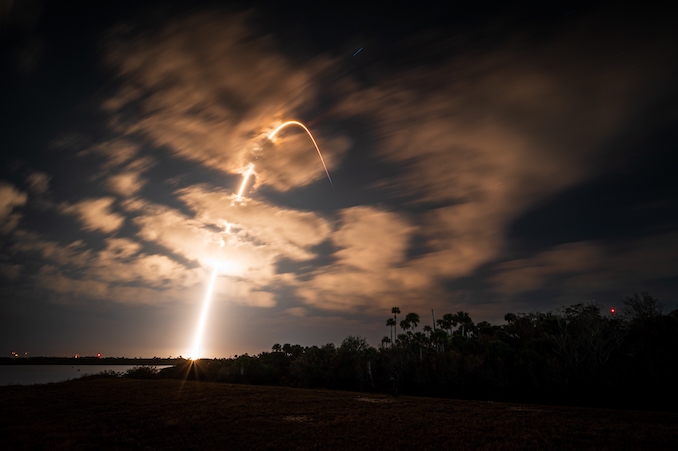
Liftoff of the Starlink 10-34 mission from pad 40 at Cape Canaveral Space Force Station happened at 8:41:40 p.m. EST (0141:40 UTC).
The 45th Weather Squadron forecast a greater than 95 percent chance for favorable liftoff during the window. Meteorologists cited not notable items that would provide a constraint to launch from a weather perspective.
SpaceX launched the mission on Falcon 9 first stage booster B1077. This was its 26th flight after launching previous missions, including Crew-5, CRS-28 and NG-20.
Less than 8.5 minutes after liftoff, B1077 landed on the drone ship, ‘Just Read the Instructions,’ situated off the coast of Exuma island in The Bahamas. This was the 150th landing on that vessel and the 573rd booster landing for SpaceX to date.
It was one year ago this week that SpaceX first landed a booster within the territorial waters of The Bahamas during the Starlink 10-12 mission on Feb. 18, 2025.
In the lead up to that flight, SpaceX announced it was planning to use that first mission as a stepping stone to enabling a crewed mission to a polar orbit, which it eventually did with the flight called Fram2.
However, Fram2 did not feature a booster landing adjacent to The Bahamas. Reportedly, there was environmental concern on the part of the government of The Bahamas following the in-flight break-ups of SpaceX’s Starship rocket during Flight 7 and Flight 8 in 2025.
The two entities have since come to an understanding in the intervening time, paving the way for this second booster landing near the island nation.
Falcon 9 lands on the Just Read the Instructions droneship off the coast of The Bahamas pic.twitter.com/h5Ju4ndXSj
— SpaceX (@SpaceX) February 20, 2026










Related Posts
Stay Informed With the Latest & Most Important News
Previous Post
Next Post
Advertisement
-
 01Two Black Holes Observed Circling Each Other for the First Time
 -
 02From Polymerization-Enabled Folding and Assembly to Chemical Evolution: Key Processes for Emergence of Functional Polymers in the Origin of Life
 -
 03Astronomy 101: From the Sun and Moon to Wormholes and Warp Drive, Key Theories, Discoveries, and Facts about the Universe (The Adams 101 Series)
 -
 04True Anomaly hires former York Space executive as chief operating officer
 -
 05Φsat-2 begins science phase for AI Earth images
 -
 06Hurricane forecasters are losing 3 key satellites ahead of peak storm season − a meteorologist explains why it matters
 -
 07Binary star systems are complex astronomical objects − a new AI approach could pin down their properties quickly