
Now Reading: Spectral Decomposition Reveals Surface Processes on Europa
-
01
Spectral Decomposition Reveals Surface Processes on Europa


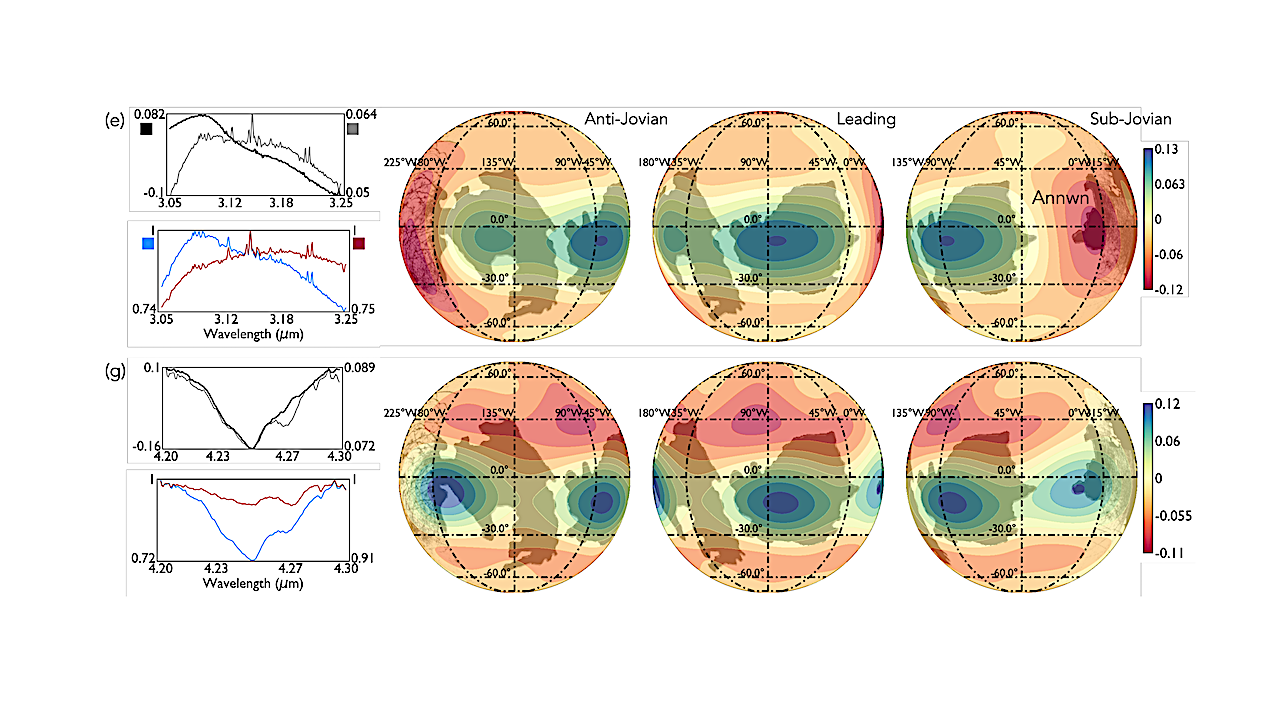
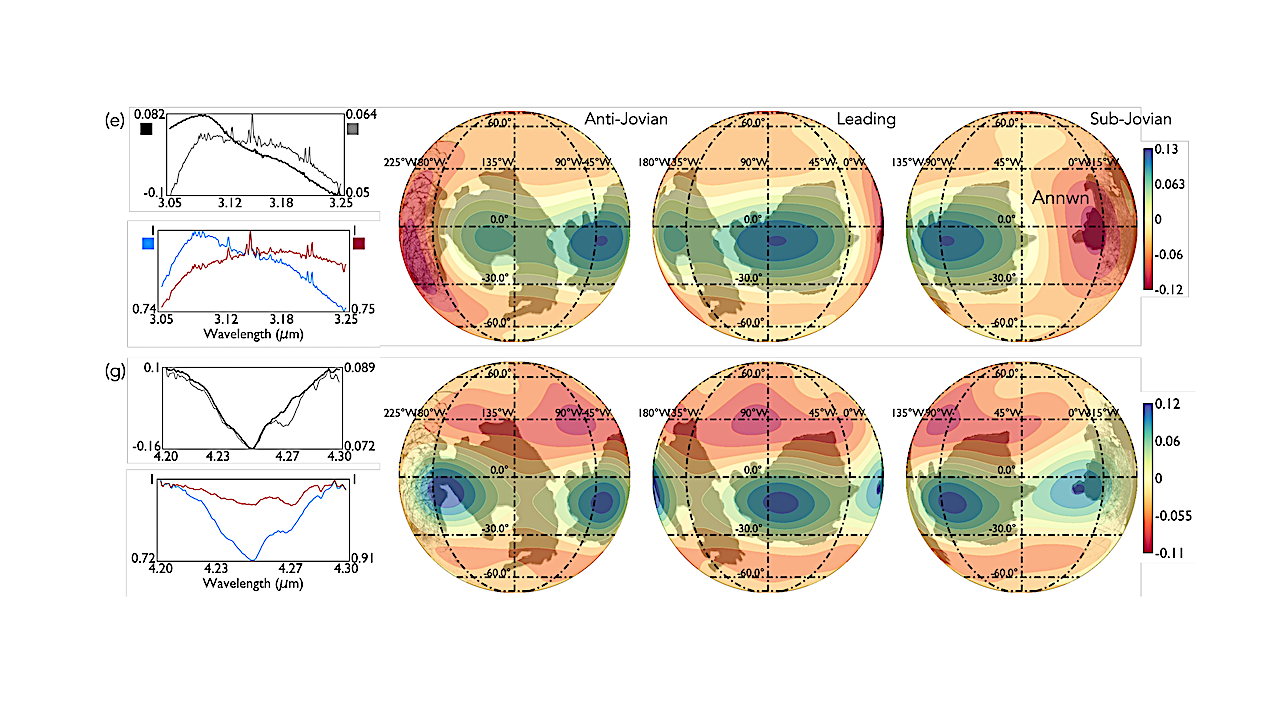
Qualitative projections of the best-fit three-dimensional spherical-harmonic model to the jointly decomposed first spatial mode, u(1), derived from three viewing geometries of Europa’s leading hemisphere. (e) Water-ice 3.1 µm Fresnel peak (ℓmax = 6). (g) CO2 absorption doublet near 4.25 µm (ℓmax = 7). Shaded outlines mark Tara, Powys, and the leading-hemisphere part of Annwn Regiones. The left panels show jointly decomposed spectral modes (v(0) and v(1) in gray and black, respectively) and spectra from the spaxels where the joint spatial mode peaks (blue) and reaches its minimum (red). — astro-ph.EP
Competing processes shape Europa’s surface: geological activity replenishes material through resurfacing, while bombardment by charged particles alters surface chemical composition. Each process leaves distinct spectral signatures.
We present a novel data-driven analysis of JWST NIRSpec-IFU observations of Europa’s leading hemisphere across three observing geometries, targeting nine spectral bands sensitive to water ice, radiolytic products, and volatiles.
Through spectral factorization, we isolate the dominant components of spectral variability and reconstruct their spatial distributions.
We find that CO2 enrichment extends beyond Tara Regio, and covers multiple chaos units in a lens-like pattern. These CO2-enriched areas co-occur with anomalous ice-texture signatures.
Together, these findings suggest that enrichment in volatiles on Europa may reflect retention-favorable near-surface microphysics as well as emplacement, refining how they are interpreted in the context of surface–interior exchange. This has implications for interpreting the sources and supply rates of extant carbon-bearing species and, ultimately, for assessing Europa’s habitability.
Gideon Yoffe, Sahar Shahaf
Comments: Accepted for publication in The Astrophysical Journal
Subjects: Earth and Planetary Astrophysics (astro-ph.EP); Instrumentation and Methods for Astrophysics (astro-ph.IM); Applications (stat.AP)
Cite as: arXiv:2603.10520 [astro-ph.EP] (or arXiv:2603.10520v2 [astro-ph.EP] for this version)
https://doi.org/10.48550/arXiv.2603.10520
Focus to learn more
Submission history
From: Gideon Yoffe
[v1] Wed, 11 Mar 2026 08:26:24 UTC (37,488 KB)
[v2] Thu, 12 Mar 2026 13:55:15 UTC (37,488 KB)
https://arxiv.org/abs/2603.10520
Astrobiology











Related Posts
Stay Informed With the Latest & Most Important News
Previous Post
Next Post
Previous Post
Next Post

Advertisement
-
 01Two Black Holes Observed Circling Each Other for the First Time
 -
 02From Polymerization-Enabled Folding and Assembly to Chemical Evolution: Key Processes for Emergence of Functional Polymers in the Origin of Life
 -
 03Astronomy 101: From the Sun and Moon to Wormholes and Warp Drive, Key Theories, Discoveries, and Facts about the Universe (The Adams 101 Series)
 -
 04True Anomaly hires former York Space executive as chief operating officer
 -
 05Φsat-2 begins science phase for AI Earth images
 -
 06Hurricane forecasters are losing 3 key satellites ahead of peak storm season − a meteorologist explains why it matters
 -
 07Binary star systems are complex astronomical objects − a new AI approach could pin down their properties quickly