
Now Reading: Spectrum showdown
-
01
Spectrum showdown


As satellite communications constellations grow in size and number, they are also competing for a scarce and increasingly valuable resource: spectrum, the bands of radio frequencies that are crucial for communications and broadband service — and for tracking weather.
The pace is intensifying as companies race to expand global communications networks, raising alarms at some agencies that the same frequencies powering space-based broadband could interfere with instruments critical to forecasting hurricanes, tracking storms and detecting atmospheric moisture.
Jordan Gerth, chief of the Architecture Planning and System Innovation branch at NOAA’s National Environmental Satellite, Data and Information Service Office of Systems Architecture and Engineering, said the most effective way scientists can help quantify interference is by carrying out observing system experiments. He was speaking at the American Meteorological Society (AMS) annual meeting, held in Houston in January, where spectrum was a frequent topic. “That is critical, because it helps NOAA go into discussions with the National Telecommunications and Information Administration and the regulators, understanding fully the consequences of interference in that band.”
In Houston, speakers warned that broadband communications constellations threaten to prevent microwave sounders on weather satellites from observing the natural emissions from atmospheric water vapor and precipitation.
“Remote sensing of the Earth is paramount to analyzing and forecasting the weather,” Gerth said. “Contamination of the natural atmosphere background with unnatural signals from communication satellites hinders the forecast ability of the Earth system.”
Spectrum issues have frequently pitted scientists and meteorologists against the U.S. Federal Communications Commission’s quest to free up spectrum for terrestrial and satellite communications. In 2019, for example, NASA and Commerce Department leaders unsuccessfully opposed an FCC plan to auction spectrum in the 24 GHz band for 5G testing because of its proximity to the 23.6–24.0 GHz band where space-based microwave sounders detect water vapor.
Radio frequency interference
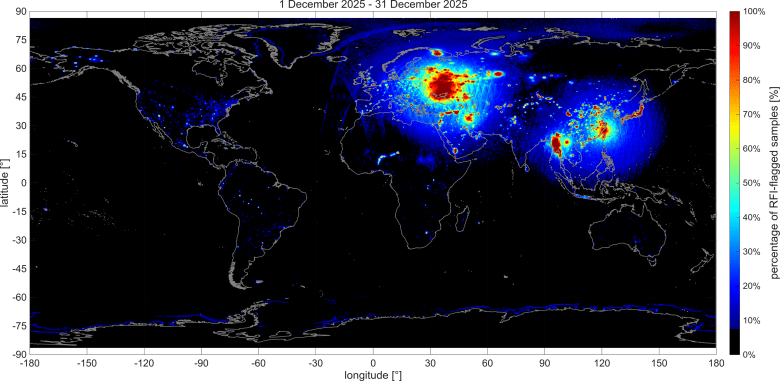
Concern about radio frequency interference (RFI) prompted NASA to equip its Soil Moisture Active Passive satellite launched in 2015 with RFI detection and mitigation algorithms. Since then, more than 6,000 additional satellites have entered orbit.
When the SMAP satellite’s L-band radiometer encounters high levels of interfercence it throws out the contaminated data. Monthly SMAP observations show increasing levels of RFI, particularly over heavily populated regions.
Meteorologists worried about the interference are focusing on an FCC proposal to increase use of the Upper Microwave Flexible Use Service (UMFUS) bands. The UMFUS proposal, published in October, would provide access to six spectrum bands to meet growing demand for broadband communications. Weather experts are concerned primarily with two: the upper 37 GHz band and the 50 GHz band.

For the National Weather Association, AMS, American Geophysical Union and University Corporation for Atmospheric Research, the primary concern is continued reliability of information from the Advanced Technology Microwave Sounder on the Joint Polar Satellite System, NOAA’s current generation of polar-orbiting weather satellites. The sounder, which measures natural thermal emissions at 50.3 GHz “is crucial for many weather forecasts and specific weather-dependent industries such as aviation and agriculture,” the organizations said Jan. 20 in a joint comment on the FCC proposal.
The organizations also noted that U.S. military satellites, including the first Weather System Follow-on Microwave satellite launched in 2024 and a second scheduled to launch in 2028, rely on microwave radiometer readings at 37.3 GHz to monitor ocean surface winds and gauge the intensity of tropical cyclones, key ingredients of hurricane forecasts.
“Passive measurements of the atmosphere are especially vulnerable to harmful interference as even faint out-of-band emissions can, in aggregate, contaminate the natural transmission of the atmosphere to the space-based microwave sensor,” the science organizations wrote.
Surging demand
The FCC, meanwhile, is faced with heightened demand for spectrum prompted by the expansion of non-geostationary orbit satellite constellations such as SpaceX Starlink and Eutelsat OneWeb and high throughput geostationary satellites like ViaSat-3.
“We have to rise to the occasion and increase the capacity for space innovation,” Jay Schwarz, FCC Space Bureau chief, said in February. “It all starts with spectrum, the lifeblood of this activity.”
Demand for spectrum has never been higher. License applications have tripled in the last decade as the complexity and size of the proposed missions has ballooned. To keep up, the FCC intends to set aside a larger pool of spectrum for satellite communications in addition to simplifying the licensing process.
“We want to make sure that when you’re coming to get a license, you have speed and predictability far beyond what’s been the case in the last few years,” Schwarz said.
Light licensing
The FCC proposal to streamline the approval process, called light licensing, poses risks for weather satellite operators at a time when organizations around the world are building constellations of tens or hundreds of thousands of communications satellites.
Taken together, the communications constellations risk raising the overall level of noise and interfering with weather satellite observations, said Beau Backus, Johns Hopkins Applied Physics Laboratory senior electro-magnetic spectrum manager.
“The FCC is trying to come up with a better way of being able to license satellites in a much faster approach,” Backus said in Houston. “The danger is that you lose some of the protections when you start doing it this way. You’re going to have a greater number of systems in orbit than we ever even thought about 20 years ago, and that aggregate can become a problem over time.”
NOAA strategy
In spite of their concerns, weather researchers acknowledge that additional spectrum is inevitably going to be allocated to expanding communications constellations. To better understand the impact and prevent significant disruption of weather monitoring, NOAA has drafted a multi-step plan that calls for study, protection, innovation, coordination and education.
“We have a lot of studying to do to understand the value of the spectrum allocations to NOAA missions,” Gerth said. “It’s easy to value telecommunications and other systems that support a business line. It’s harder to value spectrum allocations that have a secondary impact on the economy, such as the improvement to weather forecasts and the lives and property that saves.”

Still, NOAA will work to protect the spectrum its current sensors use, while making sure weather satellite operators comply with existing regulations. “That’s one way to reduce the number of conflicts we have,” Gerth said.
NOAA’s strategy also calls for technological innovation and coordination with other federal agencies. New sensors tend to be more resilient to interference than instruments currently in orbit that were developed 10 or 20 years ago.
“Coordination is going to be tricky, but it is necessary,” Gerth said. Representatives of NOAA, which is part of the Commerce Department, must recognize the agency has a mandate to promote economic growth. “With 5G and 6G dominance comes economic growth for the United States,” he added.
Finally, education remains essential, Gerth said, as meteorologists vie with communications service providers for limited spectrum.
“A lot of times we find that there’s a fundamental misunderstanding about the nature of radiometers,” Gerth said.
Since satellites circle the globe, NOAA and its international counterparts are publicizing their concerns and striving for consistent spectrum allocations at the 2027 World Radio Conference in Shanghai.
“It doesn’t make sense to sense in one band in one country and then as we go to the other side of the world use a different band,” Gerth said.
This article was first published in the March 2026 issue of SpaceNews Magazine.










Related Posts
Stay Informed With the Latest & Most Important News
Previous Post
Next Post


Advertisement
-
 01Two Black Holes Observed Circling Each Other for the First Time
 -
 02From Polymerization-Enabled Folding and Assembly to Chemical Evolution: Key Processes for Emergence of Functional Polymers in the Origin of Life
 -
 03Astronomy 101: From the Sun and Moon to Wormholes and Warp Drive, Key Theories, Discoveries, and Facts about the Universe (The Adams 101 Series)
 -
 04True Anomaly hires former York Space executive as chief operating officer
 -
 05Φsat-2 begins science phase for AI Earth images
 -
 06Hurricane forecasters are losing 3 key satellites ahead of peak storm season − a meteorologist explains why it matters
 -
 07Binary star systems are complex astronomical objects − a new AI approach could pin down their properties quickly