
Now Reading: SPHEREx Wide-Field Infrared Spectral Mapping of Interstellar Ices and Polycyclic Aromatic Hydrocarbons
-
01
SPHEREx Wide-Field Infrared Spectral Mapping of Interstellar Ices and Polycyclic Aromatic Hydrocarbons

SPHEREx Wide-Field Infrared Spectral Mapping of Interstellar Ices and Polycyclic Aromatic Hydrocarbons

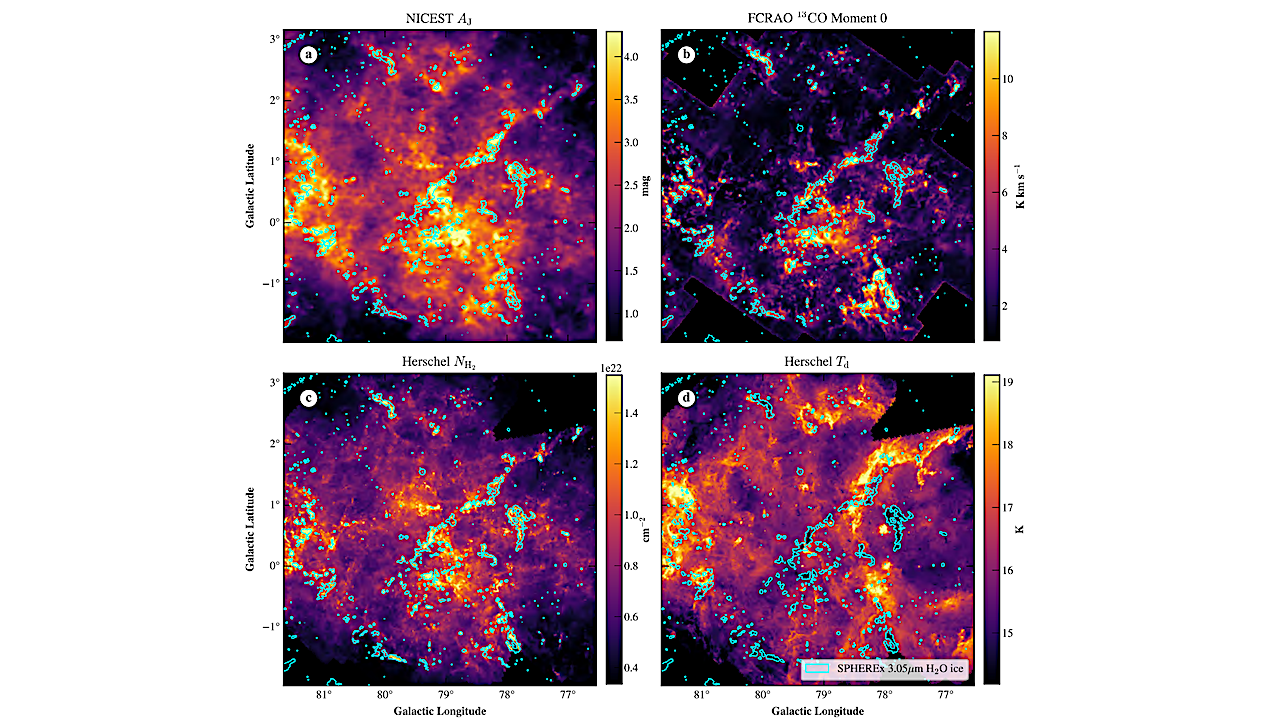
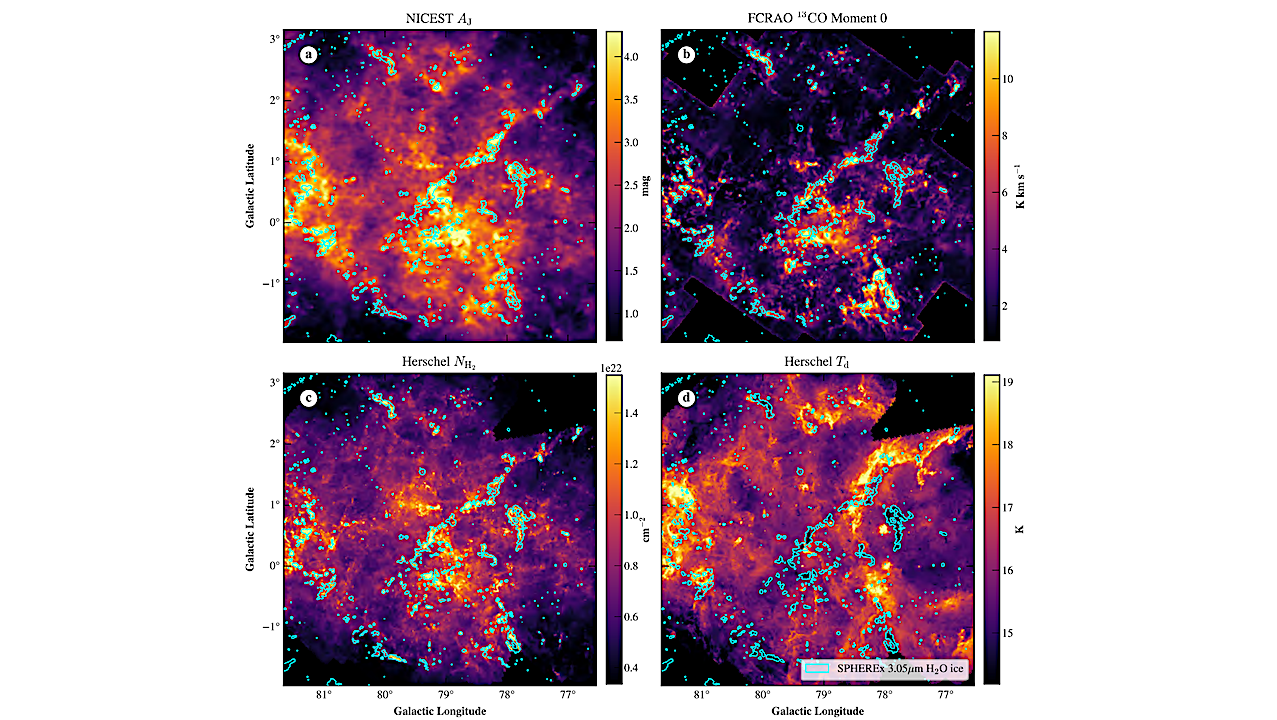
Comparison of various tracers of dust, gas, and extinction toward the CygX region. Cyan contours in all images indicate H2O ice peak optical depths of 0.25, derived from the H2O ice map smoothed with a Gaussian kernel of σ ∼ 31′′ (5 pixels). (a) 2MASS NICEST AJ extinction, with a resolution of 3′ . (b) FCRAO 13CO (1–0) Moment 0 map (beamsize 45′′ FWHM) integrated over −10 to +20 km s−1 , corresponding to the ensemble of star-forming molecular clouds directly associated with the Cyg OB2 cluster (N. Schneider et al. 2006). (c) Herschel-derived NH2 column density. (d) Herschel-derived dust temperature, Td. Both Herschel images are at a resolution of 36.4′′ — astro-ph.GA
We present some of the first infrared spectral maps acquired by SPHEREx. These maps, which to our knowledge are the largest of their type ever compiled in the near-infrared, reveal multiple strong lines due to interstellar ices and polycyclic aromatic hydrocarbons (PAHs) throughout the Cygnus X and North American Nebula regions.
The maps emphasize the strongest features arising from the 3 μm H2O, 4.27 μm CO2, and 4.67 μm CO lines and the 3.28 μm PAH feature, all of which are detected over large areas with complex and filamentary spatial distributions.
The ice absorption maps of H2O and CO2 in particular broadly trace dense, cold, and well-shielded regions across Cygnus X, consistent with the established picture of efficient ice formation in dense molecular clouds. The interstellar ice features are also detected abundantly in diffuse absorption over wide areas.
The relative strength of the H2O and CO2 features varies among different lines of sight, indicating possible differences in local physical conditions or chemical variations. The 3.28 μm PAH emission correlates with the emission from the 7.7 and 11.2 μm features, but shows small differences that may trace the grain size distribution and variations in the ambient UV field.
SPHEREx all-sky spectral imaging, of which only a small fraction is showcased in this work, will support numerous science investigations including the structure of the Galaxy, the physics of the interstellar medium, and the chemistry of stars.
Joseph L. Hora, Jinyoung K. Noh, Gary J. Melnick, Brandon S. Hensley, Roberta Paladini, Jeong-Eun Lee, Matthew L. N. Ashby, Volker Tolls, Jaeyeong Kim, Michael W. Werner, James J. Bock, Sean Bruton, Shuang-Shuang Chen, Tzu-Ching Chang, Yi-Kuan Chiang, Asantha Cooray, Brendan P. Crill, Ari J. Cukierman, Olivier Doré, Andreas L. Faisst, Zhaoyu Huai, Howard Hui, Woong-Seob Jeong, Miju Kang, Phil M. Korngut, Ho-Gyu Lee, Carey M. Lisse, Daniel C. Masters, Giulia Murgia, Chi H. Nguyen, Zafar Rustamkulov, Ji Yeon Seok, Robin Y. Wen, Yujin Yang, Michael Zemcov
Comments: 23 pages, 13 figures, 1 table. Accepted to the Astrophysical Journal March 11, 2026
Subjects: Astrophysics of Galaxies (astro-ph.GA); Solar and Stellar Astrophysics (astro-ph.SR)
Cite as: arXiv:2603.12390 [astro-ph.GA] (or arXiv:2603.12390v1 [astro-ph.GA] for this version)
https://doi.org/10.48550/arXiv.2603.12390
Focus to learn more
Submission history
From: Joseph L. Hora
[v1] Thu, 12 Mar 2026 19:09:48 UTC (33,148 KB)
https://arxiv.org/abs/2603.12390
Astrobiology, Astrochemistry,










Related Posts
Stay Informed With the Latest & Most Important News
Previous Post
Next Post
Advertisement
-
 01Two Black Holes Observed Circling Each Other for the First Time
 -
 02From Polymerization-Enabled Folding and Assembly to Chemical Evolution: Key Processes for Emergence of Functional Polymers in the Origin of Life
 -
 03Astronomy 101: From the Sun and Moon to Wormholes and Warp Drive, Key Theories, Discoveries, and Facts about the Universe (The Adams 101 Series)
 -
 04True Anomaly hires former York Space executive as chief operating officer
 -
 05Φsat-2 begins science phase for AI Earth images
 -
 06Hurricane forecasters are losing 3 key satellites ahead of peak storm season − a meteorologist explains why it matters
 -
 07Binary star systems are complex astronomical objects − a new AI approach could pin down their properties quickly