
Now Reading: Spotting smaller wildfires sooner than ever
-
01
Spotting smaller wildfires sooner than ever



Each year, SpaceNews selects the people, programs and technologies that have most influenced the direction of the space industry in the past year. Started in 2017, our annual celebration recognizes outsized achievements in a business in which no ambition feels unattainable. This year’s winners of the 8th annual SpaceNews Icon Awards were announced and celebrated at a Dec. 2 ceremony hosted at the Johns Hopkins University Bloomberg Center in Washington, D.C. Congratulations to all of the winners and finalists.
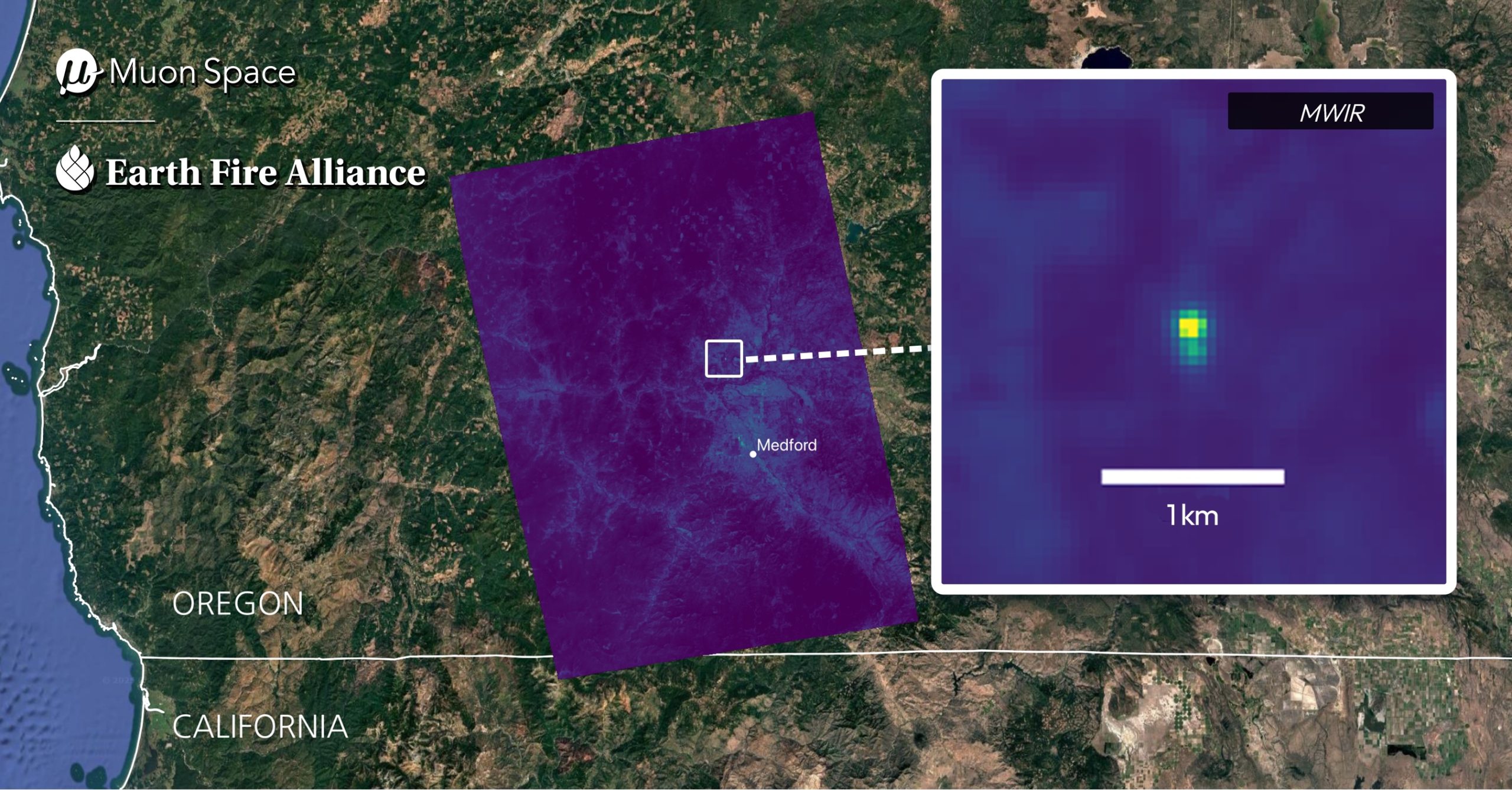
Muon Space is reimagining how Earth observation satellites can help humanity respond to one of the planet’s most urgent challenges — wildfires — and how commercial space technology can deliver real-world impact at the speed of crisis.
The California-based company has emerged as an innovative startup in the space industry by combining two roles under one roof: satellite manufacturer and data provider. It designs, builds and operates small-satellite constellations in low Earth orbit, catering to customers who need tailored sensing capabilities — multispectral, infrared or radio frequency — delivered with minimal latency.
Its most ambitious undertaking yet, FireSat, is a collaboration with Google and the nonprofit Earth Fire Alliance aimed at creating a global wildfire detection and monitoring network. The vision: to observe every point on Earth at least twice a day and every 20 minutes in fire-prone regions. Current fire detection tools rely heavily on ground reports or slow-moving government satellites. FireSat is engineered to cut that lag from hours to minutes.
The first milestone came this year, with FireSat Pathfinder, which launched in March. The prototype satellite is already validating the constellation’s ability to detect fires early, map their spread and deliver actionable intelligence to first responders, land management agencies and climate researchers. By 2029, the FireSat program is expected to comprise 52 satellites in orbit, reaching full operational capacity in 2030.
Muon’s innovation goes beyond sensors and extends to how the company moves and connects its satellites. After closing a $146 million Series B in 2025, Muon acquired Starlight Engines, bringing in zinc-fueled solid-state propulsion technology to provide more sustainable and resilient spacecraft manufacturing. The acquisition helps solve a longstanding challenge in the smallsat industry: reliable, affordable propulsion systems at scale.
Muon also struck a deal with SpaceX’s broadband satellite network to integrate Starlink’s mini laser terminals into its Halo satellite platform, enabling ultra-high-speed optical data transmission. That means FireSat satellites can send back data through Starlink’s orbital broadband network instead of waiting for a ground station to pass overhead.
“The latencies are milliseconds and satellites can send hundreds of terabytes a day down to the ground,” said Greg Smirin, Muon Space’s president.
Beyond environmental applications, Muon’s innovations are spilling into defense. The U.S. Space Force tapped the company to demonstrate how its wildfire-monitoring satellites can also fill critical weather intelligence gaps — using the same commercial platform to deliver cloud characterization and theater weather imagery under a data subscription model.
By merging sustainability with speed, the company is creating an infrastructure for a safer, smarter planet.
This article first appeared in the December 2025 issue of SpaceNews Magazine.










Related Posts

Stay Informed With the Latest & Most Important News
Previous Post
Next Post






Advertisement
-
 01Two Black Holes Observed Circling Each Other for the First Time
 -
 02From Polymerization-Enabled Folding and Assembly to Chemical Evolution: Key Processes for Emergence of Functional Polymers in the Origin of Life
 -
 03Astronomy 101: From the Sun and Moon to Wormholes and Warp Drive, Key Theories, Discoveries, and Facts about the Universe (The Adams 101 Series)
 -
 04True Anomaly hires former York Space executive as chief operating officer
 -
 05Φsat-2 begins science phase for AI Earth images
 -
 06Hurricane forecasters are losing 3 key satellites ahead of peak storm season − a meteorologist explains why it matters
 -
 07Binary star systems are complex astronomical objects − a new AI approach could pin down their properties quickly